Matthews Tomas E, Thibodeau Joseph N L, Gunther Brian P, Penhune Virginia B
Laboratory for Motor Learning and Neural Plasticity, Department of Psychology, Concordia University Montreal, QC, Canada.
Front Psychol. 2016 Feb 3;7:69. doi: 10.3389/fpsyg.2016.00069. eCollection 2016.
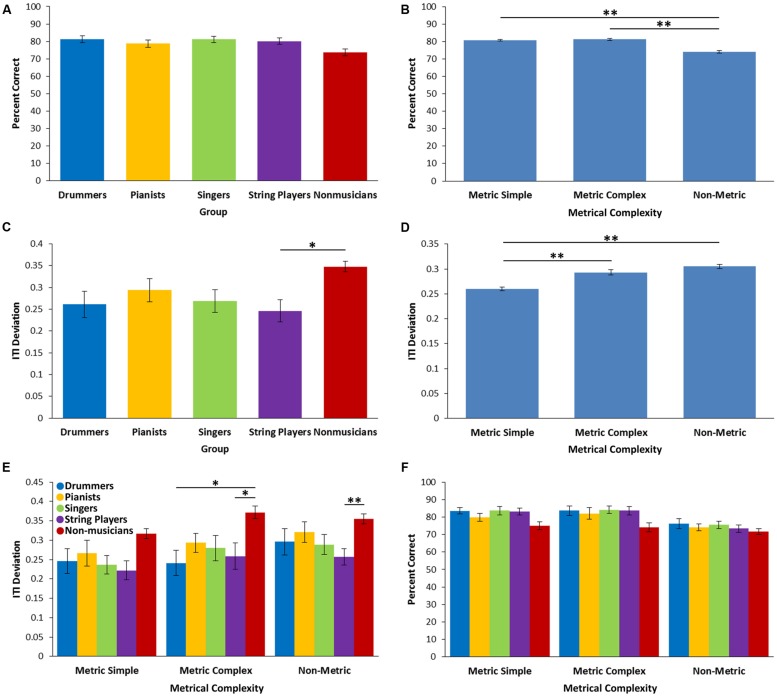
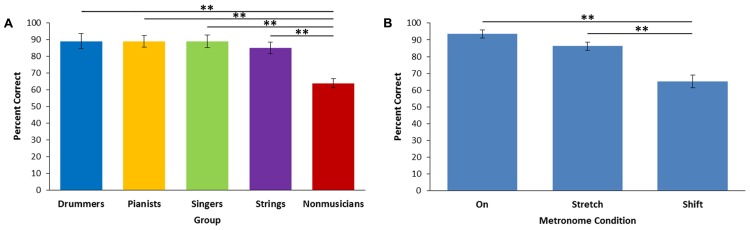
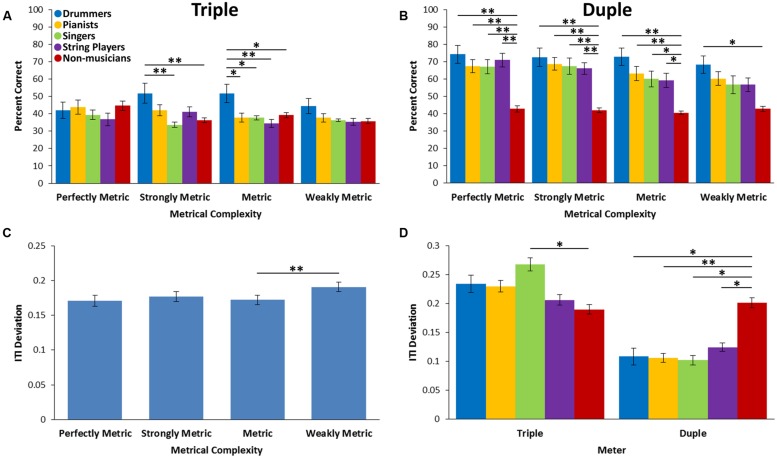
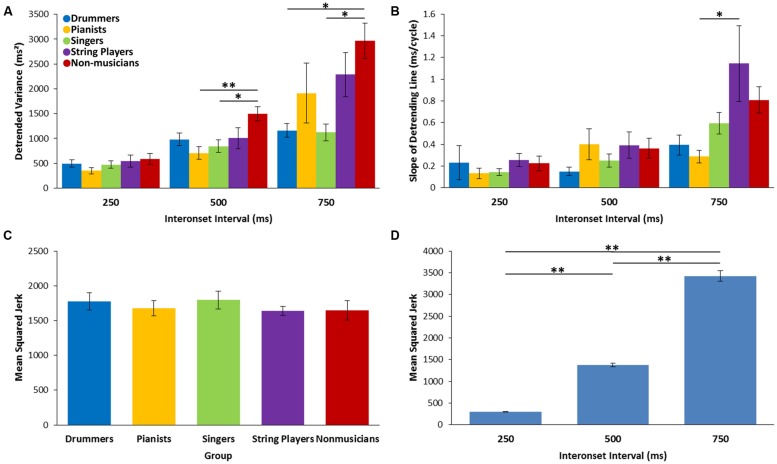
Studies comparing musicians and non-musicians have shown that musical training can improve rhythmic perception and production. These findings tell us that training can result in rhythm processing advantages, but they do not tell us whether practicing a particular instrument could lead to specific effects on rhythm perception or production. The current study used a battery of four rhythm perception and production tasks that were designed to test both higher- and lower-level aspects of rhythm processing. Four groups of musicians (drummers, singers, pianists, string players) and a control group of non-musicians were tested. Within-task differences in performance showed that factors such as meter, metrical complexity, tempo, and beat phase significantly affected the ability to perceive and synchronize taps to a rhythm or beat. Musicians showed better performance on all rhythm tasks compared to non-musicians. Interestingly, our results revealed no significant differences between musician groups for the vast majority of task measures. This was despite the fact that all musicians were selected to have the majority of their training on the target instrument, had on average more than 10 years of experience on their instrument, and were currently practicing. These results suggest that general musical experience is more important than specialized musical experience with regards to perception and production of rhythms.
比较音乐家和非音乐家的研究表明,音乐训练可以提高节奏感知和节奏生成能力。这些研究结果告诉我们,训练可以带来节奏处理方面的优势,但它们并没有告诉我们,练习特定乐器是否会对节奏感知或节奏生成产生特定影响。当前的研究使用了一组四项节奏感知和节奏生成任务,旨在测试节奏处理的高级和低级方面。对四组音乐家(鼓手、歌手、钢琴家、弦乐演奏者)和一组非音乐家对照组进行了测试。任务内的表现差异表明,节拍、节拍复杂性、速度和节拍相位等因素显著影响了感知节奏或将节拍同步到节奏的能力。与非音乐家相比,音乐家在所有节奏任务上表现得更好。有趣的是,我们的结果显示,在绝大多数任务指标上,音乐家群体之间没有显著差异。尽管所有音乐家都被挑选出来,他们大部分的训练都是在目标乐器上进行的,平均有超过10年的乐器演奏经验,并且目前仍在练习。这些结果表明,就节奏的感知和生成而言,一般音乐经验比专门的音乐经验更重要。