Desingu P A, Ray Pradeep K, Patel B H M, Singh R, Singh R K, Saikumar G
Swine Disease Lab, Division of Pathology, Indian Veterinary Research Institute, Izatnagar, Uttar Pradesh, India, 243122.
Division of Livestock Production and Management, Indian Veterinary Research Institute, Izatnagar, Uttar Pradesh, India, 243122.
PLoS One. 2016 Feb 19;11(2):e0147611. doi: 10.1371/journal.pone.0147611. eCollection 2016.
India is endemic to Japanese encephalitis virus (JEV) and recurrent outbreaks occur mainly in rice growing areas. Pigs are considered to be the amplifying host for JEV and infection in gestating pigs results in reproductive failure. Most studies conducted on JEV infection in Indian pigs have been serological surveys and very little is known about JEV genotypes circulating in pigs. So the potential risk posed by pigs in JEV transmission and the genetic relationship between viruses circulating in pigs, mosquitoes and humans is poorly understood.
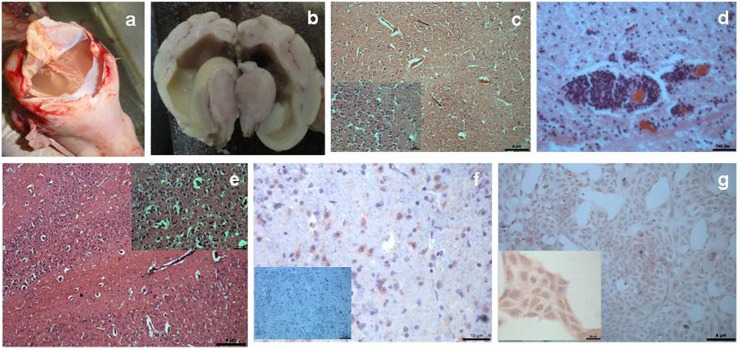
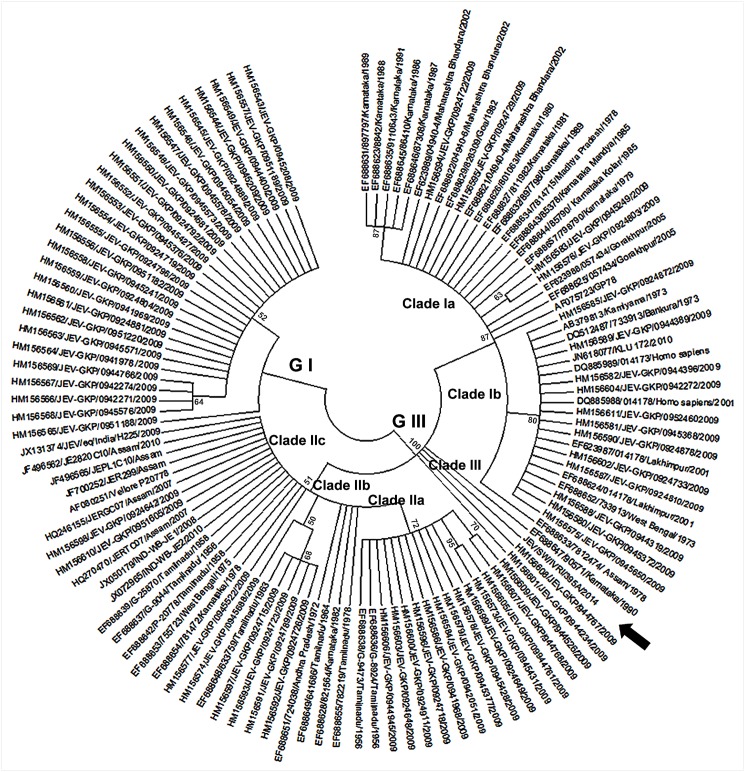
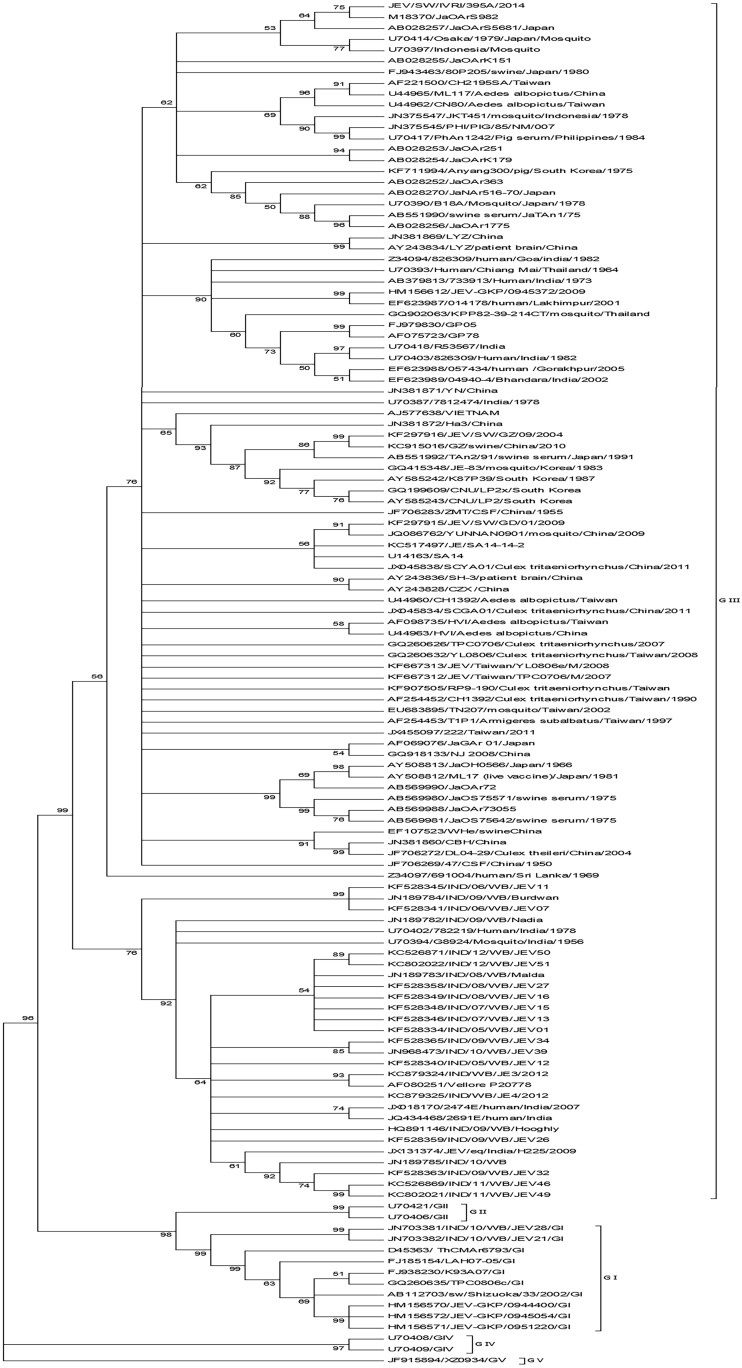
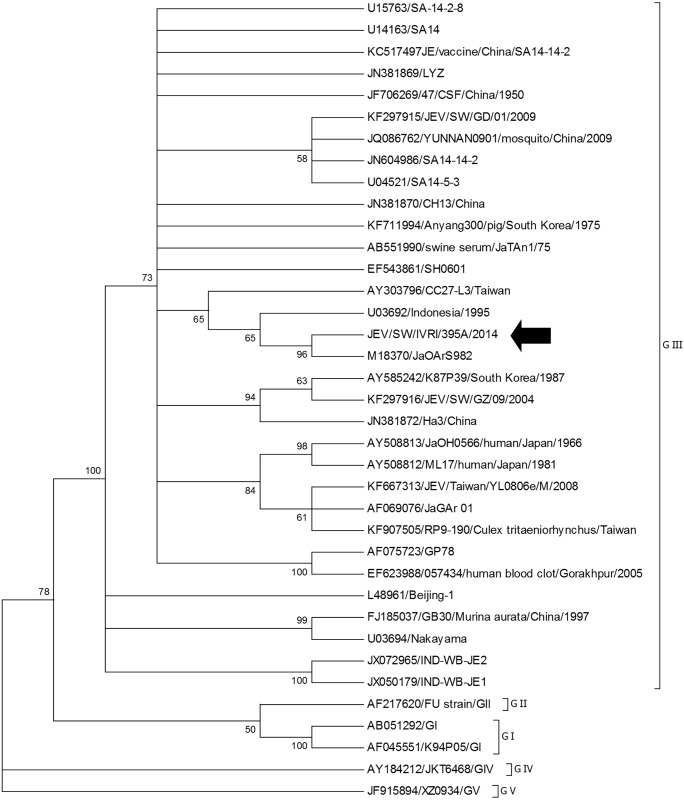
METHODOLOGY/PRINCIPAL FINDINGS: This study was conducted in pigs with a history of reproductive failure characterized by stillborn piglets with neuropathological lesions. Japanese encephalitis (JE) suspected brain specimens inoculated intracerebrally into mice and Vero cells resulted in successful isolation of JEV/SW/IVRI/395A/2014. Clinicopathological observations in infected mice, demonstration of JEV antigen in brain, and analysis of the envelope protein identified the swine isolate as being neurovirulent. Phylogenetic analysis based on prM and E gene sequences showed that it belonged to genotype III. This swine isolate was closely related to JEV associated with the 2005 outbreak in India and JaoArS982 from Japan. Phylogenetic analysis of JEV strains collected between 1956 and 2014 in India categorized the GIII viruses into different clades blurring their spatial distribution, which has been discernible in the previous century.
CONCLUSIONS/SIGNIFICANCE: Isolation of JEV from stillborn piglets and its close genetic relationship with viruses detected at least three decades ago in humans and mosquitoes in Japan suggests that the virus may have been circulating among Indian pigs for several decades. The close similarity between the present swine isolate and those detected in humans affected in the 2005 outbreak in Uttar Pradesh, India, suggests the need for more intensive surveillance of pigs and implementation of suitable strategies to control JE in India.
日本脑炎病毒(JEV)在印度呈地方流行性,主要在水稻种植区反复暴发。猪被认为是JEV的扩增宿主,妊娠母猪感染会导致繁殖失败。大多数针对印度猪JEV感染的研究都是血清学调查,对于猪体内传播的JEV基因型了解甚少。因此,猪在JEV传播中构成的潜在风险以及猪、蚊子和人类体内传播的病毒之间的遗传关系尚不清楚。
方法/主要发现:本研究对有繁殖失败病史、以死胎仔猪伴有神经病理学损伤为特征的猪进行。将疑似日本脑炎(JE)的脑标本脑内接种到小鼠和Vero细胞中,成功分离出JEV/SW/IVRI/395A/2014。对感染小鼠的临床病理观察、脑内JEV抗原的检测以及包膜蛋白分析确定该猪分离株具有神经毒性。基于prM和E基因序列的系统发育分析表明,它属于基因型III。该猪分离株与2005年印度暴发相关的JEV以及日本的JaoArS982密切相关。对1956年至2014年期间在印度收集的JEV毒株进行系统发育分析,将GIII病毒分为不同分支,模糊了它们的空间分布,而在上个世纪这种分布是可辨别的。
结论/意义:从死胎仔猪中分离出JEV,且其与至少三十年前在日本人类和蚊子中检测到的病毒具有密切的遗传关系,这表明该病毒可能已在印度猪群中传播了数十年。目前的猪分离株与在印度北方邦2005年疫情中受影响的人类中检测到的毒株非常相似,这表明需要加强对猪的监测,并实施适当的策略来控制印度的JE。