Zhou Qiang, Shaffer James, Ying Gui-shuang
Department of Ophthalmology, Beijing Chaoyang Hospital, Capital Medical University, Beijing, P. R. China.
Department of Ophthalmology, Scheie Eye Institute, Perelman School of Medicine, University of Pennsylvania, Philadelphia, Pennsylvania, United States of America.
PLoS One. 2016 Feb 19;11(2):e0149030. doi: 10.1371/journal.pone.0149030. eCollection 2016.
The fellow eye of patients with unilateral neovascular age-related degeneration (nAMD) is at increased risk of developing late AMD. Several cohort studies have evaluated the prevalence of pseudodrusen and the association between pseudodrusen and late AMD in the fellow eye of patients with unilateral nAMD. However, these studies have limited sample sizes and their results are inconsistent.
To evaluate the prevalence rate of pseudodrusen, and the association between pseudodrusen and incidence of late AMD (nAMD and geographic atrophy (GA)) in the fellow eye of patients with unilateral nAMD.
The PubMed, EMBASE, Web of Science, and Cochrane Library databases were searched up to July 2015, as well as other systematic reviews.
All cohort studies for pseudodrusen with late AMD in the fellow eye of patients with unilateral nAMD.
The numbers of patients with and without pseudodrusen at baseline and the numbers of incident nAMD and GA during follow up among patients with and without pseudodrusen were independently extracted by 2 authors. The results were pooled using random-effects meta-analysis. Heterogeneity was assessed using the I2 test.
Prevalence rate of pseudodrusen, risk ratios (RRs) and their 95% confidence intervals (95% CIs) for associations between pseudodrusen and the incidence of nAMD and GA in the fellow eye.
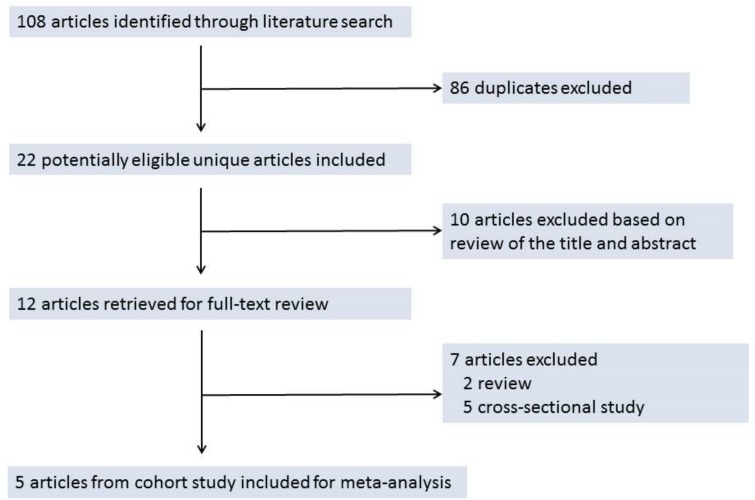
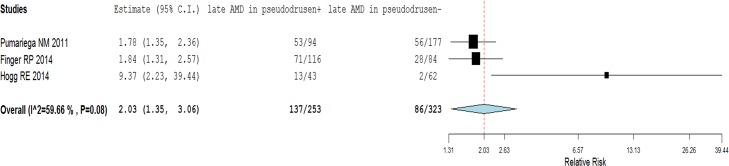
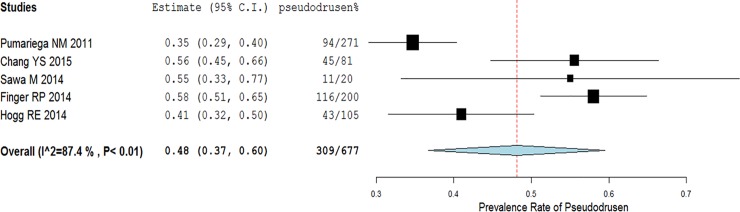
Five cohort studies (N = 677 patients) from 8 countries across 4 continents were included. The pooled prevalence rate of pseudodrusen in the fellow eye was 48.1% (95% Cl: 36.7-59.5%, I2 = 87%). Pseudodrusen were associated with an increased risk of nAMD (RR = 1.54, 95% Cl: 1.10-2.16, I2 = 42%), GA (RR = 4.70, 95% Cl: 1.22-18.1, I2 = 64%), and late AMD (RR = 2.03, 95% Cl: 1.35-3.06, I2 = 60%).
For patients with unilateral nAMD, pseudodrusen were present in about half of the fellow eyes. The presence of pseudodrusen was associated with a 1.5 times higher risk of developing nAMD, a 4.7 times higher risk of developing GA, and a 2 times higher risk of developing late AMD. Pseudodrusen should be considered in evaluating the risk of late AMD development; however, due to considerable heterogeneity across these studies, a larger study is needed to validate these findings.
单侧新生血管性年龄相关性黄斑变性(nAMD)患者的对侧眼发生晚期年龄相关性黄斑变性的风险增加。多项队列研究评估了单侧nAMD患者对侧眼中假性玻璃膜疣的患病率以及假性玻璃膜疣与晚期年龄相关性黄斑变性之间的关联。然而,这些研究样本量有限且结果不一致。
评估单侧nAMD患者对侧眼中假性玻璃膜疣的患病率,以及假性玻璃膜疣与晚期年龄相关性黄斑变性(nAMD和地图样萎缩(GA))发病率之间的关联。
截至2015年7月检索了PubMed、EMBASE、科学引文索引和考克兰图书馆数据库,以及其他系统评价。
所有关于单侧nAMD患者对侧眼中假性玻璃膜疣与晚期年龄相关性黄斑变性的队列研究。
2位作者独立提取基线时有无假性玻璃膜疣的患者数量,以及随访期间有无假性玻璃膜疣患者中nAMD和GA的发病数量。采用随机效应荟萃分析汇总结果。使用I²检验评估异质性。
假性玻璃膜疣的患病率、假性玻璃膜疣与对侧眼中nAMD和GA发病率之间关联的风险比(RRs)及其95%置信区间(95% CIs)。
纳入了来自四大洲8个国家的5项队列研究(N = 677例患者)。对侧眼中假性玻璃膜疣的汇总患病率为48.1%(95% Cl:36.7 - 59.5%,I² = 87%)。假性玻璃膜疣与nAMD风险增加相关(RR = 1.54,95% Cl:1.10 - 2.16,I² = 42%)、GA风险增加相关(RR = 4.70,95% Cl:1.22 - 18.1,I² = 64%)以及晚期年龄相关性黄斑变性风险增加相关(RR = 2.03,95% Cl:1.35 - 3.06,I² = 60%)。
对于单侧nAMD患者,约半数对侧眼中存在假性玻璃膜疣。假性玻璃膜疣的存在与发生nAMD的风险高1.5倍、发生GA的风险高4.7倍以及发生晚期年龄相关性黄斑变性的风险高2倍相关。在评估晚期年龄相关性黄斑变性发生风险时应考虑假性玻璃膜疣;然而,由于这些研究存在相当大的异质性,需要更大规模的研究来验证这些发现。