Raab Ronald W, Moore Julia E, Vargo Edward L, Rose Lucy, Raab Julie, Culbreth Madeline, Burzumato Gracie, Koyee Aurvan, McCarthy Brittany, Raffaele Jennifer, Schal Coby, Vaidyanathan Rajeev
College of Integrated Science and Technology, James Madison University, Harrisonburg, Virginia, United States of America.
SRI International, Center for Immunity and Infectious Diseases, Harrisonburg, Virginia, United States of America.
PLoS One. 2016 Feb 22;11(2):e0117805. doi: 10.1371/journal.pone.0117805. eCollection 2016.
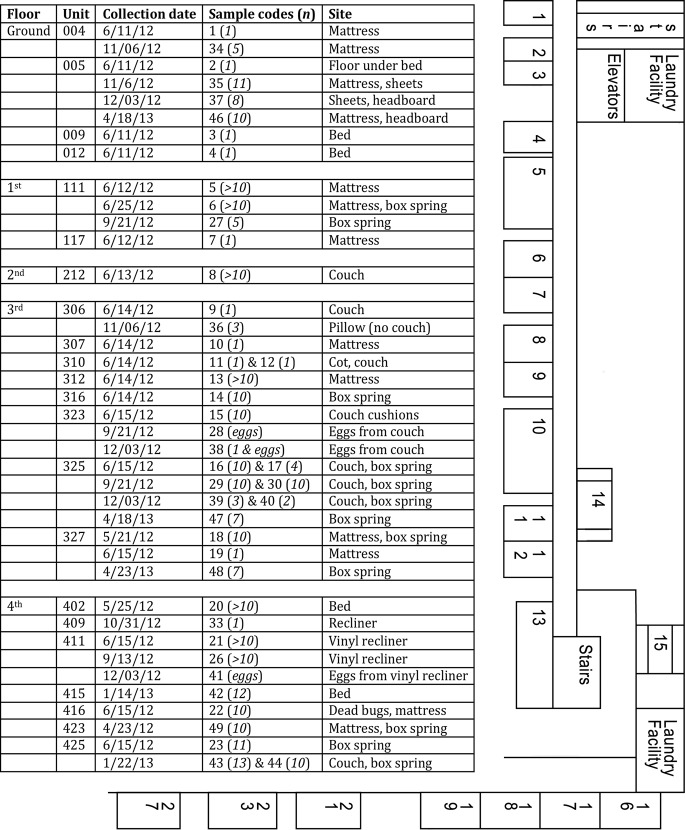
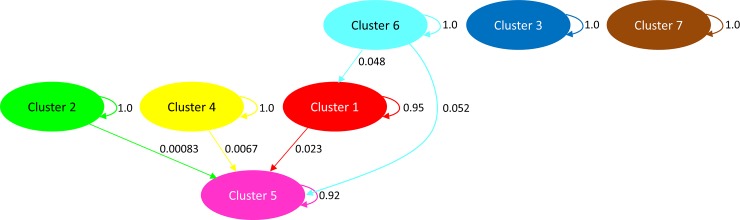
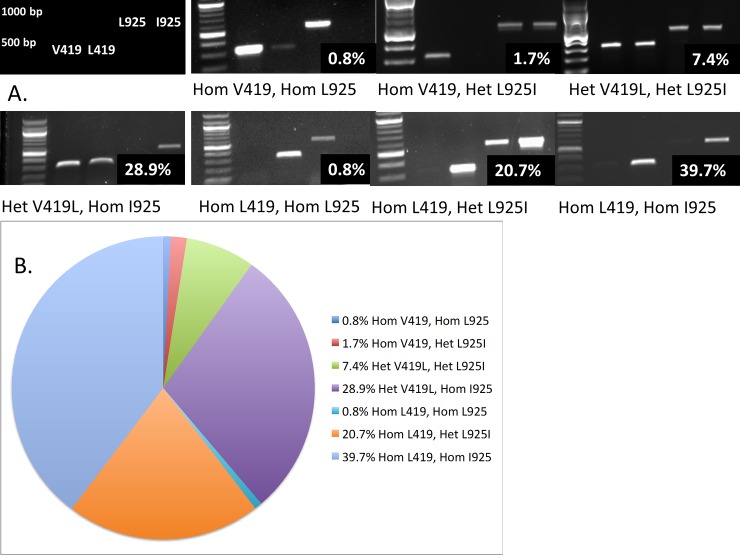
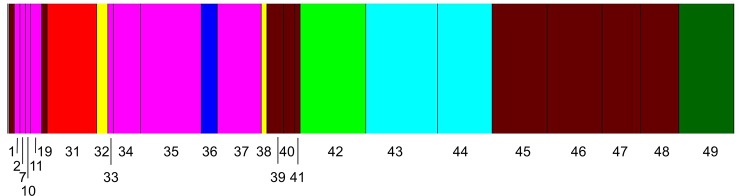
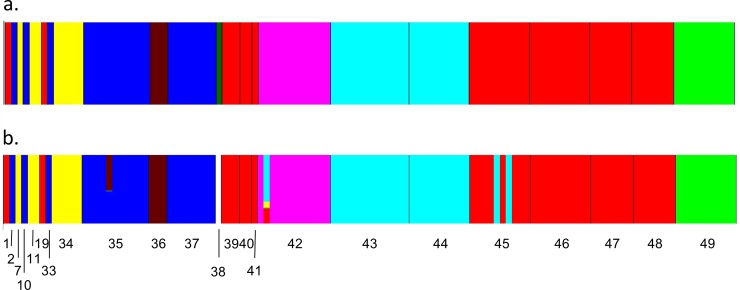
Infestations of the common bed bug (Cimex lectularius L.) have increased substantially in the United States in the past 10-15 years. The housing authority in Harrisonburg, Virginia, conducts heat-treatments after bed bugs are detected in a lower-income housing complex, by treating each infested unit at 60°C for 4-6 hours. However, a high frequency of recurrent infestations called into question the efficacy of this strategy. Genetic analysis using Bayesian clustering of polymorphic microsatellite loci from 123 bed bugs collected from 23 units from May 2012 to April 2013 in one building indicated that (a) 16/21 (73%) infestations were genetically similar, suggesting ineffective heat-treatments or reintroductions from within the building or from a common external source, followed by local spread of existing populations; and (b) up to 5 of the infestations represented new genotypes, indicating that 5 new populations were introduced into this building in one year, assuming they were not missed in earlier screens. There was little to no gene flow among the 8 genetic clusters identified in the building. Bed bugs in the U.S. often possess one or both point mutations in the voltage-gated sodium channel, termed knockdown resistance (kdr), from valine to leucine (V419L) and leucine to isoleucine (L925I) that confer target-site resistance against pyrethroid insecticides. We found that 48/121 (40%) bed bugs were homozygous for both kdr mutations (L419/I925), and a further 59% possessed at least one of the kdr mutations. We conclude that ineffective heat treatments, new introductions, reintroductions and local spread, and an exceptionally high frequency of pyrethroid resistance are responsible for chronic infestations in lower-income housing. Because heat treatments fail to protect from reintroductions, and pesticide use has not decreased the frequency of infestations, preventing new introductions and early detection are the most effective strategies to avoid bed bug infestations in multistory apartment buildings.
在过去10到15年里,美国普通臭虫(温带臭虫)的侵扰显著增加。弗吉尼亚州哈里森堡的住房管理部门在低收入住房小区检测到臭虫后,会进行热处理,将每个受侵扰单元在60°C下处理4至6小时。然而,反复侵扰的高频率对该策略的有效性提出了质疑。对2012年5月至2013年4月从一栋楼的23个单元收集的123只臭虫的多态微卫星位点进行贝叶斯聚类的遗传分析表明:(a)21次侵扰中有16次(73%)在基因上相似,这表明热处理无效,或者是楼内或共同外部来源的重新引入,随后是现有种群的局部扩散;(b)多达5次侵扰代表新的基因型,这表明假设在早期筛查中没有遗漏,一年内有5个新种群被引入到这栋楼中。在该楼中确定的8个基因簇之间几乎没有基因流动。美国的臭虫通常在电压门控钠通道中具有一个或两个点突变,称为击倒抗性(kdr),即从缬氨酸变为亮氨酸(V419L)和从亮氨酸变为异亮氨酸(L925I),这赋予了对拟除虫菊酯类杀虫剂的靶标位点抗性。我们发现121只臭虫中有48只(40%)两个kdr突变(L419/I925)均为纯合子,另有59%至少拥有一个kdr突变。我们得出结论,无效的热处理、新的引入、重新引入和局部扩散,以及拟除虫菊酯抗性的异常高频率是低收入住房中慢性侵扰的原因。由于热处理无法防止重新引入,而且使用杀虫剂并没有降低侵扰的频率,因此防止新的引入和早期检测是避免多层公寓楼臭虫侵扰的最有效策略。