Lilly David G, Latham Sharissa L, Webb Cameron E, Doggett Stephen L
Department of Medical Entomology, The University of Sydney and Pathology West-ICPMR Westmead, Westmead Hospital, Westmead, NSW, 2415, Australia.
Australian Centre for Microscopy & Microanalysis, The University of Sydney, NSW, 2006, Australia.
PLoS One. 2016 Apr 13;11(4):e0153302. doi: 10.1371/journal.pone.0153302. eCollection 2016.
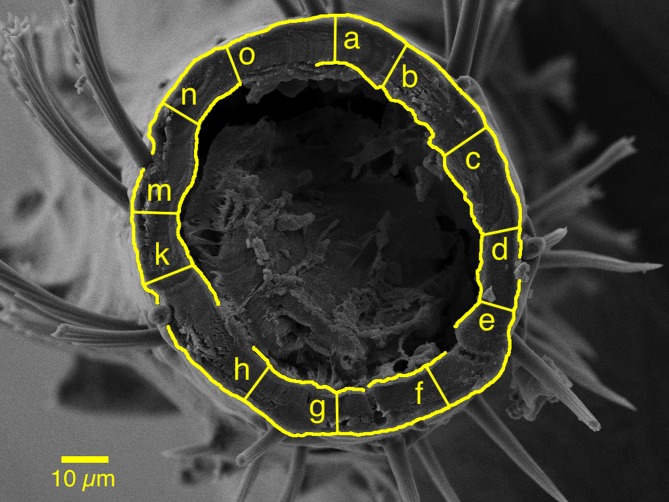
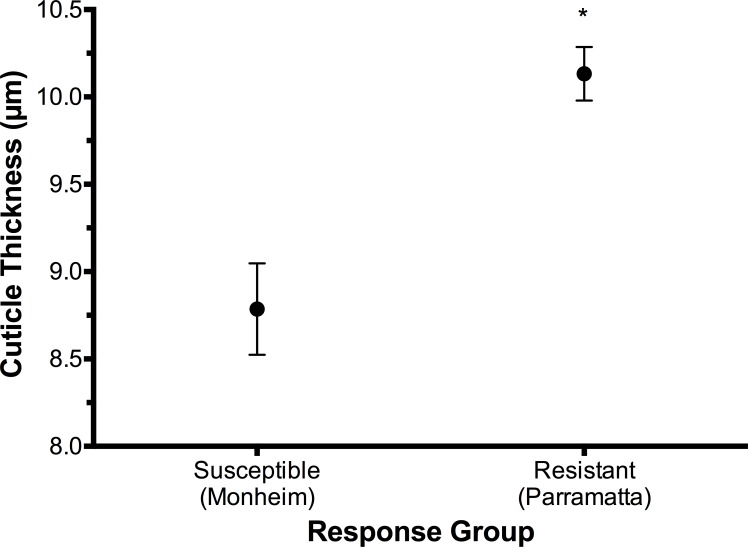
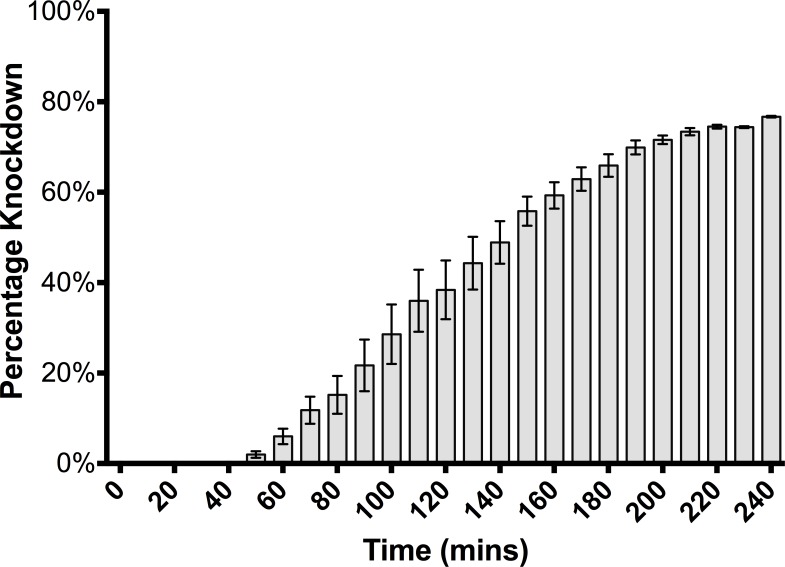
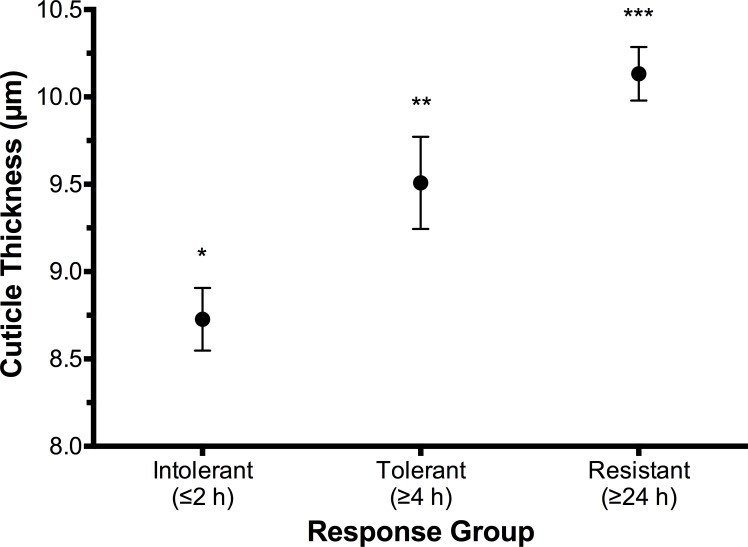
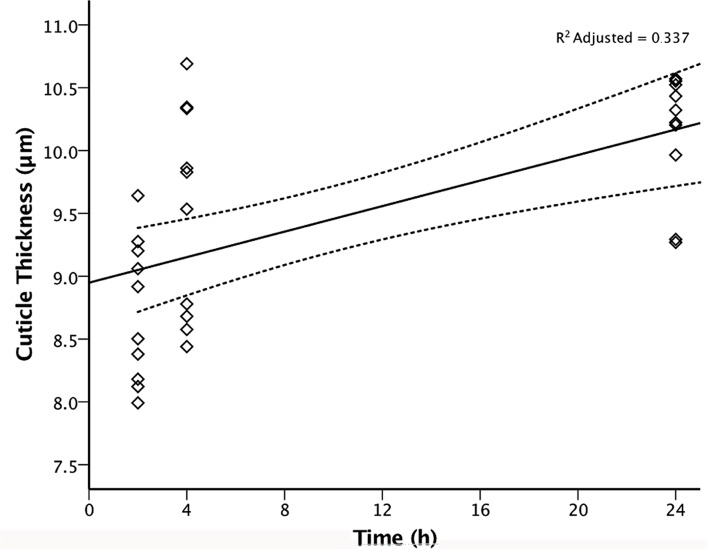
Thickening of the integument as a mechanism of resistance to insecticides is a well recognised phenomenon in the insect world and, in recent times, has been found in insects exhibiting pyrethroid-resistance. Resistance to pyrethroid insecticides in the common bed bug, Cimex lectularius L., is widespread and has been frequently inferred as a reason for the pest's resurgence. Overexpression of cuticle depositing proteins has been demonstrated in pyrethroid-resistant bed bugs although, to date, no morphological analysis of the cuticle has been undertaken in order to confirm a phenotypic link. This paper describes examination of the cuticle thickness of a highly pyrethroid-resistant field strain collected in Sydney, Australia, in response to time-to-knockdown upon forced exposure to a pyrethroid insecticide. Mean cuticle thickness was positively correlated to time-to-knockdown, with significant differences observed between bugs knocked-down at 2 hours, 4 hours, and those still unaffected at 24 hours. Further analysis also demonstrated that the 24 hours survivors possessed a statistically significantly thicker cuticle when compared to a pyrethroid-susceptible strain of C. lectularius. This study demonstrates that cuticle thickening is present within a pyrethroid-resistant strain of C. lectularius and that, even within a stable resistant strain, cuticle thickness will vary according to time-to-knockdown upon exposure to an insecticide. This response should thus be considered in future studies on the cuticle of insecticide-resistant bed bugs and, potentially, other insects.
体表增厚作为一种抗杀虫剂机制,在昆虫界是一种广为人知的现象,近来在表现出拟除虫菊酯抗性的昆虫中也被发现。普通臭虫(温带臭虫)对拟除虫菊酯类杀虫剂的抗性广泛存在,并且经常被推断为该害虫再度猖獗的一个原因。尽管迄今为止尚未对表皮进行形态学分析以确认表型联系,但在对拟除虫菊酯具有抗性的臭虫中已证实表皮沉积蛋白过度表达。本文描述了对在澳大利亚悉尼采集的一个对拟除虫菊酯具有高度抗性的野外菌株的表皮厚度进行的检测,该检测针对的是在强制接触一种拟除虫菊酯类杀虫剂后达到击倒时间的情况。平均表皮厚度与击倒时间呈正相关,在2小时、4小时被击倒的臭虫与24小时仍未受影响的臭虫之间观察到显著差异。进一步分析还表明,与温带臭虫的一个对拟除虫菊酯敏感的菌株相比,24小时存活的臭虫表皮在统计学上显著更厚。本研究表明,在温带臭虫的一个对拟除虫菊酯具有抗性的菌株中存在表皮增厚现象,而且即使在一个稳定的抗性菌株中,表皮厚度也会根据接触杀虫剂后的击倒时间而变化。因此,在未来关于抗杀虫剂臭虫以及可能还有其他昆虫表皮的研究中应考虑这种反应。