French Clare E, McKenzie Bruce C, Coope Caroline, Rajanaidu Subhadra, Paranthaman Karthik, Pebody Richard, Nguyen-Van-Tam Jonathan S, Higgins Julian P T, Beck Charles R
School of Social and Community Medicine, University of Bristol, Bristol, UK.
NIHR Health Protection Research Unit in Evaluation of Interventions at University of Bristol, Bristol, UK.
Influenza Other Respir Viruses. 2016 Jul;10(4):268-90. doi: 10.1111/irv.12379. Epub 2016 Mar 24.
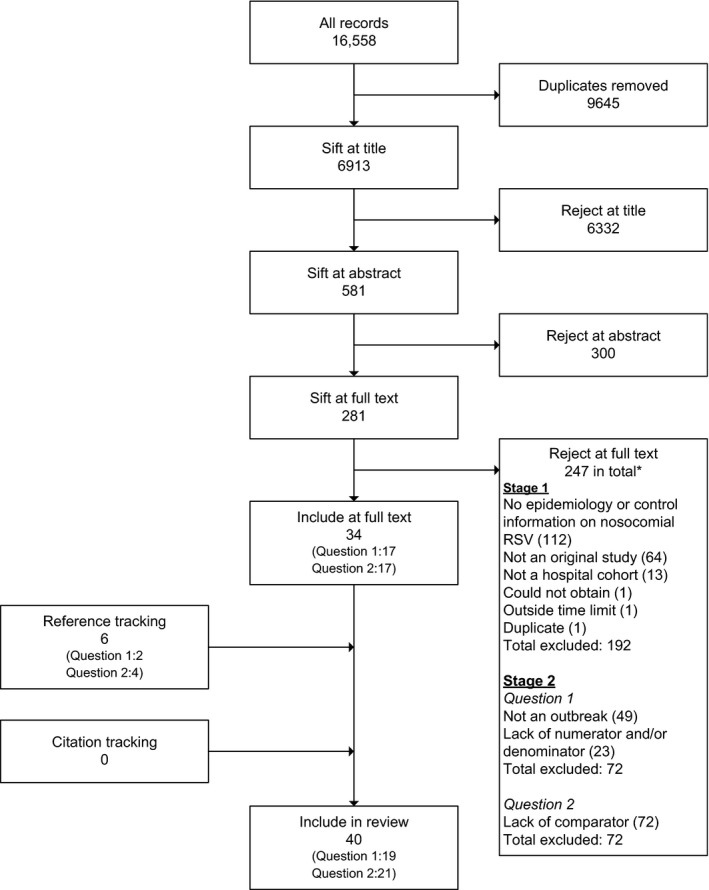
Respiratory syncytial virus (RSV) causes a significant public health burden, and outbreaks among vulnerable patients in hospital settings are of particular concern. We reviewed published and unpublished literature from hospital settings to assess: (i) nosocomial RSV transmission risk (attack rate) during outbreaks, (ii) effectiveness of infection control measures. We searched the following databases: MEDLINE, EMBASE, CINAHL, Cochrane Library, together with key websites, journals and grey literature, to end of 2012. Risk of bias was assessed using the Cochrane risk of bias tool or Newcastle-Ottawa scale. A narrative synthesis was conducted. Forty studies were included (19 addressing research question one, 21 addressing question two). RSV transmission risk varied by hospital setting; 6-56% (median: 28·5%) in neonatal/paediatric settings (n = 14), 6-12% (median: 7%) in adult haematology and transplant units (n = 3), and 30-32% in other adult settings (n = 2). For question two, most studies (n = 13) employed multi-component interventions (e.g. cohort nursing, personal protective equipment (PPE), isolation), and these were largely reported to be effective in reducing nosocomial transmission. Four studies examined staff PPE; eye protection appeared more effective than gowns and masks. One study reported on RSV prophylaxis for patients (RSV-Ig/palivizumab); there was no statistical evidence of effectiveness although the sample size was small. Overall, risk of bias for included studies tended to be high. We conclude that RSV transmission risk varies widely during hospital outbreaks. Although multi-component control strategies appear broadly successful, further research is required to disaggregate the effectiveness of individual components including the potential role of palivizumab prophylaxis.
呼吸道合胞病毒(RSV)造成了重大的公共卫生负担,医院环境中易感患者群体的疫情爆发尤其令人担忧。我们回顾了来自医院环境的已发表和未发表文献,以评估:(i)疫情爆发期间医院内RSV传播风险(感染率),(ii)感染控制措施的有效性。我们检索了以下数据库:MEDLINE、EMBASE、CINAHL、Cochrane图书馆,以及主要网站、期刊和灰色文献,检索截止至2012年底。使用Cochrane偏倚风险工具或纽卡斯尔-渥太华量表评估偏倚风险。进行了叙述性综合分析。纳入了40项研究(19项针对研究问题一,21项针对问题二)。RSV传播风险因医院环境而异;在新生儿/儿科环境中为6%-56%(中位数:28.5%)(n = 14),在成人血液学和移植科室中为6%-12%(中位数:7%)(n = 3),在其他成人科室中为30%-32%(n = 2)。对于问题二,大多数研究(n = 13)采用了多组分干预措施(如分组护理、个人防护装备(PPE)、隔离),并且这些措施在很大程度上被报告可有效减少医院内传播。四项研究考察了工作人员的PPE;眼部防护似乎比防护服和口罩更有效。一项研究报告了对患者的RSV预防措施(RSV免疫球蛋白/帕利珠单抗);尽管样本量较小,但没有统计学证据表明其有效。总体而言,纳入研究的偏倚风险往往较高。我们得出结论,医院疫情爆发期间RSV传播风险差异很大。尽管多组分控制策略总体上似乎是成功的,但仍需要进一步研究以区分各个组分的有效性,包括帕利珠单抗预防的潜在作用。