Ju Cynthia, Tacke Frank
Skaggs School of Pharmacy and Pharmaceutical Sciences and Integrated Immunology, University of Colorado Anschutz Medical Campus, Aurora, USA.
Department of Medicine III, University Hospital Aachen, Aachen, Germany.
Cell Mol Immunol. 2016 May;13(3):316-27. doi: 10.1038/cmi.2015.104. Epub 2016 Feb 24.
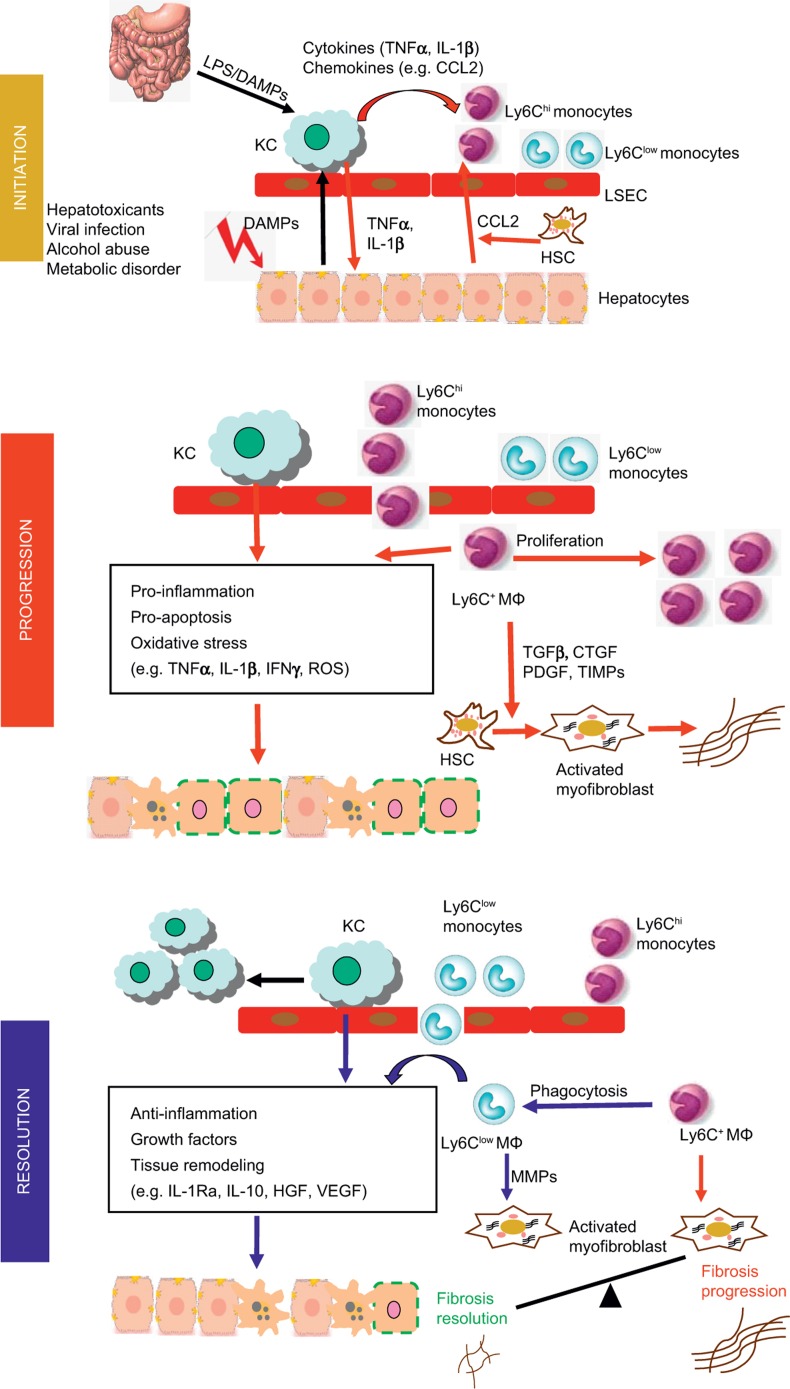
Macrophages represent a major cell type of innate immunity and have emerged as a critical player and therapeutic target in many chronic inflammatory diseases. Hepatic macrophages consist of Kupffer cells, which are originated from the fetal yolk-sack, and infiltrated bone marrow-derived monocytes/macrophages. Hepatic macrophages play a central role in maintaining homeostasis of the liver and in the pathogenesis of liver injury, making them an attractive therapeutic target for liver diseases. However, the various populations of hepatic macrophages display different phenotypes and exert distinct functions. Thus, more research is required to better understand these cells to guide the development of macrophage-based therapeutic interventions. This review article will summarize the current knowledge on the origins and composition of hepatic macrophages, their functions in maintaining hepatic homeostasis, and their involvement in both promoting and resolving liver inflammation, injury, and fibrosis. Finally, the current strategies being developed to target hepatic macrophages for the treatment of liver diseases will be reviewed.
巨噬细胞是固有免疫的主要细胞类型,已成为许多慢性炎症性疾病的关键参与者和治疗靶点。肝巨噬细胞由源自胎儿卵黄囊的库普弗细胞和浸润的骨髓来源的单核细胞/巨噬细胞组成。肝巨噬细胞在维持肝脏稳态及肝损伤发病机制中起核心作用,使其成为肝脏疾病颇具吸引力的治疗靶点。然而,不同群体的肝巨噬细胞表现出不同的表型并发挥不同的功能。因此,需要更多研究以更好地了解这些细胞,从而指导基于巨噬细胞的治疗干预措施的开发。这篇综述文章将总结关于肝巨噬细胞的起源、组成、其在维持肝脏稳态中的功能以及其在促进和解决肝脏炎症、损伤及纤维化中的作用的现有知识。最后,将综述目前正在开发的针对肝巨噬细胞治疗肝脏疾病的策略。