Javanmard M, Emaminejad S, Gupta C, Provine J, Davis R W, Howe R T
Stanford Genome Technology Center, Stanford University, Stanford, CA, USA.
Electrical Engineering Department, Stanford University, Stanford, CA, USA.
Sens Actuators B Chem. 2014 Mar;193:918-924. doi: 10.1016/j.snb.2013.11.100.
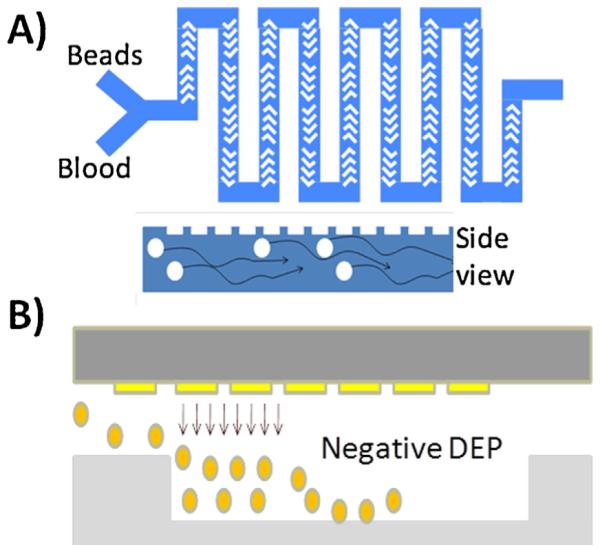
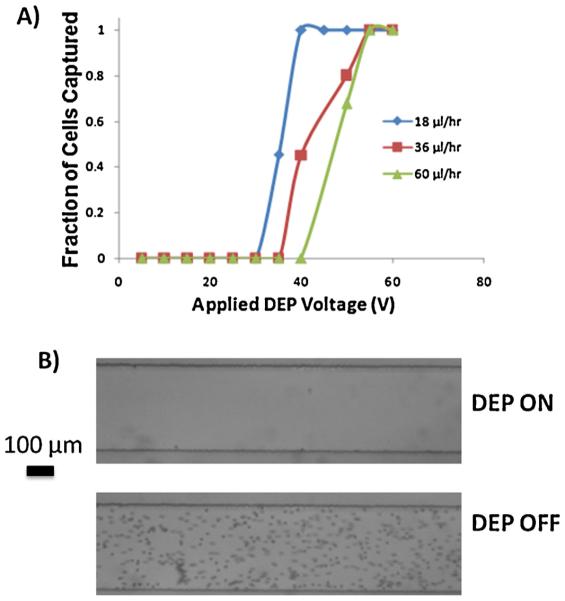
Platforms that are sensitive and specific enough to assay low-abundance protein biomarkers, in a high throughput multiplex format, within a complex biological fluid specimen, are necessary to enable protein biomarker based diagnostics for diseases such as cancer. The signal from an assay for a low-abundance protein biomarker in a biological fluid sample like blood is typically buried in a background that arises from the presence of blood cells and from high-abundance proteins that make up 90% of the assayed protein mass. We present an automated on-chip platform for the depletion of cells and highly abundant serum proteins in blood. Our platform consists of two components, the first of which is a microfluidic mixer that mixes beads containing antibodies against the highly abundant proteins in the whole blood. This complex mixture (consisting of beads, cells, and serum proteins) is then injected into the second component of our microfluidic platform, which comprises a filter trench to capture all the cells and the beads. The size-based trapping of the cells and beads into the filter trench is significantly enhanced by leveraging additional negative dielectrophoretic forces to push the micron sized particles (cells and beads which have captured the highly abundant proteins) down into the trench, allowing the serum proteins of lower abundance to flow through. In general, dielectrophoresis using bare electrodes is incapable of producing forces beyond the low piconewton range that tend to be insufficient for separation applications. However, by using electrodes passivated with atomic layer deposition, we demonstrate the application of enhanced negative DEP electrodes together with size-based flltration induced by the filter trench, to deplete 100% of the micron sized particles in the mixture.
对于癌症等疾病,要实现基于蛋白质生物标志物的诊断,就需要有足够灵敏和特异的平台,能够以高通量多重检测形式,在复杂的生物流体样本中检测低丰度蛋白质生物标志物。在血液等生物流体样本中检测低丰度蛋白质生物标志物时,其信号通常会被血细胞以及占检测蛋白质总量90%的高丰度蛋白质所产生的背景信号所掩盖。我们展示了一种用于去除血液中细胞和高丰度血清蛋白的自动化芯片平台。我们的平台由两个组件组成,第一个是微流体混合器,它将含有针对全血中高丰度蛋白质抗体的珠子进行混合。然后将这种复杂混合物(由珠子、细胞和血清蛋白组成)注入我们微流体平台的第二个组件,该组件包括一个过滤槽,用于捕获所有细胞和珠子。通过利用额外的负介电泳力将微米级颗粒(捕获了高丰度蛋白质的细胞和珠子)向下推入微槽,基于尺寸的细胞和珠子捕获到过滤槽中的效率显著提高,从而使较低丰度的血清蛋白能够流过。一般来说,使用裸电极的介电泳无法产生超过低皮牛顿范围的力,这对于分离应用往往是不够的。然而,通过使用原子层沉积钝化的电极,我们展示了增强的负介电泳电极与过滤槽诱导的基于尺寸的过滤相结合的应用,能够去除混合物中100%的微米级颗粒。