Lee Jane J, Pedley Alison, Hoffmann Udo, Massaro Joseph M, Keaney John F, Vasan Ramachandran S, Fox Caroline S
National Heart, Lung, and Blood Institute's Division of Intramural Research, The Framingham Heart Study, and the Population Studies Branch, Framingham, MA.
Department of Radiology, Massachusetts General Hospital, Boston, MA.
J Am Heart Assoc. 2016 Feb 29;5(3):e002545. doi: 10.1161/JAHA.115.002545.
Excess accumulation of abdominal subcutaneous (SAT) and visceral adipose tissue (VAT) is associated with adverse levels of adipokines and cardiovascular disease risk. Whether fat quality is associated with adipokines has not been firmly established. This study examined the association between abdominal SAT and VAT density, an indirect measure of fat quality, with a panel of metabolic regulatory biomarkers secreted by adipose tissue or the liver independently of absolute fat volumes.
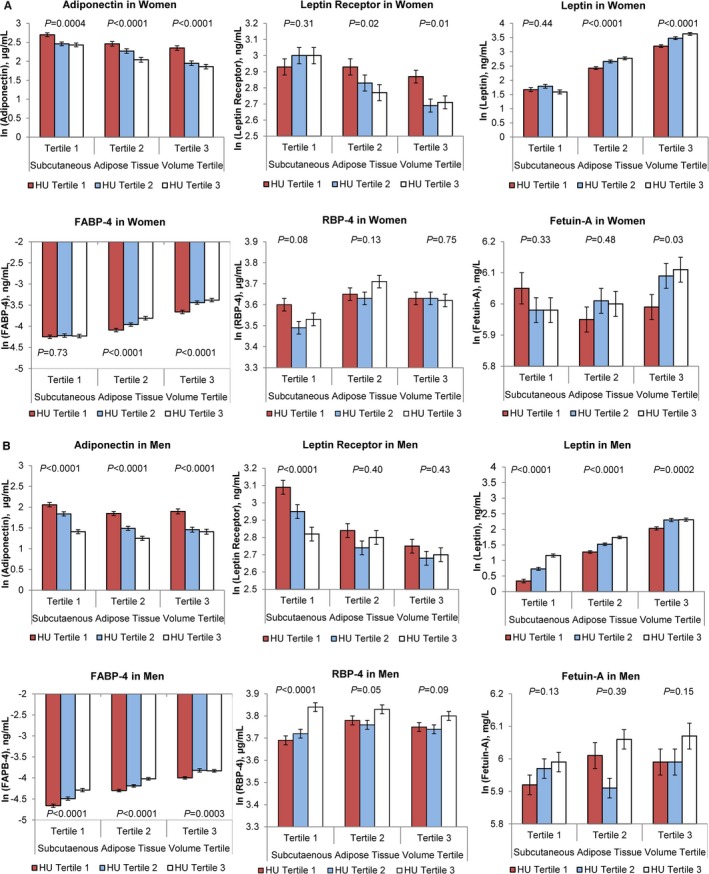
We evaluated 1829 Framingham Heart Study participants (44.9% women). Abdominal SAT and VAT density was estimated indirectly by adipose tissue attenuation using computed tomography. Adipokines included adiponectin, leptin receptor, leptin, fatty acid-binding protein 4 (FABP-4), retinol-binding protein 4 (RBP-4), and fetuin-A. Fat density was associated with all the biomarkers evaluated, except fetuin-A. Lower fat density (ie, more-negative fat attenuation) was associated with lower adiponectin and leptin receptor, but higher leptin and FABP-4 levels (all P<0.0001). SAT density was inversely associated with RPB-4 in both sexes, whereas the association between VAT density and RPB-4 was only observed in men (P<0.0001). In women, after additional adjustment for respective fat volume, SAT density retained the significant associations with adiponectin, leptin, FABP-4, and RBP-4; and VAT density with adiponectin only (all P<0.0001). In men, significant associations were maintained upon additional adjustment for respective fat volume (P<0.005).
Lower abdominal fat density was associated with a profile of biomarkers suggestive of greater cardiometabolic risk. These observations support that fat density may be a valid biomarker of cardiometabolic risk.
腹部皮下脂肪(SAT)和内脏脂肪组织(VAT)的过度积累与脂肪因子的不良水平及心血管疾病风险相关。脂肪质量与脂肪因子之间的关联尚未完全明确。本研究探讨了腹部SAT和VAT密度(一种间接衡量脂肪质量的指标)与一组由脂肪组织或肝脏分泌的代谢调节生物标志物之间的关联,且独立于绝对脂肪量。
我们评估了1829名弗雷明汉心脏研究参与者(44.9%为女性)。通过计算机断层扫描利用脂肪组织衰减间接估计腹部SAT和VAT密度。脂肪因子包括脂联素、瘦素受体、瘦素、脂肪酸结合蛋白4(FABP - 4)、视黄醇结合蛋白4(RBP - 4)和胎球蛋白 - A。脂肪密度与除胎球蛋白 - A外的所有评估生物标志物相关。较低的脂肪密度(即脂肪衰减更负)与较低的脂联素和瘦素受体相关,但与较高的瘦素和FABP - 4水平相关(所有P<0.0001)。SAT密度在两性中均与RPB - 4呈负相关,而VAT密度与RPB - 4的关联仅在男性中观察到(P<0.0001)。在女性中,在进一步调整各自的脂肪量后,SAT密度与脂联素、瘦素、FABP - 4和RBP - 4仍保持显著关联;VAT密度仅与脂联素保持显著关联(所有P<0.0001)。在男性中,进一步调整各自的脂肪量后仍保持显著关联(P<0.005)。
较低的腹部脂肪密度与提示更高心血管代谢风险的生物标志物谱相关。这些观察结果支持脂肪密度可能是心血管代谢风险的有效生物标志物。