Clinical Research Unit (Homeopathy), Central Council for Research in Homeopathy, Government of India, Gokhel Road, Arabindapally, Siliguri 734006, Darjeeling, West Bengal, India.
Department of Pathology and Microbiology, Mahesh Bhattacharyya Homeopathic Medical College and Hospital, Government of West Bengal, Drainage Canal Road, Doomurjala, Howrah 711104, West Bengal, India.
J Tradit Complement Med. 2015 Jan 7;6(1):72-7. doi: 10.1016/j.jtcme.2014.11.020. eCollection 2016 Jan.
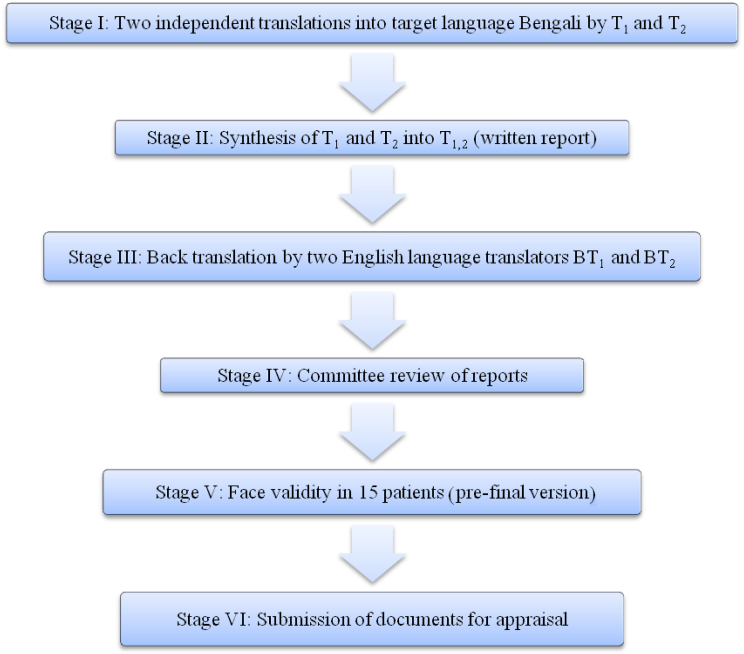
Homeopathy research has focused on chronic conditions; however, the extent to which current homeopathic care is compliant with the Chronic Care Model (CCM) has been sparsely shown. As the Bengali Patient-Assessed Chronic Illness Care (PACIC)-20 was not available, the English questionnaire was translated and evaluated in a government homeopathic hospital in West Bengal, India. The translation was done in six steps, and approved by an expert committee. Face validity was tested by 15 people for comprehension. Test/retest reliability (reproducibility) was tested on 30 patients with chronic conditions. Internal consistency was tested in 377 patients suffering from various chronic conditions. The questionnaire showed acceptable test/retest reliability [intraclass correlation coefficient (ICC) 0.57-0.75; positive to strong positive correlations; p < 0.0001] for all domains and the total score, strong internal consistency (Cronbach's α = 0.86 overall and 0.65-0.82 for individual subscales), and large responsiveness (1.11). The overall mean score percentage seemed to be moderate at 69.5 ± 8.8%. Gender and presence of chronic conditions did not seem to vary significantly with PACIC-20 subscale scores (p > 0.05); however, monthly household income had a significant influence (p < 0.05) on the subscales except for "delivery system or practice design." Overall, chronic illness care appeared to be quite promising and CCM-compliant. The psychometric properties of the Bengali PACIC-20 were satisfactory, rendering it a valid and reliable instrument for assessing chronic illness care among the patients attending a homeopathic hospital.
顺势疗法研究主要集中在慢性病上;然而,当前顺势疗法护理符合慢性照护模式(CCM)的程度尚不清楚。由于孟加拉语患者评估的慢性病照护量表(PACIC-20)不可用,因此对印度西孟加拉邦的一家政府顺势疗法医院进行了英语问卷的翻译和评估。翻译分六个步骤进行,并由专家委员会批准。通过 15 人对理解能力进行了表面有效性测试。对 30 名慢性病患者进行了测试/重测可靠性(可重复性)测试。在 377 名患有各种慢性病的患者中进行了内部一致性测试。该问卷在所有领域和总分上均表现出可接受的测试/重测可靠性[组内相关系数(ICC)0.57-0.75;阳性至强阳性相关;p<0.0001],具有很强的内部一致性(整体 Cronbach's α为 0.86,个别分量表为 0.65-0.82),且反应度较大(1.11)。总体平均得分百分比似乎为 69.5±8.8%,处于中等水平。性别和慢性病的存在似乎与 PACIC-20 分量表得分没有明显差异(p>0.05);然而,除了“传递系统或实践设计”外,月家庭收入对各分量表有显著影响(p<0.05)。总体而言,慢性病护理似乎相当有前景,符合 CCM。孟加拉语 PACIC-20 的心理测量学特性令人满意,使其成为评估接受顺势疗法治疗的患者慢性病护理的有效且可靠的工具。