Mejri Mohamed Arbi, Yousfi Narimen, Mhenni Thouraya, Tayech Amel, Hammouda Omar, Driss Tarak, Chaouachi Anis, Souissi Nizar
Research Laboratory "Sport Performance Optimization", National Center of Medicine and Sciences in Sport (CNMSS), Tunis, Tunisia; Faculty of Science, Carthage University, Bizerte, Tunisia.
Research Laboratory "Sport Performance Optimization", National Center of Medicine and Sciences in Sport (CNMSS), Tunis, Tunisia; High Institute of Sport and Physical Education, Ksar-Saïd, Manouba University, Tunis, Tunisia.
J Exerc Rehabil. 2016 Feb 1;12(1):47-53. doi: 10.12965/jer.150256. eCollection 2016 Feb.
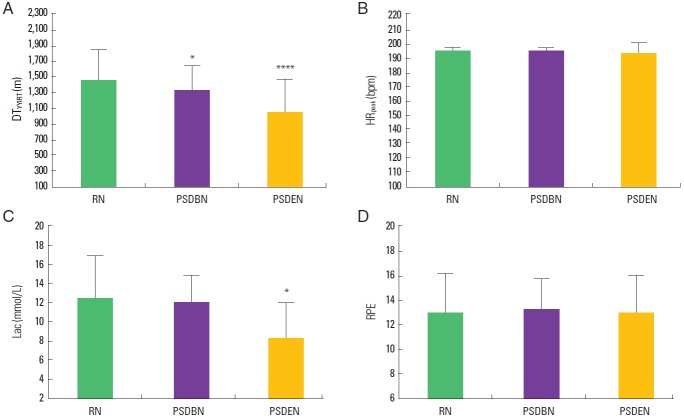
Athletes and coaches believe that adequate sleep is essential for peak performance. There is ample scientific evidence which support the conclusion that sleep loss seems to stress many physiological functions in humans. The aim of this study was to determine the effect of one night's sleep deprivation on intermittent exercise performance in the evening of the following day. Ten male Taekwondo players performed the Yo-Yo intermittent recovery test (YYIRT) in three sleep conditions (reference sleep night [RN], partial sleep deprivation at the beginning of night [PSDBN], partial sleep deprivation at the end of night [PSDEN]) in a counterbalanced order, allowing a recovery period ≥36 hr in between them. Heart rate peak (HRpeak), plasma lactate concentrations (Lac) and rating of perceived exertion (RPE) were measured during the test. A significant effect of sleep restriction was observed on the total distance covered in YYIRT (P<0.0005) and Lac (P<0.01) in comparison with the RN. In addition, performance more decreased after PSDEN (P<0.0005) than PSDBN (P<0.05). Also, Lac decreased significantly only after PS-DEN (P<0.05) compared with RN. However, there were no significant changes in HRpeak and RPE after the two types of partial sleep deprivation compared to RN. The present study indicates that short-term sleep restriction affect the intermittent performance, as well as the Lac levels of the Taekwondo players in the evening of the following day, without alteration of HRpeak and RPE.
运动员和教练认为充足的睡眠对于最佳表现至关重要。有大量科学证据支持睡眠不足似乎会给人类许多生理功能带来压力这一结论。本研究的目的是确定一夜睡眠剥夺对次日傍晚间歇性运动表现的影响。十名男性跆拳道运动员在三种睡眠条件下(参考睡眠夜[RN]、夜间开始时部分睡眠剥夺[PSDBN]、夜间结束时部分睡眠剥夺[PSDEN])以平衡顺序进行了Yo-Yo间歇性恢复测试(YYIRT),两次测试之间允许有≥36小时的恢复期。在测试过程中测量心率峰值(HRpeak)、血浆乳酸浓度(Lac)和主观用力程度分级(RPE)。与RN相比,观察到睡眠限制对YYIRT中的总距离(P<0.0005)和Lac(P<0.01)有显著影响。此外,PSDEN后的表现下降幅度(P<0.0005)大于PSDBN(P<0.05)。而且,与RN相比,仅在PS-DEN后Lac显著下降(P<0.05)。然而,与RN相比,两种部分睡眠剥夺后HRpeak和RPE没有显著变化。本研究表明,短期睡眠限制会影响次日傍晚跆拳道运动员的间歇性表现以及Lac水平,而不会改变HRpeak和RPE。