Lindhardt Morten, Persson Frederik, Currie Gemma, Pontillo Claudia, Beige Joachim, Delles Christian, von der Leyen Heiko, Mischak Harald, Navis Gerjan, Noutsou Marina, Ortiz Alberto, Ruggenenti Piero Luigi, Rychlik Ivan, Spasovski Goce, Rossing Peter
Steno Diabetes Center, Gentofte, Denmark.
Institute of Cardiovascular and Medical Sciences, University of Glasgow, Glasgow, UK.
BMJ Open. 2016 Mar 2;6(3):e010310. doi: 10.1136/bmjopen-2015-010310.
Diabetes mellitus affects 9% of the European population and accounts for 15% of healthcare expenditure, in particular, due to excess costs related to complications. Clinical trials aiming for earlier prevention of diabetic nephropathy by renin angiotensin system blocking treatment in normoalbumuric patients have given mixed results. This might reflect that the large fraction of normoalbuminuric patients are not at risk of progression, thereby reducing power in previous studies. A specific risk classifier based on urinary proteomics (chronic kidney disease (CKD)273) has been shown to identify normoalbuminuric diabetic patients who later progressed to overt kidney disease, and may hold the potential for selection of high-risk patients for early intervention. Combining the ability of CKD273 to identify patients at highest risk of progression with prescription of preventive aldosterone blockade only to this high-risk population will increase power. We aim to confirm performance of CKD273 in a prospective multicentre clinical trial and test the ability of spironolactone to delay progression of early diabetic nephropathy.
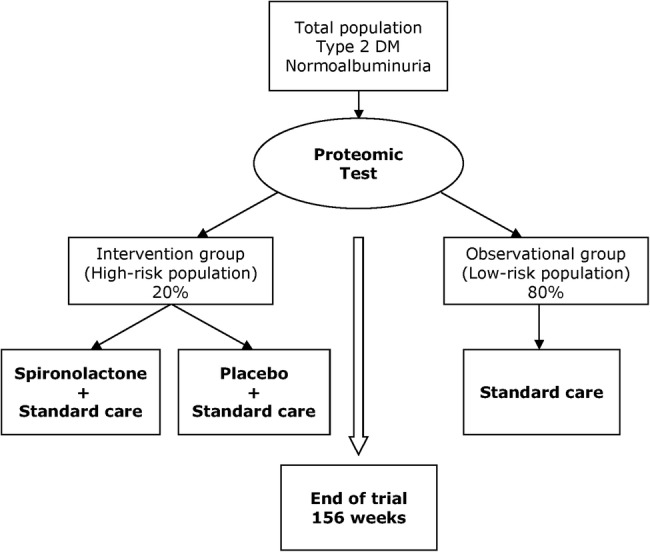
Investigator-initiated, prospective multicentre clinical trial, with randomised double-masked placebo-controlled intervention and a prospective observational study. We aim to include 3280 type 2 diabetic participants with normoalbuminuria. The CKD273 classifier will be assessed in all participants. Participants with high-risk pattern are randomised to treatment with spironolactone 25 mg once daily, or placebo, whereas, those with low-risk pattern will be observed without intervention other than standard of care. Treatment or observational period is 3 years.The primary endpoint is development of confirmed microalbuminuria in 2 of 3 first morning voids urine samples.
The study will be conducted under International Conference on Harmonisation - Good clinical practice (ICH-GCP) requirements, ethical principles of Declaration of Helsinki and national laws. This first new biomarker-directed intervention trial aiming at primary prevention of diabetic nephropathy may pave the way for personalised medicine approaches in treatment of diabetes complications.
NCT02040441; Pre-results.
糖尿病影响着9%的欧洲人口,占医疗保健支出的15%,特别是由于并发症相关的额外费用。旨在通过肾素血管紧张素系统阻断治疗在正常白蛋白尿患者中早期预防糖尿病肾病的临床试验结果不一。这可能反映出大部分正常白蛋白尿患者没有疾病进展风险,从而降低了先前研究的效力。一种基于尿液蛋白质组学的特定风险分类器(慢性肾脏病(CKD)273)已被证明可识别出后来进展为显性肾病的正常白蛋白尿糖尿病患者,并可能具有选择高危患者进行早期干预的潜力。将CKD273识别疾病进展风险最高患者的能力与仅对该高危人群开具预防性醛固酮阻断药物相结合,将提高效力。我们旨在在前瞻性多中心临床试验中确认CKD273的性能,并测试螺内酯延缓早期糖尿病肾病进展的能力。
由研究者发起的前瞻性多中心临床试验,采用随机双盲安慰剂对照干预和前瞻性观察研究。我们旨在纳入3280名正常白蛋白尿的2型糖尿病参与者。将在所有参与者中评估CKD273分类器。具有高危模式的参与者被随机分配接受每日一次25毫克螺内酯治疗或安慰剂治疗,而具有低危模式的参与者将在除标准治疗外不进行干预的情况下接受观察。治疗或观察期为3年。主要终点是在首次晨尿的3份样本中有2份样本确认出现微量白蛋白尿。
本研究将根据国际协调会议 - 良好临床实践(ICH - GCP)要求、《赫尔辛基宣言》的伦理原则和国家法律进行。这项首个针对糖尿病肾病一级预防的新型生物标志物导向干预试验可能为糖尿病并发症的个性化医疗方法铺平道路。
NCT02040441;预结果。