Zhang Wenhai, Ding Qiang, Chen Ning, Wei Qing, Zhao Cancan, Zhang Ping, Li Xiying, Liu Qiang, Li Hong
Mental Health Center, Yancheng Institute of Technology, Yancheng City 224051, China; Research Center of Brain and Cognitive Neuroscience, Liaoning Normal University, Dalian City 116029, China; College of Education Science, Chengdu University, Chengdu City 610106, China.
Department of Psychology, Shanghai Normal University, Shanghai City 200234, China.
Neuroimage Clin. 2016 Jan 21;11:116-123. doi: 10.1016/j.nicl.2016.01.018. eCollection 2016.
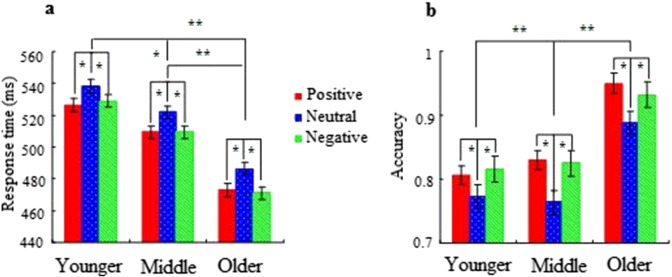
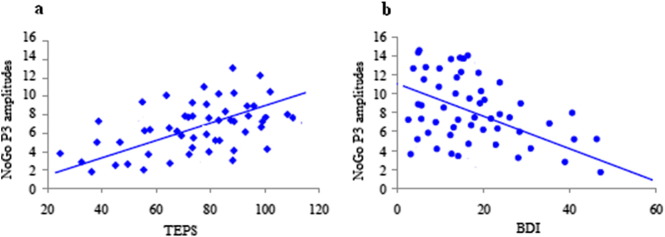
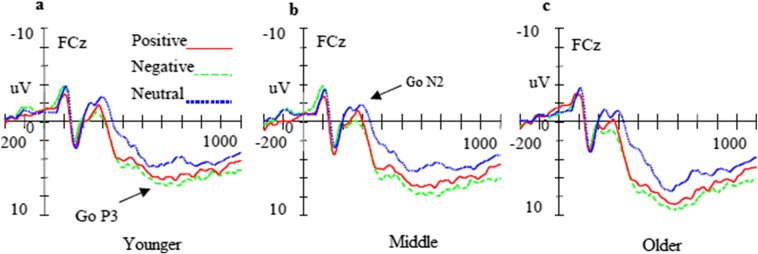
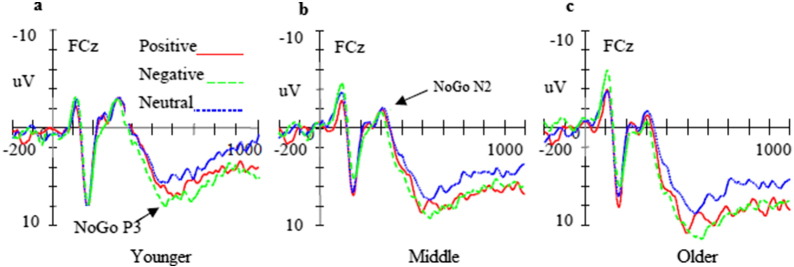
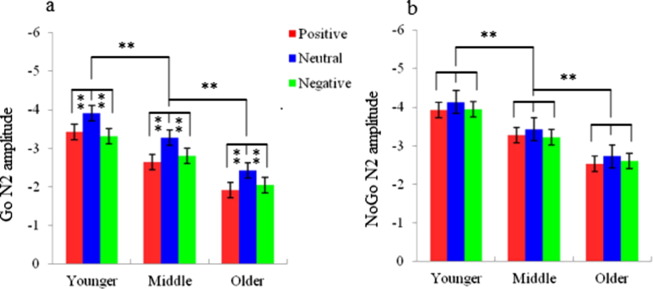
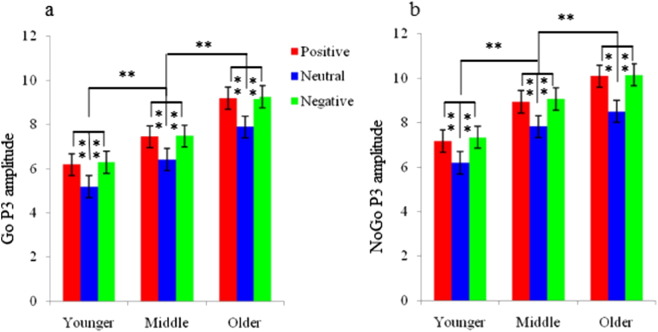
Impaired automatic emotion regulation (AER) is closely related to major depressive disorder. Our research in adults has identified two AER-related components, Go N2 and NoGo P3, in an implicit emotional Go/NoGo paradigm. However, it is unclear whether Go N2 and NoGo P3 reflect the development of AER in adolescents and the relationship of these components with subclinical depressive symptoms and trait anhedonia. We collected EEG data from 55 adolescents while they completed the implicit emotional Go/NoGo task. After the experiment, the subjects completed the Chinese version of the Temporal Experience of Pleasure Scale and the Beck Depression Inventory. Consistent with results in adults, we determined that Go N2 represents automatic top-down attention to emotions in Go trials, whereas NoGo P3 represents automatic response inhibition in NoGo trials. These AER components exhibited age-dependent improvement during adolescence. Additionally, NoGo P3 amplitudes elicited by viewing positive faces were positively correlated with trait anhedonia, whereas NoGo P3 amplitudes elicited by viewing negative faces were negatively correlated with depressive symptoms. Our observations provide further understanding of the neurodevelopmental mechanism of AER and yield new insight into dissociable impairments in AER in adolescents with major depressive disorder during positive and negative implicit processing.
自动情绪调节(AER)受损与重度抑郁症密切相关。我们对成年人的研究在一个内隐情绪Go/NoGo范式中确定了两个与AER相关的成分,即Go N2和NoGo P3。然而,尚不清楚Go N2和NoGo P3是否反映了青少年AER的发展,以及这些成分与亚临床抑郁症状和特质性快感缺乏的关系。我们收集了55名青少年在完成内隐情绪Go/NoGo任务时的脑电图数据。实验结束后,受试者完成了中文版的愉悦感时间体验量表和贝克抑郁量表。与成年人的结果一致,我们确定Go N2代表在Go试验中对情绪的自动自上而下的注意,而NoGo P3代表在NoGo试验中的自动反应抑制。这些AER成分在青少年时期表现出与年龄相关的改善。此外,观看正面面孔引发的NoGo P3波幅与特质性快感缺乏呈正相关,而观看负面面孔引发的NoGo P3波幅与抑郁症状呈负相关。我们的观察结果进一步加深了对AER神经发育机制的理解,并为重度抑郁症青少年在正性和负性内隐加工过程中AER的可分离损伤提供了新的见解。