Yasuda Yuka, Hashimoto Ryota, Nakae Aya, Kang Hongling, Ohi Kazutaka, Yamamori Hidenaga, Fujimoto Michiko, Hagihira Satoshi, Takeda Masatoshi
Department of Psychiatry, Osaka University Graduate School of Medicine, D3, 2-2, Yamadaoka, Suita, Osaka, 565-0871 Japan.
Department of Psychiatry, Osaka University Graduate School of Medicine, D3, 2-2, Yamadaoka, Suita, Osaka, 565-0871 Japan ; Molecular Research Center for Children's Mental Development, United Graduate School of Child Development, Osaka University, D3, 2-2, Yamadaoka, Suita, Osaka, 565-0871 Japan.
Ann Gen Psychiatry. 2016 Mar 5;15:8. doi: 10.1186/s12991-016-0095-1. eCollection 2016.
The Diagnostic and Statistical Manual of Mental Disorders, 5th Edition (DSM-5) recently included sensory processing abnormalities in the diagnostic criteria for individuals with autism spectrum disorder (ASD). However, there is no standard method for evaluating sensory abnormalities in individuals with ASD.
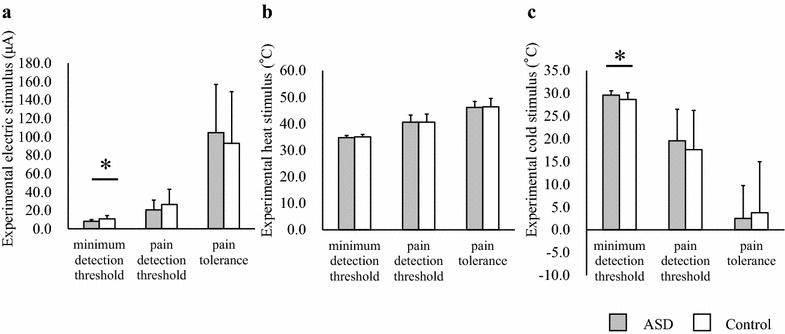
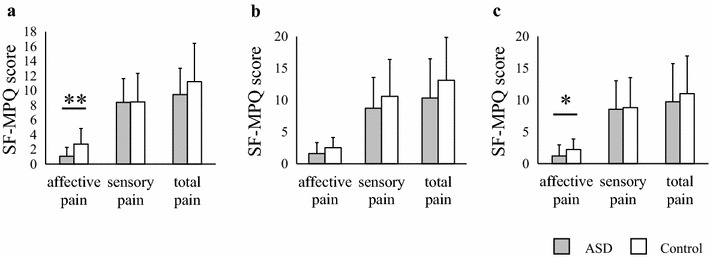
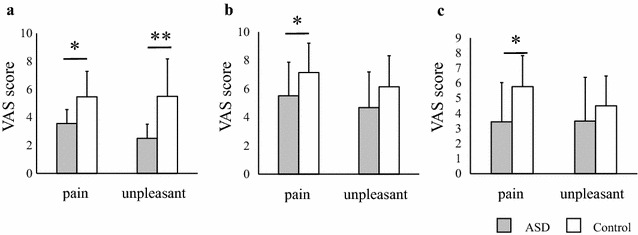
Fifteen individuals with ASD and 15 age- and sex-matched controls were enrolled in this study. We compared objective pain sensitivity by measuring the pain detection threshold and pain tolerance to three different stimuli (electricity, heat, and cold). Then, we compared both subjective pain sensitivity, assessed by the visual analog scale (VAS), and quality of pain, assessed by the short-form McGill Pain Questionnaire (SF-MPQ), to determine the maximum tolerable pain intensities of each stimulation.
The pain detection threshold and pain tolerance of individuals with ASD were not impaired, indicating that there were no differences in the somatic perception of pain between groups. However, individuals with ASD were hyposensitive to subjective pain intensity compared to controls (VAS; electrical: p = 0.044, cold: p = 0.011, heat: p = 0.042) and hyposensitive to affective aspects of pain sensitivity (SF-MPQ; electrical: p = 0.0071, cold: p = 0.042).
Our results suggest that the cognitive pathways for pain processing are impaired in ASD and, furthermore, that our methodology can be used to assess pain sensitivity in individuals with ASD. Further investigations into sensory abnormalities in individuals with ASD are needed to clarify the pathophysiologic processes that may alter sensory processing in this disorder.
《精神疾病诊断与统计手册》第5版(DSM - 5)最近将感觉加工异常纳入了自闭症谱系障碍(ASD)个体的诊断标准。然而,目前尚无评估ASD个体感觉异常的标准方法。
本研究纳入了15名ASD个体以及15名年龄和性别匹配的对照。我们通过测量对三种不同刺激(电、热和冷)的疼痛检测阈值和疼痛耐受性来比较客观疼痛敏感性。然后,我们比较了通过视觉模拟量表(VAS)评估的主观疼痛敏感性以及通过简式麦吉尔疼痛问卷(SF - MPQ)评估的疼痛质量,以确定每种刺激的最大可耐受疼痛强度。
ASD个体的疼痛检测阈值和疼痛耐受性未受损,表明两组之间在疼痛的躯体感知方面没有差异。然而,与对照组相比,ASD个体对主观疼痛强度的敏感性较低(VAS;电刺激:p = 0.044,冷刺激:p = 0.011,热刺激:p = 0.042),并且对疼痛敏感性的情感方面也较不敏感(SF - MPQ;电刺激:p = 0.0071,冷刺激:p = 0.042)。
我们的结果表明,ASD个体中疼痛处理的认知途径受损,此外,我们的方法可用于评估ASD个体的疼痛敏感性。需要对ASD个体的感觉异常进行进一步研究,以阐明可能改变该疾病感觉加工的病理生理过程。