Nam Seungyoon
Department of Life Sciences, Gachon University, Seongnam 13120; Department of Genome Medicine and Science, College of Medicine, Gachon University; Gachon Institute of Genome Medicine and Science, Gachon University Gil Medical Center, Incheon 21565, Korea.
BMB Rep. 2017 Jan;50(1):12-19. doi: 10.5483/bmbrep.2017.50.1.135.
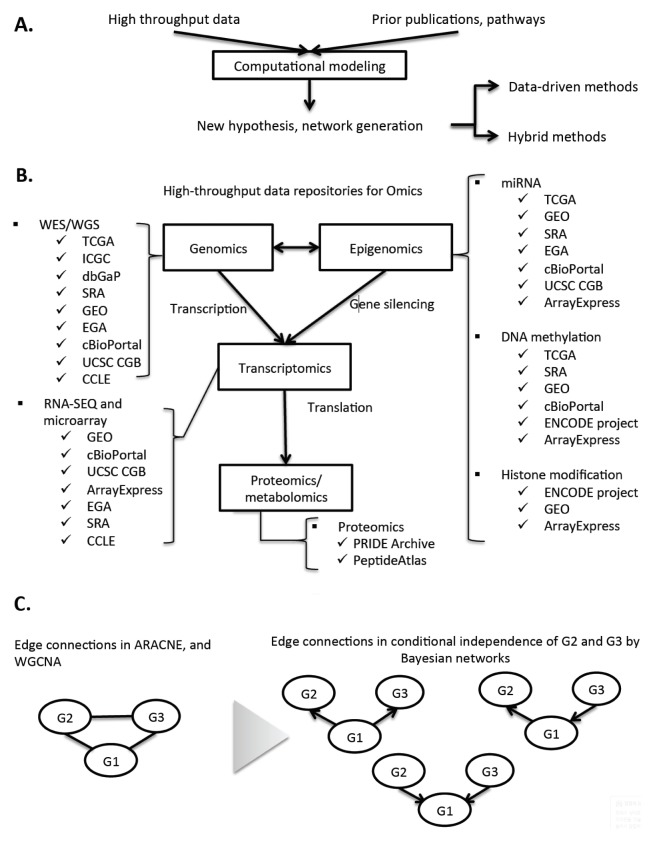
Traditionally, biologists have devoted their careers to studying individual biological entities of their own interest, partly due to lack of available data regarding that entity. Large, highthroughput data, too complex for conventional processing methods (i.e., "big data"), has accumulated in cancer biology, which is freely available in public data repositories. Such challenges urge biologists to inspect their biological entities of interest using novel approaches, firstly including repository data retrieval. Essentially, these revolutionary changes demand new interpretations of huge datasets at a systems-level, by so called "systems biology". One of the representative applications of systems biology is to generate a biological network from high-throughput big data, providing a global map of molecular events associated with specific phenotype changes. In this review, we introduce the repositories of cancer big data and cutting-edge systems biology tools for network generation, and improved identification of therapeutic targets. [BMB Reports 2017; 50(1): 12-19].
传统上,生物学家们将职业生涯投入到研究他们感兴趣的单个生物实体上,部分原因是缺乏关于该实体的可用数据。癌症生物学领域已经积累了大量的高通量数据,这些数据对于传统处理方法(即“大数据”)来说过于复杂,它们可在公共数据存储库中免费获取。这些挑战促使生物学家使用新方法来检查他们感兴趣的生物实体,首先包括从存储库中检索数据。从本质上讲,这些革命性的变化需要通过所谓的“系统生物学”在系统层面上对海量数据集进行新的解读。系统生物学的代表性应用之一是从高通量大数据生成生物网络,提供与特定表型变化相关的分子事件的全局图谱。在这篇综述中,我们介绍了癌症大数据存储库以及用于网络生成和改进治疗靶点识别的前沿系统生物学工具。[《BMB报告》2017年;50(1): 12 - 19]