Russell Lindsey, Broderick Gordon, Taylor Renee, Fernandes Henrique, Harvey Jeanna, Barnes Zachary, Smylie AnneLiese, Collado Fanny, Balbin Elizabeth G, Katz Ben Z, Klimas Nancy G, Fletcher Mary Ann
Department of Medicine, University of Alberta, Edmonton, AB, Canada.
Miami Veterans Affairs Medical Center, Miami, FL, USA.
BMC Immunol. 2016 Mar 10;17:3. doi: 10.1186/s12865-016-0142-3.
Validation of biomarkers for myalgic encephalomyelitis/chronic fatigue syndrome (ME/CFS) across data sets has proven disappointing. As immune signature may be affected by many factors, our objective was to explore the shift in discriminatory cytokines across ME/CFS subjects separated by duration of illness.
Cytokine expression collected at rest across multiple studies for female ME/CFS subjects (i) 18 years or younger, ill for 2 years or less (n = 18), (ii) 18-50 years of age, ill for 7 years (n = 22), and (iii) age 50 years or older (n = 28), ill for 11 years on average. Control subjects were matched for age and body mass index (BMI). Data describing the levels of 16 cytokines using a chemiluminescent assay was used to support the identification of separate linear classification models for each subgroup. In order to isolate the effects of duration of illness alone, cytokines that changed significantly with age in the healthy control subjects were excluded a priori.
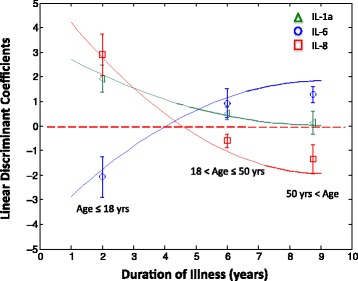
Optimal selection of cytokines in each group resulted in subsets of IL-1α, 6, 8, 15 and TNFα. Common to any 2 of 3 groups were IL-1α, 6 and 8. Setting these 3 markers as a triple screen and adjusting their contribution according to illness duration sub-groups produced ME/CFS classification accuracies of 75-88 %. The contribution of IL-1α, higher in recently ill adolescent ME/CFS subjects was progressively less important with duration. While high levels of IL-8 screened positive for ME/CFS in the recently afflicted, the opposite was true for subjects ill for more than 2 years. Similarly, while low levels of IL-6 suggested early ME/CFS, the reverse was true in subjects over 18 years of age ill for more than 2 years.
These preliminary results suggest that IL-1α, 6 and 8 adjusted for illness duration may serve as robust biomarkers, independent of age, in screening for ME/CFS.
事实证明,跨数据集对肌痛性脑脊髓炎/慢性疲劳综合征(ME/CFS)生物标志物进行验证的结果令人失望。由于免疫特征可能受多种因素影响,我们的目标是探究不同病程的ME/CFS患者中具有鉴别能力的细胞因子的变化情况。
在多项研究中收集了女性ME/CFS患者静息状态下的细胞因子表达数据,这些患者分为三组:(i)18岁及以下,患病2年及以内(n = 18);(ii)18至50岁,患病7年(n = 22);(iii)50岁及以上(n = 28),平均患病11年。对照组在年龄和体重指数(BMI)方面进行了匹配。使用化学发光分析法描述16种细胞因子水平的数据用于支持为每个亚组识别单独的线性分类模型。为了仅分离病程的影响,预先排除了在健康对照受试者中随年龄显著变化的细胞因子。
每组中细胞因子的最佳选择产生了白细胞介素-1α(IL-1α)、白细胞介素-6(IL-6)、白细胞介素-8(IL-8)、白细胞介素-15(IL-15)和肿瘤坏死因子α(TNFα)的子集。三组中的任意两组共有的细胞因子是IL-1α、IL-6和IL-8。将这三种标志物设为三联筛查,并根据病程亚组调整它们的贡献,得出ME/CFS的分类准确率为75%至88%。IL-1α的贡献在近期患病的青少年ME/CFS患者中较高,但随着病程延长其重要性逐渐降低。虽然高水平的IL-8在近期患病者中对ME/CFS筛查呈阳性,但在患病超过2年的患者中情况相反。同样,虽然低水平的IL-6提示早期ME/CFS,但在18岁以上且患病超过2年的患者中情况相反。
这些初步结果表明,针对病程进行调整的IL-1α、IL-6和IL-8可能作为强大的生物标志物,在筛查ME/CFS时不受年龄影响。