Kirchner Thomas R, Anesetti-Rothermel Andrew, Bennett Morgane, Gao Hong, Carlos Heather, Scheuermann Taneisha S, Reitzel Lorraine R, Ahluwalia Jasjit S
College of Global Public Health, New York University, New York, New York, USA.
Bloomberg School of Public Health, Johns Hopkins University, Baltimore, Maryland, USA.
Tob Control. 2017 Jan;26(1):85-91. doi: 10.1136/tobaccocontrol-2015-052487. Epub 2016 Mar 11.
Investigate whether non-daily smokers' (NDS) cigarette price and purchase preferences, recent cessation attempts, and current intentions to quit are associated with the density of the retail cigarette product landscape surrounding their residential address.
Cross-sectional assessment of N=904 converted NDS (CNDS). who previously smoked every day, and N=297 native NDS (NNDS) who only smoked non-daily, drawn from a national panel.
Kernel density estimation was used to generate a nationwide probability surface of tobacco outlets linked to participants' residential ZIP code. Hierarchically nested log-linear models were compared to evaluate associations between outlet density, non-daily use patterns, price sensitivity and quit intentions.
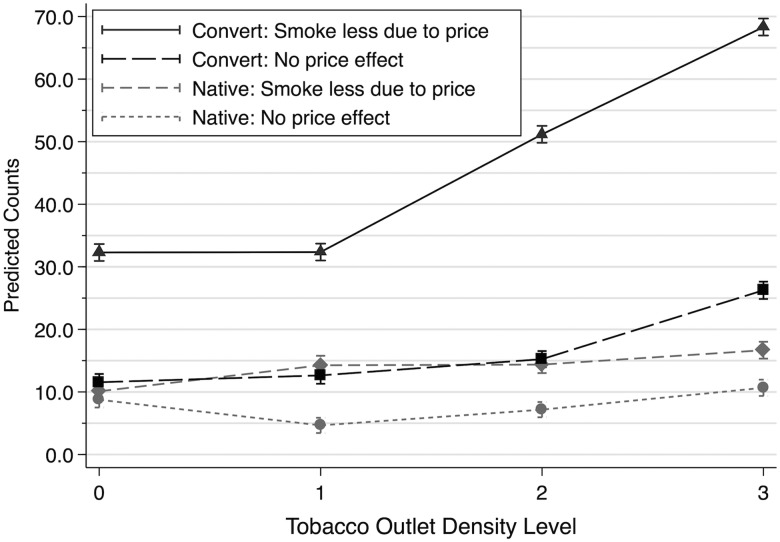
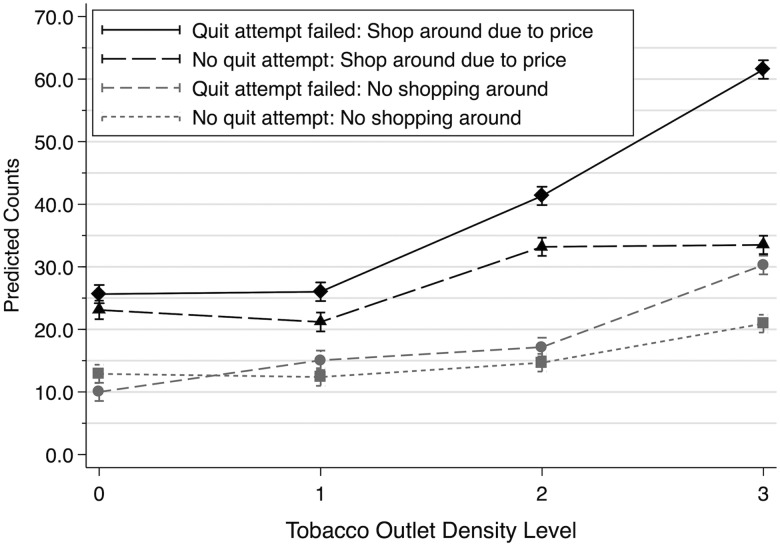
Overall, NDS in ZIP codes with greater outlet density were less likely than NDS in ZIP codes with lower outlet density to hold 6-month quit intentions when they also reported that price affected use patterns (G=66.1, p<0.001) and purchase locations (G=85.2, p<0.001). CNDS were more likely than NNDS to reside in ZIP codes with higher outlet density (G=322.0, p<0.001). Compared with CNDS in ZIP codes with lower outlet density, CNDS in high-density ZIP codes were more likely to report that price influenced the amount they smoke (G=43.9, p<0.001), and were more likely to look for better prices (G=59.3, p<0.001). NDS residing in high-density ZIP codes were not more likely to report that price affected their cigarette brand choice compared with those in ZIP codes with lower density.
This paper provides initial evidence that the point-of-sale cigarette environment may be differentially associated with the maintenance of CNDS versus NNDS patterns. Future research should investigate how tobacco control efforts can be optimised to both promote cessation and curb the rising tide of non-daily smoking in the USA.
调查非每日吸烟者(NDS)的香烟价格与购买偏好、近期戒烟尝试以及当前戒烟意愿是否与他们居住地址周围零售香烟产品格局的密度相关。
对904名转变为非每日吸烟者(CNDS,他们之前每天吸烟)和297名原生非每日吸烟者(NNDS,他们仅非每日吸烟)进行横断面评估,样本来自一个全国性小组。
使用核密度估计生成与参与者居住邮政编码相关的全国烟草销售点概率曲面。比较分层嵌套对数线性模型,以评估销售点密度、非每日使用模式、价格敏感性和戒烟意愿之间的关联。
总体而言,当居住在销售点密度较高邮政编码区域的非每日吸烟者报告价格影响使用模式(G = 66.1,p < 0.001)和购买地点(G = 85.2,p < 0.001)时,他们持有6个月戒烟意愿的可能性低于居住在销售点密度较低邮政编码区域的非每日吸烟者。转变为非每日吸烟者比原生非每日吸烟者更有可能居住在销售点密度较高的邮政编码区域(G = 322.0,p < 0.001)。与居住在销售点密度较低邮政编码区域的转变为非每日吸烟者相比,居住在高密度邮政编码区域的转变为非每日吸烟者更有可能报告价格影响他们的吸烟量(G = 43.9,p < 0.001),并且更有可能寻找更优惠的价格(G = 59.3,p < 0.001)。与居住在低密度邮政编码区域的非每日吸烟者相比,居住在高密度邮政编码区域的非每日吸烟者报告价格影响其香烟品牌选择的可能性并没有更高。
本文提供了初步证据,表明销售点香烟环境可能与转变为非每日吸烟者和原生非每日吸烟者模式的维持存在差异关联。未来的研究应调查如何优化烟草控制措施,以促进戒烟并遏制美国非每日吸烟率的上升趋势。