Steel Jennifer L, Geller David A, Kim Kevin H, Butterfield Lisa H, Spring Michael, Grady Jonathan, Sun Weiing, Marsh Wallis, Antoni Michael, Dew Mary Amanda, Helgeson Vicki, Schulz Richard, Tsung Allan
Department of Surgery, University of Pittsburgh School of Medicine, Pittsburgh, Pennsylvania.
Department of Surgery, University of Pittsburgh, Pittsburgh, Pennsylvania.
Cancer. 2016 Apr 15;122(8):1270-82. doi: 10.1002/cncr.29906. Epub 2016 Mar 11.
The aim of this study was to examine the efficacy of a collaborative care intervention in reducing depression, pain, and fatigue and improve quality of life.
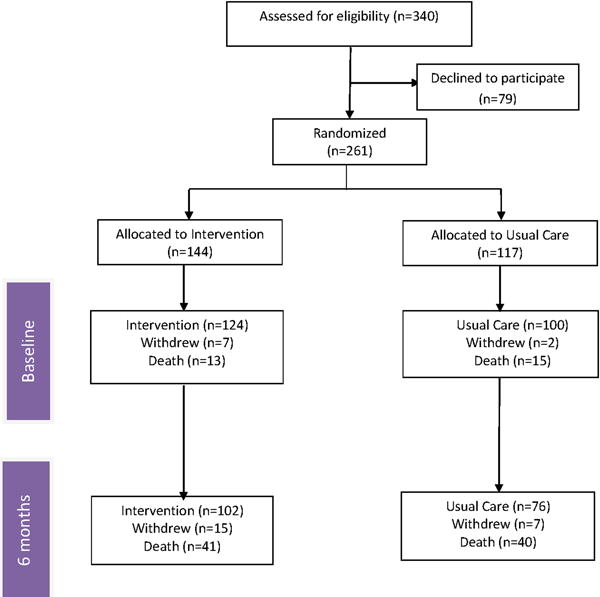
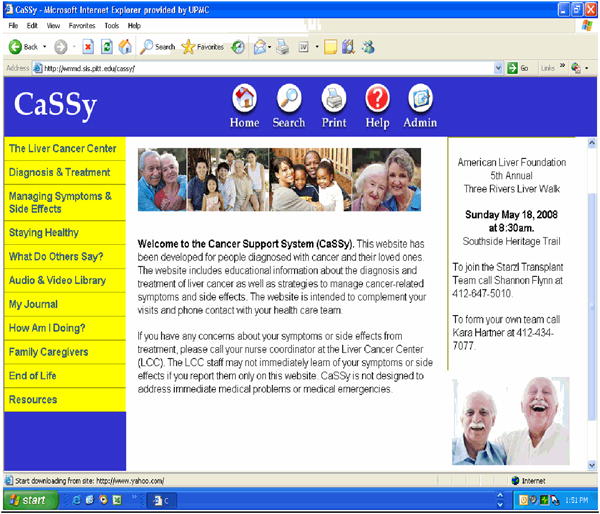
A total of 261 patients with advanced cancer and 179 family caregivers were randomized to a web-based collaborative care intervention or enhanced usual care. The intervention included the following: 1) a web site with written and audiovisual self-management strategies, a bulletin board, and other resources; 2) visits with a care coordinator during a physician's appointment every 2 months; and 3) telephone follow-up every 2 weeks. Primary patient outcomes included measures of depression, pain, fatigue, and health-related quality of life. Secondary outcomes included Interleukin (IL)-1α, IL-1β, IL-6, and IL-8 levels, Natural Killer (NK) cell numbers, and caregiver stress and depression.
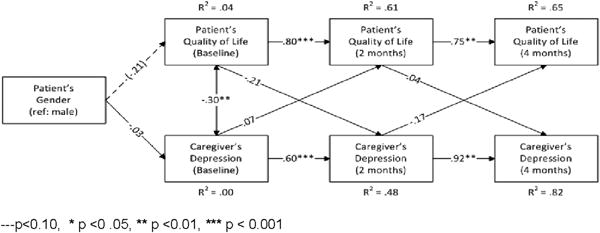
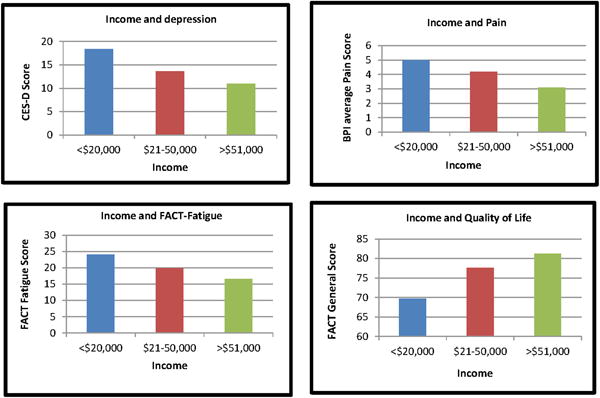
At the baseline, 51% of the patients reported 1 or more symptoms in the clinical range. For patients who presented with clinical levels of symptoms and were randomized to the intervention, reductions in depression (Cohen's d = 0.71), pain (Cohen's d = 0.62), and fatigue (Cohen's d = 0.26) and improvements in quality of life (Cohen's d = 0.99) were observed when compared to those in the enhanced usual car arm at 6 months. Reductions in IL-6 (φ = 0.18), IL-1β (φ = 0.35), IL-1α (φ = 0.19), and IL-8 (φ = 0.15) and increases in NK cell numbers (φ = 0.23) were observed in comparison with enhanced usual care arm at 6 months. Reductions in caregiver stress (Cohen's d = 0.75) and depression (Cohen's d = 0.37) were observed at 6 months for caregivers whose loved ones were randomized to the intervention arm.
The integration of screening and symptom management into cancer care is recommended.
本研究旨在探讨协作护理干预在减轻抑郁、疼痛和疲劳以及改善生活质量方面的效果。
共有261例晚期癌症患者和179名家庭照顾者被随机分为基于网络的协作护理干预组或强化常规护理组。干预措施包括:1)一个提供书面和视听自我管理策略、公告栏及其他资源的网站;2)每2个月在医生预约就诊期间与护理协调员进行面谈;3)每2周进行电话随访。患者的主要结局指标包括抑郁、疼痛、疲劳及与健康相关的生活质量的测量。次要结局指标包括白细胞介素(IL)-1α、IL-1β、IL-6和IL-8水平、自然杀伤(NK)细胞数量以及照顾者的压力和抑郁情况。
在基线时,51%的患者报告有1种或更多处于临床范围的症状。对于出现临床症状水平且被随机分配至干预组的患者,与强化常规护理组相比,在6个月时观察到抑郁(科恩d值 = 0.71)、疼痛(科恩d值 = 0.62)和疲劳(科恩d值 = 0.26)减轻,生活质量改善(科恩d值 = 0.99)。与强化常规护理组相比,在6个月时观察到IL-6(φ = 0.18)、IL-1β(φ = 0.35)、IL-1α(φ = 0.19)和IL-8(φ = 0.15)水平降低,NK细胞数量增加(φ = 0.23)。对于其亲人被随机分配至干预组的照顾者,在6个月时观察到照顾者压力(科恩d值 = 0.75)和抑郁(科恩d值 = 0.37)减轻。
建议将筛查和症状管理纳入癌症护理中。