Cataldi Amelia, Gallorini Marialucia, Di Giulio Mara, Guarnieri Simone, Mariggiò Maria Addolorata, Traini Tonino, Di Pietro Roberta, Cellini Luigina, Marsich Eleonora, Sancilio Silvia
Department of Pharmacy, G. d'Annunzio University, Chieti-Pescara, Via dei Vestini 31, 66100, Chieti Scalo, CH, Italy.
Center for Aging Science (Ce.S.I.), G. d'Annunzio University Foundation, Chieti, Italy.
J Mater Sci Mater Med. 2016 May;27(5):88. doi: 10.1007/s10856-016-5701-x. Epub 2016 Mar 12.
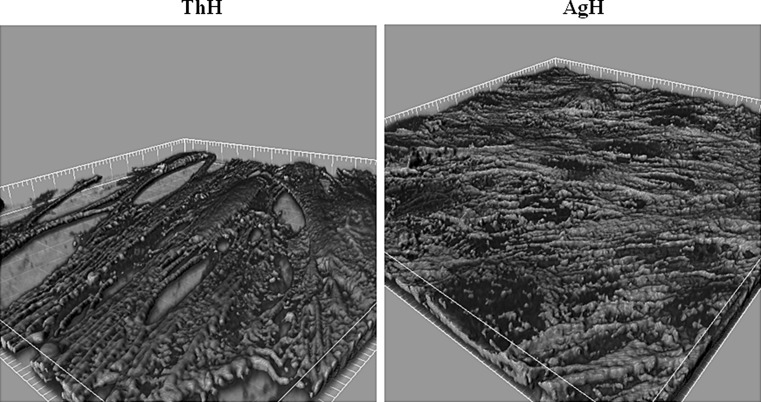
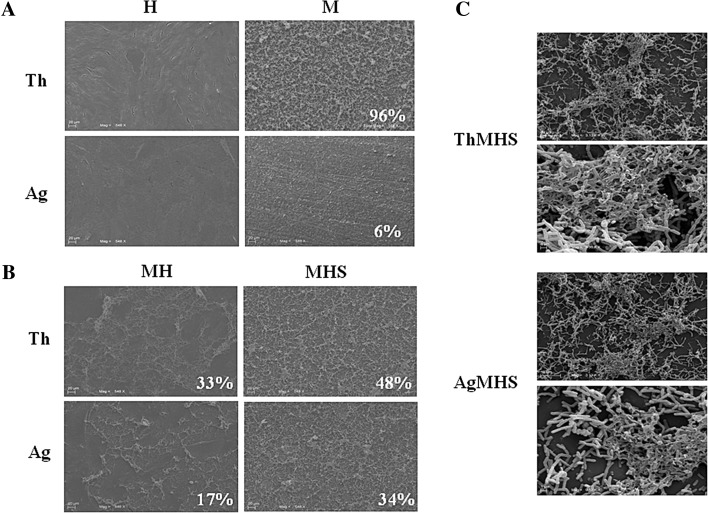
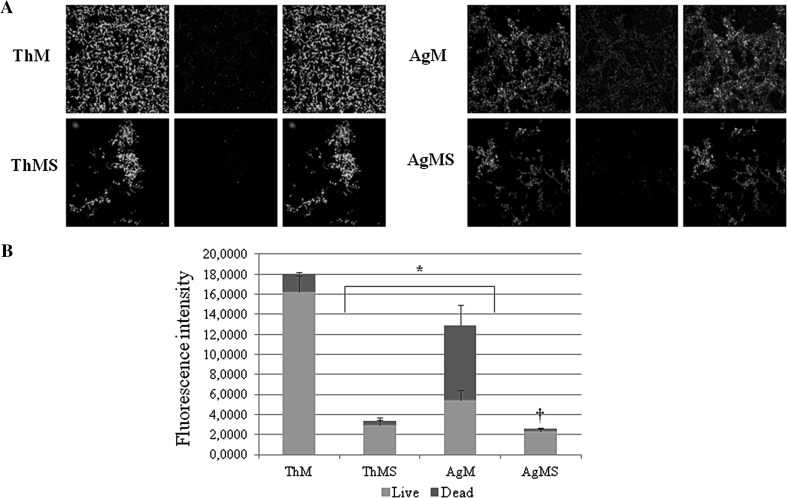
Composite materials are increasingly used as dental restoration. In the field of biomaterials, infections remain the main reason of dental devices failure. Silver, in the form of nanoparticles (AgNPs), ions and salt, well known for its antimicrobial properties, is used in several medical applications in order to avoid bacterial infection. To reduce both bacterial adhesion to dental devices and cytotoxicity against eukaryotic cells, we coated BisGMA/TEGDMA methacrylic thermosets with a new material, Chitlac-nAg, formed by stabilized AgNPs with a polyelectrolyte solution containing Chitlac. Here we analyzed the proliferative and adhesive ability of human gingival fibroblasts (HGFs) on BisGMA/TEGDMA thermosets uncoated and coated with AgNPs in a coculture model system with Streptococcus mitis. After 48 h, HGFs well adhered onto both surfaces, while S. mitis cytotoxic response was higher in the presence of AgNPs coated thermosets. After 24 h thermosets coated with Chitlac as well as those coated with Chitlac-nAg exerted a minimal cytotoxic effect on HGFs, while after 48 h LDH release raised up to 20 %. Moreover the presence of S. mitis reduced this release mainly when HGFs adhered to Chitlac-nAg coated thermosets. The reduced secretion of collagen type I was significant in the presence of both surfaces with the co-culture system even more when saliva is added. Integrin β1 localized closely to cell membranes onto Chitlac-nAg thermosets and PKCα translocated into nuclei. These data confirm that Chitlac-nAg have a promising utilization in the field of restorative dentistry exerting their antimicrobial activity due to AgNPs without cytotoxicity for eukaryotic cells.
复合材料越来越多地被用作牙齿修复材料。在生物材料领域,感染仍然是牙科器械失效的主要原因。银以纳米颗粒(AgNPs)、离子和盐的形式存在,因其抗菌特性而闻名,被用于多种医疗应用中以避免细菌感染。为了减少细菌对牙科器械的粘附以及对真核细胞的细胞毒性,我们用一种新材料Chitlac-nAg涂覆了BisGMA/TEGDMA甲基丙烯酸热固性材料,该材料由稳定的AgNPs与含有Chitlac的聚电解质溶液形成。在此,我们在与缓症链球菌的共培养模型系统中分析了人牙龈成纤维细胞(HGFs)在未涂覆和涂覆有AgNPs的BisGMA/TEGDMA热固性材料上的增殖和粘附能力。48小时后,HGFs在两种表面上都能良好粘附,而在涂覆有AgNPs的热固性材料存在时,缓症链球菌的细胞毒性反应更高。24小时后,涂覆有Chitlac以及涂覆有Chitlac-nAg的热固性材料对HGFs产生的细胞毒性作用最小,而48小时后乳酸脱氢酶(LDH)释放量上升至20%。此外,缓症链球菌的存在主要在HGFs粘附于涂覆有Chitlac-nAg的热固性材料时减少了这种释放。在共培养系统中,当加入唾液时,两种表面存在时I型胶原蛋白分泌的减少更为显著。整合素β1紧密定位于Chitlac-nAg热固性材料的细胞膜上,蛋白激酶Cα(PKCα)转移到细胞核中。这些数据证实,Chitlac-nAg在修复牙科领域具有广阔的应用前景,由于AgNPs具有抗菌活性且对真核细胞无细胞毒性。