Shandong Provincial Key Laboratory of Oral Tissue Regeneration, School of Stomatology, Shandong University, Jinan 250012, China.
Department of Periodontology, School of Stomatology, Shandong University, Jinan 250012, China.
Molecules. 2019 Mar 15;24(6):1033. doi: 10.3390/molecules24061033.
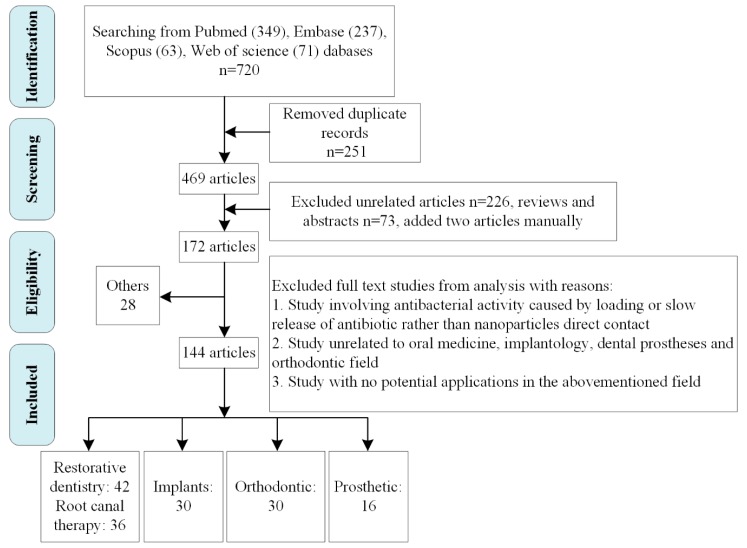
Oral cavity incessantly encounters a plethora of microorganisms. Plaque biofilm-a major cause of caries, periodontitis and other dental diseases-is a complex community of bacteria or fungi that causes infection by protecting pathogenic microorganisms from external drug agents and escaping the host defense mechanisms. Antimicrobial nanoparticles are promising because of several advantages such as ultra-small sizes, large surface-area-to-mass ratio and special physical and chemical properties. To better summarize explorations of antimicrobial nanoparticles and provide directions for future studies, we present the following critical review. The keywords "nanoparticle," "anti-infective or antibacterial or antimicrobial" and "dentistry" were retrieved from Pubmed, Scopus, Embase and Web of Science databases in the last five years. A total of 172 articles met the requirements were included and discussed in this review. The results show that superior antibacterial properties of nanoparticle biomaterials bring broad prospects in the oral field. This review presents the development, applications and underneath mechanisms of antibacterial nanoparticles in dentistry including restorative dentistry, endodontics, implantology, orthodontics, dental prostheses and periodontal field.
口腔不断接触到大量的微生物。菌斑生物膜是龋齿、牙周炎和其他口腔疾病的主要原因,它是一种由细菌或真菌组成的复杂群落,通过保护致病微生物免受外部药物制剂的侵害并逃避宿主防御机制来引起感染。由于具有超小尺寸、大表面积与质量比以及特殊的物理和化学性质等优势,抗菌纳米颗粒具有广阔的应用前景。为了更好地总结抗菌纳米颗粒的研究进展并为未来的研究提供方向,我们进行了此次关键性综述。关键词“纳米颗粒”“抗感染或抗菌或抗微生物”和“牙科”在过去五年中从 Pubmed、Scopus、Embase 和 Web of Science 数据库中检索,共有 172 篇符合要求的文章被纳入并在本综述中进行了讨论。结果表明,纳米颗粒生物材料卓越的抗菌性能在口腔领域带来了广阔的前景。本综述介绍了抗菌纳米颗粒在修复牙科、牙髓学、种植学、正畸学、牙科假体和牙周领域的发展、应用和潜在机制。