Ranjbar Reza, Khamesipour Faham, Jonaidi-Jafari Nematollah, Rahimi Ebrahim
Molecular Biology Research Center, Baqiyatallah University of Medical Sciences, Tehran, Iran.
Cellular and Molecular Research Center, Sabzevar University of Medical Sciences, Sabzevar, Iran.
BMC Microbiol. 2016 Mar 12;16:40. doi: 10.1186/s12866-016-0647-1.
Up to now, fecal-oral and oral-oral are the most commonly known routes for transmission of H. pylori, therefore, contaminated water can play an important role in transmission of H. pylori to humans. Genotyping using virulence markers of H. pylori is one of the best approaches to study the correlations between H. pylori isolates from different samples. The present research was carried out to study the vacA, cagA, cagE, oipA, iceA and babA2 genotyping and antimicrobial resistance properties of H. pylori isolated from the bottled mineral water samples of Iran.
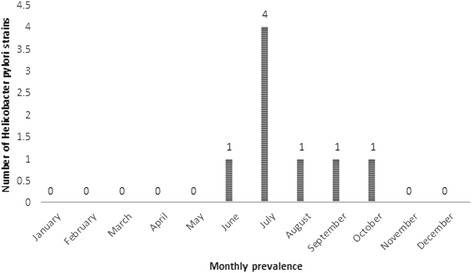
Of 450 samples studied, 8 samples (1.77%) were contaminated with H. pylori. Brand C of bottled mineral water had the highest prevalence of H. pylori (3.63%). The bottled mineral water samples of July month had the highest levels of H. pylori-contamination (50%). H. pylori strains had the highest levels of resistance against metronidazole (62.5%), erythromycin (62.5%), clarithromycin (62.5%), amoxicillin (62.5%) and trimethoprim (62.5%). Totally, 12.5% of strains were resistant to more than 6 antibiotics. VvacAs1a (100%), vacAm1a (87.5%), cagA (62.5%), iceA1 (62.5%), oipA (25%), babA2 (25%) and cagE (37.5%) were the most commonly detected genotypes. M1as1a (62.5%), m1as2 (37.5%), m2s2 (37.5%) and S1a/cagA+/IceA2/oipA-/babA2-/cagE- (50%) were the most commonly detected combined genotypes.
Contaminated bottled mineral water maybe the sources of virulent and resistant strains H. pylori. Careful monitoring of bottled mineral water production may reduce the risk of H. pylori transmission into the human population.
到目前为止,粪口传播和口口传播是幽门螺杆菌最常见的传播途径,因此,受污染的水在幽门螺杆菌传播给人类的过程中可能起重要作用。利用幽门螺杆菌的毒力标记进行基因分型是研究不同样本中幽门螺杆菌分离株之间相关性的最佳方法之一。本研究旨在对从伊朗瓶装矿泉水样本中分离出的幽门螺杆菌进行vacA、cagA、cagE、oipA、iceA和babA2基因分型及抗菌药物耐药性研究。
在研究的450个样本中,有8个样本(1.77%)被幽门螺杆菌污染。品牌C的瓶装矿泉水幽门螺杆菌污染率最高(3.63%)。7月份的瓶装矿泉水样本幽门螺杆菌污染水平最高(50%)。幽门螺杆菌菌株对甲硝唑(耐药率62.5%)、红霉素(耐药率62.5%)、克拉霉素(耐药率62.5%)、阿莫西林(耐药率62.5%)和甲氧苄啶(耐药率62.5%)的耐药水平最高。总体而言,12.5%的菌株对6种以上抗生素耐药。最常检测到的基因型为VvacAs1a(100%)、vacAm1a(87.5%)、cagA(62.5%)、iceA1(62.5%)、oipA(25%)、babA2(25%)和cagE(37.5%)。最常检测到的组合基因型为M1as1a(62.5%)、m1as2(37.5%)、m2s2(37.5%)和S1a/cagA+/IceA2/oipA-/babA2-/cagE-(50%)。
受污染的瓶装矿泉水可能是幽门螺杆菌毒力和耐药菌株的来源。对瓶装矿泉水生产进行严格监测可能会降低幽门螺杆菌传播给人群的风险。