Yang Shanshan, Fresnedo-Ramírez Jonathan, Sun Qi, Manns David C, Sacks Gavin L, Mansfield Anna Katharine, Luby James J, Londo Jason P, Reisch Bruce I, Cadle-Davidson Lance E, Fennell Anne Y
Horticulture Section, School of Integrative Plant Science, Cornell University, Geneva, New York, United States of America.
Bioinformatics Facility, Institute of Biotechnology, Cornell University, Rhodes Hall, Ithaca, New York, United States of America.
PLoS One. 2016 Mar 14;11(3):e0149560. doi: 10.1371/journal.pone.0149560. eCollection 2016.
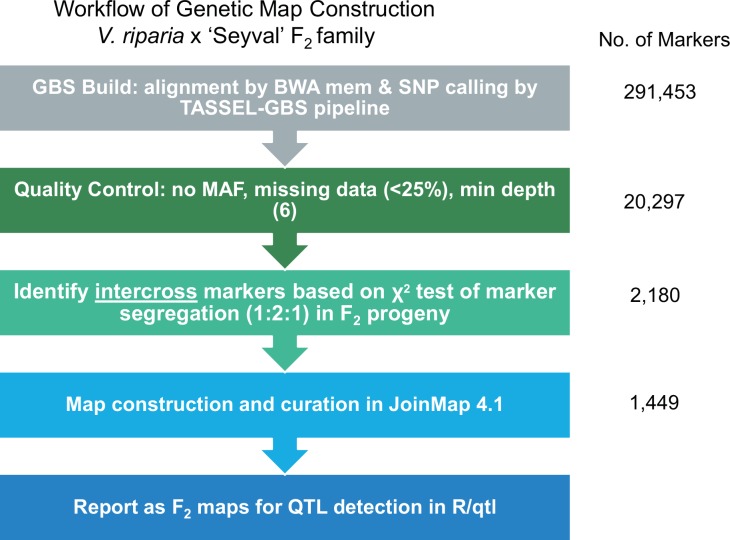
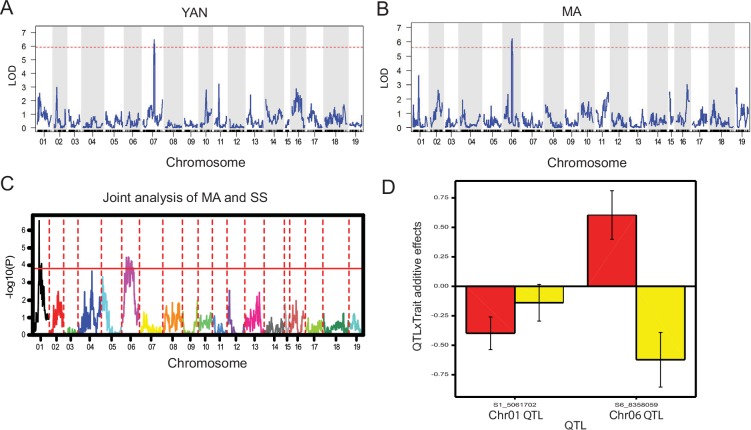
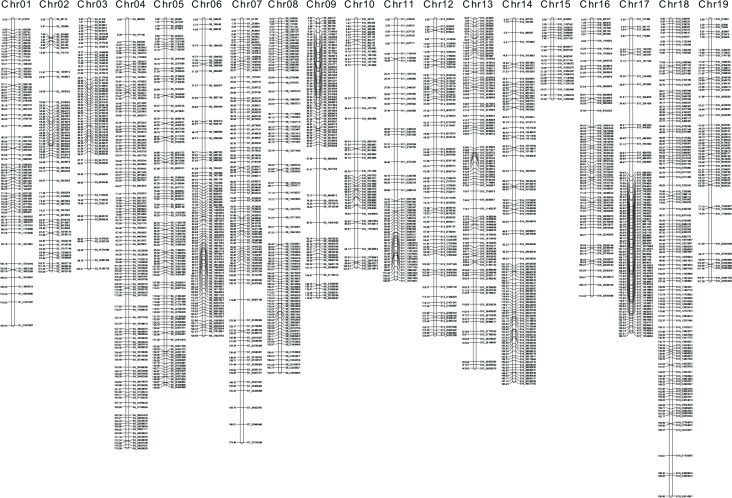
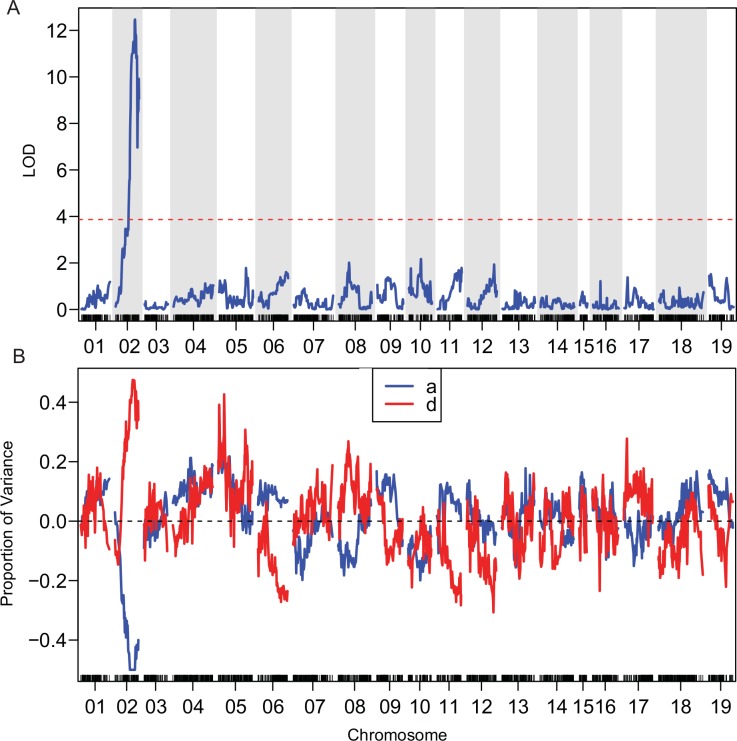
In winegrapes (Vitis spp.), fruit quality traits such as berry color, total soluble solids content (SS), malic acid content (MA), and yeast assimilable nitrogen (YAN) affect fermentation or wine quality, and are important traits in selecting new hybrid winegrape cultivars. Given the high genetic diversity and heterozygosity of Vitis species and their tendency to exhibit inbreeding depression, linkage map construction and quantitative trait locus (QTL) mapping has relied on F1 families with the use of simple sequence repeat (SSR) and other markers. This study presents the construction of a genetic map by single nucleotide polymorphisms identified through genotyping-by-sequencing (GBS) technology in an F2 mapping family of 424 progeny derived from a cross between the wild species V. riparia Michx. and the interspecific hybrid winegrape cultivar, 'Seyval'. The resulting map has 1449 markers spanning 2424 cM in genetic length across 19 linkage groups, covering 95% of the genome with an average distance between markers of 1.67 cM. Compared to an SSR map previously developed for this F2 family, these results represent an improved map covering a greater portion of the genome with higher marker density. The accuracy of the map was validated using the well-studied trait berry color. QTL affecting YAN, MA and SS related traits were detected. A joint MA and SS QTL spans a region with candidate genes involved in the malate metabolism pathway. We present an analytical pipeline for calling intercross GBS markers and a high-density linkage map for a large F2 family of the highly heterozygous Vitis genus. This study serves as a model for further genetic investigations of the molecular basis of additional unique characters of North American hybrid wine cultivars and to enhance the breeding process by marker-assisted selection. The GBS protocols for identifying intercross markers developed in this study can be adapted for other heterozygous species.
在酿酒葡萄(葡萄属)中,果实品质性状如浆果颜色、总可溶性固形物含量(SS)、苹果酸含量(MA)和酵母可同化氮(YAN)会影响发酵过程或葡萄酒品质,并且是选择新的杂交酿酒葡萄品种的重要性状。鉴于葡萄属物种具有高度的遗传多样性和杂合性,且有表现出近交衰退的倾向,连锁图谱构建和数量性状基因座(QTL)定位一直依赖于利用简单序列重复(SSR)和其他标记的F1家系。本研究展示了通过基因分型测序(GBS)技术在一个由野生种河岸葡萄(Vitis riparia Michx.)与种间杂交酿酒葡萄品种‘赛瓦尔’杂交产生的424个后代的F2作图群体中鉴定单核苷酸多态性来构建遗传图谱。所得图谱有1449个标记,遗传长度跨越2424厘摩,分布在19个连锁群上,覆盖了95%的基因组,标记间平均距离为1.67厘摩。与之前为这个F2群体构建的SSR图谱相比,这些结果代表了一个改进的图谱,覆盖了基因组中更大的部分且标记密度更高。利用已充分研究的性状浆果颜色验证了图谱的准确性。检测到了影响YAN、MA和与SS相关性状的QTL。一个联合的MA和SS QTL跨越了一个包含参与苹果酸代谢途径候选基因的区域。我们提出了一个用于调用杂交GBS标记的分析流程以及一个针对高度杂合的葡萄属的大型F2群体的高密度连锁图谱。本研究为进一步开展北美杂交葡萄酒品种其他独特性状分子基础的遗传研究以及通过标记辅助选择来优化育种过程提供了一个范例。本研究中开发的用于鉴定杂交标记的GBS方案可适用于其他杂合物种。