Wiley Matthew T, Rivas Ryan L, Hristidis Vagelis
Department of Computer Science and Engineering, University of California, Riverside, CA, USA.
SmartDocFinder LLC, 3499 10th Street, Riverside, CA, USA.
BMC Health Serv Res. 2016 Mar 14;16:90. doi: 10.1186/s12913-016-1338-1.
There has been a recent growth in health provider search portals, where patients specify filters-such as specialty or insurance-and providers are ranked by patient ratings or other attributes. Previous work has identified attributes associated with a provider's quality through user surveys. Other work supports that intuitive quality-indicating attributes are associated with a provider's quality.
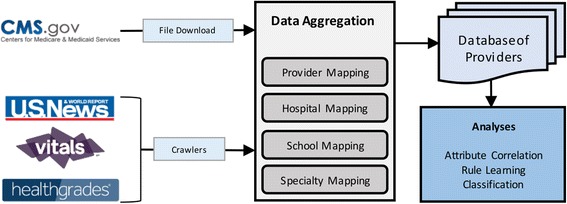
We adopt a data-driven approach to study how quality indicators of providers are associated with a rich set of attributes including medical school, graduation year, procedures, fellowships, patient reviews, location, and technology usage. In this work, we only consider providers as individuals (e.g., general practitioners) and not organizations (e.g., hospitals). As quality indicators, we consider the referral frequency of a provider and a peer-nominated quality designation. We combined data from the Centers for Medicare and Medicaid Services (CMS) and several provider rating web sites to perform our analysis.
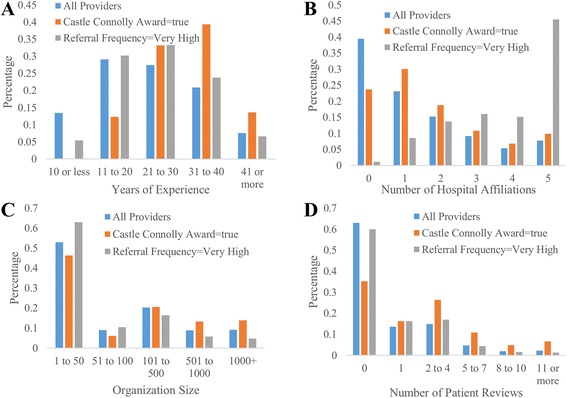
Our data-driven analysis identified several attributes that correlate with and discriminate against referral volume and peer-nominated awards. In particular, our results consistently demonstrate that these attributes vary by locality and that the frequency of an attribute is more important than its value (e.g., the number of patient reviews or hospital affiliations are more important than the average review rating or the ranking of the hospital affiliations, respectively). We demonstrate that it is possible to build accurate classifiers for referral frequency and quality designation, with accuracies over 85 %.
Our findings show that a one-size-fits-all approach to ranking providers is inadequate and that provider search portals should calibrate their ranking function based on location and specialty. Further, traditional filters of provider search portals should be reconsidered, and patients should be aware of existing pitfalls with these filters and educated on local factors that affect quality. These findings enable provider search portals to empower patients and to "load balance" patients between younger and older providers.
近期,医疗服务提供者搜索平台不断增多,患者可设定诸如专业或保险等筛选条件,平台会根据患者评分或其他属性对医疗服务提供者进行排名。此前的研究通过用户调查确定了与医疗服务提供者质量相关的属性。其他研究也表明,直观的质量指示属性与医疗服务提供者的质量相关。
我们采用数据驱动的方法来研究医疗服务提供者的质量指标如何与一系列丰富的属性相关联,这些属性包括医学院校、毕业年份、诊疗程序、进修经历、患者评价、地理位置和技术使用情况等。在本研究中,我们仅将医疗服务提供者视为个体(如全科医生),而非组织(如医院)。作为质量指标,我们考虑了医疗服务提供者的转诊频率和同行提名的质量认定。我们整合了医疗保险和医疗补助服务中心(CMS)以及多个医疗服务提供者评级网站的数据来进行分析。
我们的数据驱动分析确定了几个与转诊量和同行提名奖项相关且具有区分性的属性。具体而言,我们的结果一致表明,这些属性因地区而异,且属性的频率比其值更为重要(例如,患者评价的数量或医院附属关系的数量分别比平均评价评分或医院附属关系的排名更为重要)。我们证明,有可能构建出针对转诊频率和质量认定的准确分类器,准确率超过85%。
我们的研究结果表明,采用一刀切的方法对医疗服务提供者进行排名是不够的,医疗服务提供者搜索平台应根据地理位置和专业来校准其排名功能。此外,应重新考虑医疗服务提供者搜索平台的传统筛选条件,患者应了解这些筛选条件存在的问题,并接受有关影响质量的当地因素的教育。这些研究结果使医疗服务提供者搜索平台能够帮助患者,并在年轻和年长的医疗服务提供者之间实现患者的“负载平衡”。