Jaworska Natalia, MacMaster Frank P, Foster Jane, Ramasubbu Rajamannar
Department of Psychiatry, McGill University, Montreal, PQ, Canada.
Department of Psychiatry, Mathison Centre for Mental Health Research & Education, University of Calgary, #4D64 TRW Building, 3280 Hospital Drive NW, Calgary, AB, T2N4Z6, Canada.
BMC Psychiatry. 2016 Mar 15;16:61. doi: 10.1186/s12888-016-0777-x.
Structural brain abnormalities have been investigated in multi-genetic and complex disorders such as major depressive disorder (MDD). Among the various candidate genes implicated in MDD, the brain-derived neurotrophic factor (BDNF) Val66Met polymorphism and 5-HT transporter gene linked polymorphism (5-HTTLPR) have garnered the most attention due to their putative roles in neural plasticity and antidepressant response. However, relatively few studies have assessed the influence of these polymorphysims on cortical thickness or brain volume in para-limbic and limbic regions in MDD, which was the aim of this study.
Forty-three adults with MDD and 15 healthy controls (HC) underwent structural magnetic resonance imaging (MRI). Cortical thickness was assessed in frontal, cingulate and temporal regions. Volumetric measures were carried out in the thalamus, caudate, putamen, pallidum, hippocampus and amygdala. Participants were genotyped to determine their 5-HTTLPR (tri-allelic) and Val66Met polymorphisms.
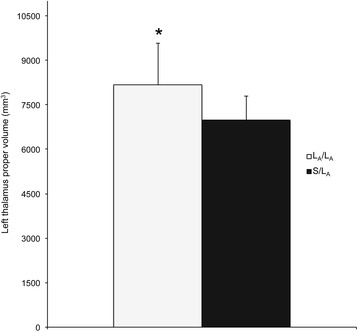
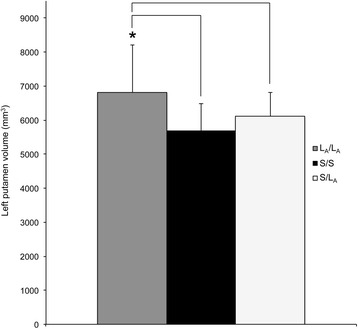
In the combined sample (MDD + HC), smaller right pallidum volumes were found in LA/S (LA/S & LA/LG) heterozygotes compared to S/S (S/S, LG/S & LG/LG) homozygotes, though the effect was modest. In the MDD group, larger left thalamus and putamen volumes were observed in LA/LA homozygotes. No Val66Met or 5-HTTLPR genotype effects existed on cortical thickness and no main effects of the Val66Met polymorphism were observed.
Our preliminary results suggest that the 5-HTTLPR polymorphism is associated with morphometric changes in regions known to play an important role in emotional and reward processing in depression. A larger sample size is required to replicate these findings and to potentially reveal subtle morphometric changes.
在诸如重度抑郁症(MDD)等多基因复杂疾病中,已经对大脑结构异常进行了研究。在与MDD相关的各种候选基因中,脑源性神经营养因子(BDNF)Val66Met多态性和5-羟色胺转运体基因连锁多态性(5-HTTLPR)因其在神经可塑性和抗抑郁反应中的假定作用而备受关注。然而,相对较少的研究评估了这些多态性对MDD患者边缘旁和边缘区域皮质厚度或脑容量的影响,这正是本研究的目的。
43名成年MDD患者和15名健康对照(HC)接受了结构磁共振成像(MRI)检查。评估了额叶、扣带回和颞叶区域的皮质厚度。对丘脑、尾状核、壳核、苍白球、海马体和杏仁核进行了体积测量。对参与者进行基因分型以确定其5-HTTLPR(三等位基因)和Val66Met多态性。
在合并样本(MDD + HC)中,与S/S(S/S、LG/S和LG/LG)纯合子相比,LA/S(LA/S和LA/LG)杂合子的右侧苍白球体积较小,尽管影响较小。在MDD组中,LA/LA纯合子的左侧丘脑和壳核体积较大。Val66Met或5-HTTLPR基因型对皮质厚度没有影响,且未观察到Val66Met多态性的主要影响。
我们的初步结果表明,5-HTTLPR多态性与已知在抑郁症的情绪和奖赏处理中起重要作用的区域的形态学变化有关。需要更大的样本量来重复这些发现,并有可能揭示细微的形态学变化。