Hollander Anna-Clara, Dal Henrik, Lewis Glyn, Magnusson Cecilia, Kirkbride James B, Dalman Christina
Department of Public Health Sciences, Karolinska Institutet, 171 77 Stockholm, Sweden
Centre for Epidemiology and Community Medicine, Stockholm County Council, SE-171 77 Stockholm, Sweden.
BMJ. 2016 Mar 15;352:i1030. doi: 10.1136/bmj.i1030.
To determine whether refugees are at elevated risk of schizophrenia and other non-affective psychotic disorders, relative to non-refugee migrants from similar regions of origin and the Swedish-born population.
Cohort study of people living in Sweden, born after 1 January 1984 and followed from their 14th birthday or arrival in Sweden, if later, until diagnosis of a non-affective psychotic disorder, emigration, death, or 31 December 2011.
Linked Swedish national register data.
1,347,790 people, including people born in Sweden to two Swedish-born parents (1,191,004; 88.4%), refugees (24,123; 1.8%), and non-refugee migrants (132,663; 9.8%) from four major refugee generating regions: the Middle East and north Africa, sub-Saharan Africa, Asia, and Eastern Europe and Russia.
Cox regression analysis was used to estimate adjusted hazard ratios for non-affective psychotic disorders by refugee status and region of origin, controlling for age at risk, sex, disposable income, and population density.
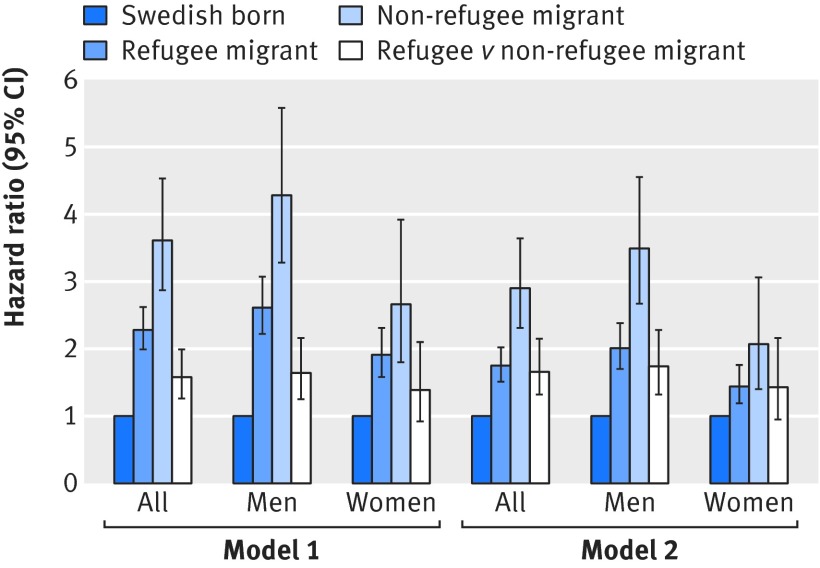
3704 cases of non-affective psychotic disorder were identified during 8.9 million person years of follow-up. The crude incidence rate was 38.5 (95% confidence interval 37.2 to 39.9) per 100,000 person years in the Swedish-born population, 80.4 (72.7 to 88.9) per 100,000 person years in non-refugee migrants, and 126.4 (103.1 to 154.8) per 100,000 person years in refugees. Refugees were at increased risk of psychosis compared with both the Swedish-born population (adjusted hazard ratio 2.9, 95% confidence interval 2.3 to 3.6) and non-refugee migrants (1.7, 1.3 to 2.1) after adjustment for confounders. The increased rate in refugees compared with non-refugee migrants was more pronounced in men (likelihood ratio test for interaction χ(2) (df=2) z=13.5; P=0.001) and was present for refugees from all regions except sub-Saharan Africa. Both refugees and non-refugee migrants from sub-Saharan Africa had similarly high rates relative to the Swedish-born population.
Refugees face an increased risk of schizophrenia and other non-affective psychotic disorders compared with non-refugee migrants from similar regions of origin and the native-born Swedish population. Clinicians and health service planners in refugee receiving countries should be aware of a raised risk of psychosis in addition to other mental and physical health inequalities experienced by refugees.
确定相对于来自相似原籍地区的非难民移民和瑞典出生人口,难民患精神分裂症及其他非情感性精神障碍的风险是否更高。
对1984年1月1日后出生且居住在瑞典的人群进行队列研究,从其14岁生日或抵达瑞典之日(若更晚)开始随访,直至诊断出非情感性精神障碍、移民、死亡或2011年12月31日。
瑞典国家登记数据联动。
1347790人,包括父母均为瑞典出生的瑞典本土出生者(1191004人,占88.4%)、难民(24123人,占1.8%)以及来自四个主要难民来源地区的非难民移民(132663人,占9.8%),这四个地区为中东和北非、撒哈拉以南非洲、亚洲以及东欧和俄罗斯。
采用Cox回归分析,通过难民身份和原籍地区估计非情感性精神障碍的调整风险比,同时控制风险年龄、性别、可支配收入和人口密度。
在890万人年的随访期间,共确诊3704例非情感性精神障碍病例。瑞典本土出生人群的粗发病率为每10万人年38.5例(95%置信区间37.2至39.9),非难民移民为每10万人年80.4例(72.7至88.9),难民为每10万人年126.4例(103.1至154.8)。调整混杂因素后,难民患精神病的风险高于瑞典本土出生人群(调整风险比2.9,95%置信区间2.3至3.6)和非难民移民(1.7,1.3至2.1)。难民与非难民移民相比,发病率的增加在男性中更为明显(交互作用似然比检验χ(²)(自由度 = 2)z = 13.5;P = 0.001),且除撒哈拉以南非洲外,其他地区的难民均存在这种情况。撒哈拉以南非洲的难民和非难民移民相对于瑞典本土出生人群的发病率同样较高。
与来自相似原籍地区的非难民移民和瑞典本土出生人口相比,难民患精神分裂症及其他非情感性精神障碍的风险更高。难民接收国的临床医生和卫生服务规划者除了应意识到难民在其他身心健康方面存在不平等外,还应注意到他们患精神病的风险增加。