Fraser John F, Spooner Amy J, Dunster Kimble R, Anstey Chris M, Corley Amanda
Critical Care Research Group, The Prince Charles Hospital and University of Queensland, Brisbane, Australia.
Critical Care Research Group, The Prince Charles Hospital and University of Queensland, Brisbane, Australia Biomedical Engineering and Medical Physics, Science and Engineering Faculty, Queensland University of Technology, Brisbane, Australia.
Thorax. 2016 Aug;71(8):759-61. doi: 10.1136/thoraxjnl-2015-207962. Epub 2016 Mar 25.
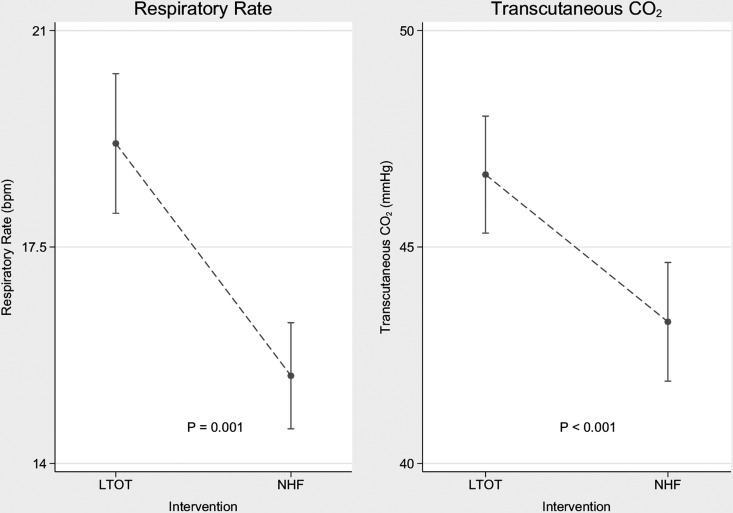
Patients with COPD using long-term oxygen therapy (LTOT) over 15 h per day have improved outcomes. As inhalation of dry cold gas is detrimental to mucociliary clearance, humidified nasal high flow (NHF) oxygen may reduce frequency of exacerbations, while improving lung function and quality of life in this cohort. In this randomised crossover study, we assessed short-term physiological responses to NHF therapy in 30 males chronically treated with LTOT. LTOT (2-4 L/min) through nasal cannula was compared with NHF at 30 L/min from an AIRVO through an Optiflow nasal interface with entrained supplemental oxygen. Comparing NHF with LTOT: transcutaneous carbon dioxide (TcCO2) (43.3 vs 46.7 mm Hg, p<0.001), transcutaneous oxygen (TcO2) (97.1 vs 101.2 mm Hg, p=0.01), I:E ratio (0.75 vs 0.86, p=0.02) and respiratory rate (RR) (15.4 vs 19.2 bpm, p<0.001) were lower; and tidal volume (Vt) (0.50 vs 0.40, p=0.003) and end-expiratory lung volume (EELV) (174% vs 113%, p<0.001) were higher. EELV is expressed as relative change from baseline (%Δ). Subjective dyspnoea and interface comfort favoured LTOT. NHF decreased TcCO2, I:E ratio and RR, with a concurrent increase in EELV and Vt compared with LTOT. This demonstrates a potential mechanistic rationale behind the improved outcomes observed in long-term treatment with NHF in oxygen-dependent patients.
ACTRN12613000028707.
每天接受超过15小时长期氧疗(LTOT)的慢性阻塞性肺疾病(COPD)患者预后得到改善。由于吸入干冷气体对黏液纤毛清除功能有害,经鼻高流量湿化(NHF)吸氧可能会减少急性加重的频率,同时改善该队列患者的肺功能和生活质量。在这项随机交叉研究中,我们评估了30名长期接受LTOT治疗的男性患者对NHF治疗的短期生理反应。通过鼻导管进行的LTOT(2 - 4升/分钟)与通过Optiflow鼻接口连接AIRVO以30升/分钟的速度输送并夹带补充氧气的NHF进行比较。将NHF与LTOT比较:经皮二氧化碳(TcCO2)(43.3对46.7毫米汞柱,p<0.001)、经皮氧(TcO2)(97.1对101.2毫米汞柱,p = 0.01)、I:E比值(0.75对0.86,p = 0.02)和呼吸频率(RR)(15.4对19.2次/分钟,p<0.001)较低;潮气量(Vt)(0.50对0.40,p = 0.003)和呼气末肺容积(EELV)(174%对113%,p<0.001)较高。EELV表示为相对于基线的相对变化(%Δ)。主观呼吸困难和接口舒适度方面LTOT更具优势。与LTOT相比,NHF降低了TcCO2、I:E比值和RR,同时EELV和Vt增加。这证明了在依赖氧气的患者中长期使用NHF治疗观察到预后改善背后的潜在机制原理。
ACTRN12613000028