Green Adam E, Mays Darren, Falk Emily B, Vallone Donna, Gallagher Natalie, Richardson Amanda, Tercyak Kenneth P, Abrams David B, Niaura Raymond S
Department of Psychology, Georgetown University, Washington, DC.
Georgetown University Medical Center, Lombardi Comprehensive Cancer Center, Washington, DC.
Addict Behav Rep. 2016 Jun 1;3:28-32. doi: 10.1016/j.abrep.2016.02.001.
The study examined young adult smokers' neural response to graphic warning labels (GWLs) on cigarette packs using functional magnetic resonance imaging (fMRI).
Nineteen young adult smokers ( age 22.9, 52.6% male, 68.4% non-white, 4.3 cigarettes/day) completed pre-scan, self-report measures of demographics, cigarette smoking behavior, and nicotine dependence, and an fMRI scanning session. During the scanning session participants viewed cigarette pack images (total 64 stimuli, viewed 4 seconds each) that varied based on the warning label (graphic or visually occluded control) and pack branding (branded or plain packaging) in an event-related experimental design. Participants reported motivation to quit (MTQ) in response to each image using a push-button control. Whole-brain blood oxygenation level-dependent (BOLD) functional images were acquired during the task.
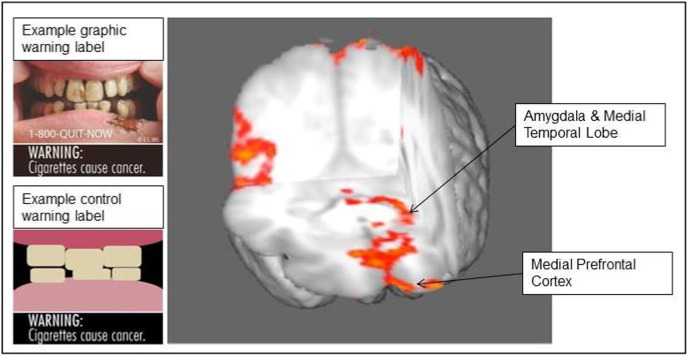
GWLs produced significantly greater self-reported MTQ than control warnings ( < .001). Imaging data indicate stronger neural activation in response to GWLs than the control warnings at a cluster-corrected threshold <.001 in medial prefrontal cortex, amygdala, medial temporal lobe, and occipital cortex. There were no significant differences in response to warnings on branded versus plain cigarette packages.
In this sample of young adult smokers, GWLs promoted neural activation in brain regions involved in cognitive and affective decision-making and memory formation and the effects of GWLs did not differ on branded or plain cigarette packaging. These findings complement other recent neuroimaging GWL studies conducted with older adult smokers and with adolescents by demonstrating similar patterns of neural activation in response to GWLs among young adult smokers.
本研究使用功能磁共振成像(fMRI)检查了年轻成年吸烟者对香烟包装上图形警告标签(GWLs)的神经反应。
19名年轻成年吸烟者(年龄22.9岁,52.6%为男性,68.4%为非白人,每天吸食4.3支香烟)完成了扫描前的人口统计学、吸烟行为和尼古丁依赖的自我报告测量,以及一次fMRI扫描。在扫描过程中,参与者观看香烟包装图像(共64个刺激物,每个观看4秒),这些图像根据警告标签(图形或视觉遮挡对照)和包装品牌(有品牌或无品牌包装)在事件相关实验设计中有所不同。参与者通过按钮控制报告对每张图像的戒烟动机(MTQ)。在任务过程中获取全脑血氧水平依赖(BOLD)功能图像。
与对照警告相比,GWLs产生的自我报告MTQ显著更高(<0.001)。成像数据表明,在内侧前额叶皮层、杏仁核、内侧颞叶和枕叶皮层,在簇校正阈值<0.001时,对GWLs的神经激活比对对照警告更强。对有品牌和无品牌香烟包装上的警告的反应没有显著差异。
在这个年轻成年吸烟者样本中,GWLs促进了参与认知和情感决策以及记忆形成的脑区的神经激活,并且GWLs对有品牌或无品牌香烟包装的影响没有差异。这些发现通过展示年轻成年吸烟者对GWLs的类似神经激活模式,补充了最近对老年成年吸烟者和青少年进行的其他神经影像学GWL研究。