McLellan Sandra L, Fisher Jenny C, Newton Ryan J
Institute of Microbiology, Biological and Environmental Sciences College, University San Francisco de Quito, Quito, Ecuador.
School of Freshwater Sciences, University of Wisconsin-Milwaukee, Milwaukee, WI, USA.
Int Microbiol. 2015 Sep;18(3):141-9. doi: 10.2436/20.1501.01.244.
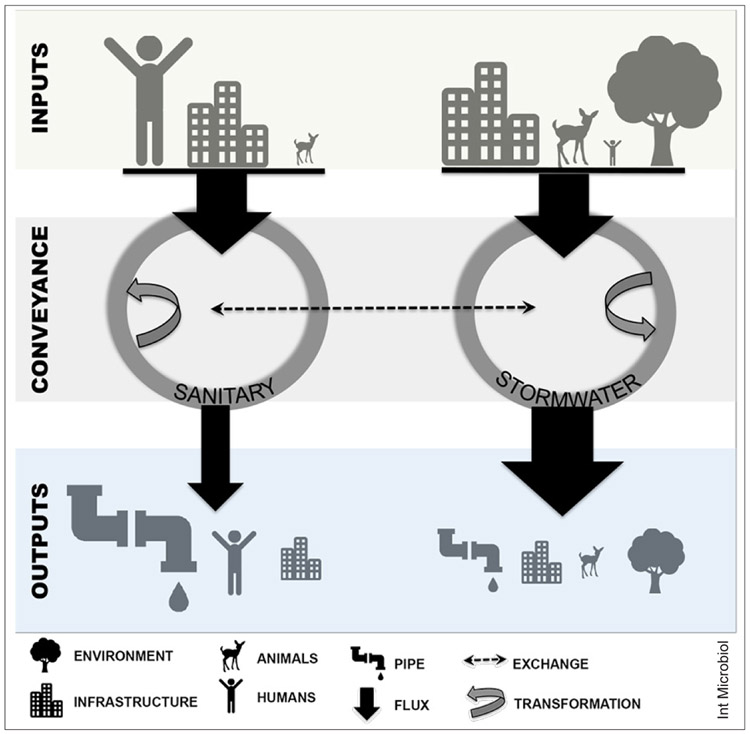
More than 50% of the world's population lives in urban centers. As collection basins for landscape activity, urban waters are an interface between human activity and the natural environment. The microbiome of urban waters could provide insight into the impacts of pollution, the presence of human health risks, or the potential for long-term consequences for these ecosystems and the people who depend upon them. An integral part of the urban water cycle is sewer infrastructure. Thousands of miles of pipes line cities as part of wastewater and stormwater systems. As stormwater and sewage are released into natural waterways, traces of human and animal microbiomes reflect the sources and magnitude of fecal pollution and indicate the presence of pollutants, such as nutrients, pathogens, and chemicals. Non-fecal organisms are also released as part of these systems. Runoff from impervious surfaces delivers microbes from soils, plants and the built environment to stormwater systems. Further, urban sewer infrastructure contains its own unique microbial community seemingly adapted to this relatively new artificial habitat. High microbial densities are conveyed via pipes to waterways, and these organisms can be found as an urban microbial signature imprinted on the natural community of rivers and urban coastal waters. The potential consequences of mass releases of non-indigenous microorganisms into natural waters include creation of reservoirs for emerging human pathogens, altered nutrient flows into aquatic food webs, and increased genetic exchange between two distinct gene pools. This review highlights the recent characterization of the microbiome of urban sewer and stormwater infrastructure and its connection to and potential impact upon freshwater systems.
全球超过50%的人口居住在城市中心。作为景观活动的集水区,城市水体是人类活动与自然环境的界面。城市水体的微生物群落可以为污染的影响、人类健康风险的存在,或这些生态系统及其依赖者的长期后果的可能性提供见解。下水道基础设施是城市水循环的一个组成部分。作为废水和雨水系统的一部分,数千英里的管道遍布城市。当雨水和污水排入天然水道时,人类和动物微生物群落的痕迹反映了粪便污染的来源和程度,并表明了污染物的存在,如营养物质、病原体和化学物质。非粪便生物也作为这些系统的一部分被排放。不透水表面的径流将来自土壤、植物和建筑环境的微生物输送到雨水系统。此外,城市下水道基础设施包含其自身独特的微生物群落,似乎适应了这个相对较新的人工栖息地。高微生物密度通过管道输送到水道,这些生物可以作为城市微生物特征在河流和城市沿海水域的自然群落中被发现。非本土微生物大量释放到天然水体中的潜在后果包括为新出现的人类病原体创造储存库、改变进入水生食物网的营养物质流动,以及增加两个不同基因库之间的基因交换。本综述强调了城市下水道和雨水基础设施微生物群落的最新特征及其与淡水系统的联系和潜在影响。