Li Qinghua, Yao Zheng-Ju, Mi Hualing
National Key Laboratory of Plant Molecular Genetics and Photosynthesis, Institute of Plant Physiology and Ecology, Shanghai Institutes for Biological Sciences, Chinese Academy of Sciences Shanghai, China.
Front Plant Sci. 2016 Mar 30;7:285. doi: 10.3389/fpls.2016.00285. eCollection 2016.
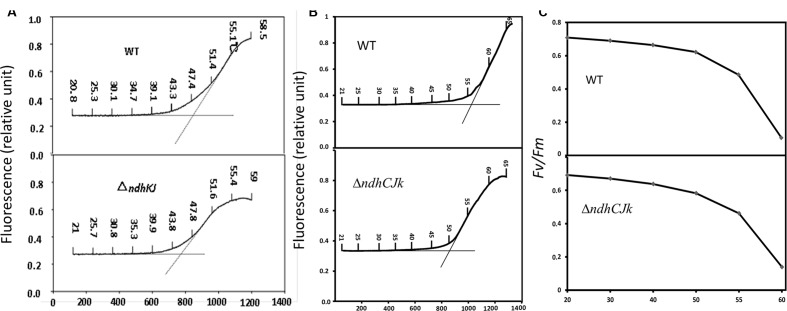
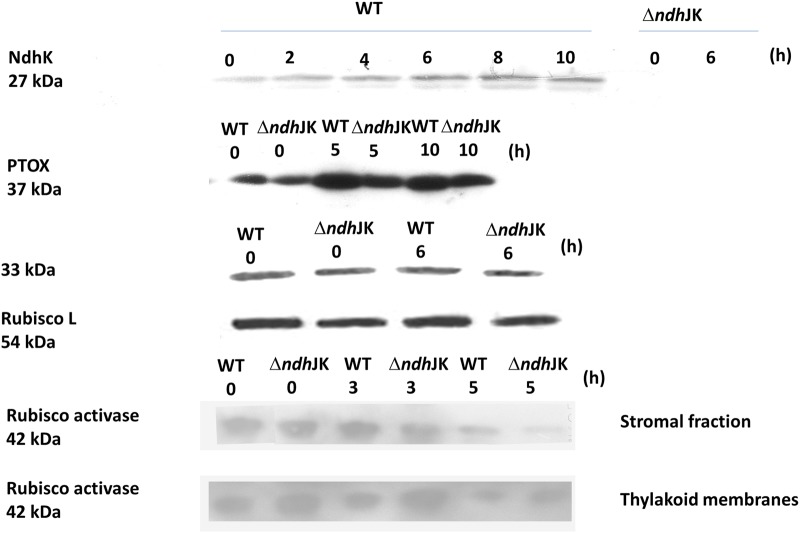
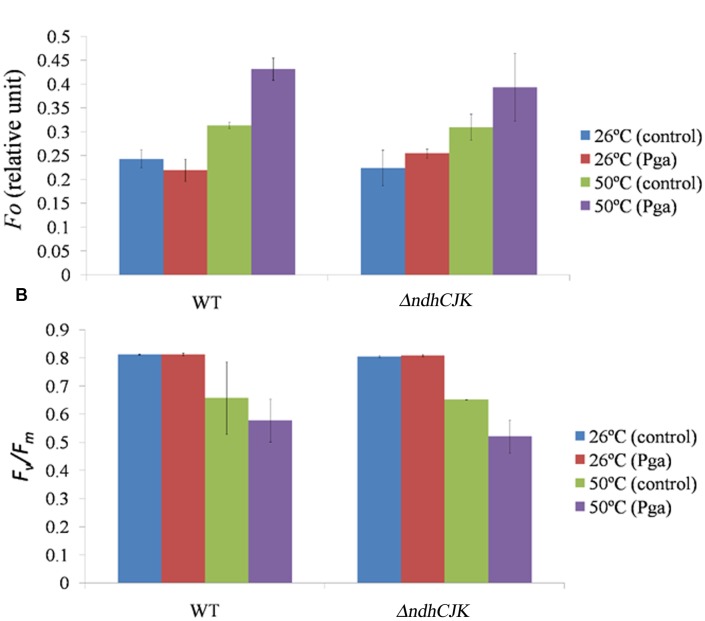
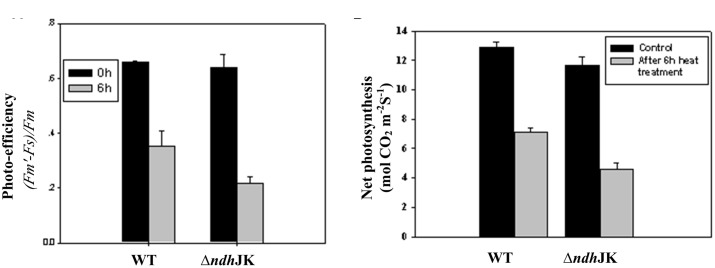
With increase of temperature, F o gradually rose in both WT and the mutant inactivated in the type 1 NAD(P)H dehydrogenase (NDH), a double mutant disrupted the genes of ndhJ and ndhK (ΔndhJK) or a triple mutant disrupted the genes of ndhC, ndhJ, and ndhK (ΔndhCJK). The temperature threshold of Fo rise was about 3-5°C lower in the mutants than in WT, indicating ΔndhJK and ΔndhCJK were more sensitive to elevated temperature. The F o rise after the threshold was slower and the reached maximal level was lower in the mutants than in WT, implying the chlororespiratory pathway was suppressed when NDH was inactivated. Meanwhile, the maximum quantum efficiency of photosystem II (PS II) (F v /F m) decreased to a similar extent below 50°C in WT and mutants. However, the decline was sharper in WT when temperature rose above 55°C, indicating a down regulation of PS II photochemical activity by the chlororespiratory pathway in response to elevated temperature. On the other hand, in the presence of n-propyl gallate, an inhibitor of plastid terminal oxidase (PTOX), the less evident increase in F o while the more decrease in F v /F m in ΔndhCJK than in WT after incubation at 50°C for 6 h suggest the increased sensitivity to heat stress when both NDH and chlororespiratory pathways are suppressed. Moreover, the net photosynthetic rate and photo-efficiency decreased more significantly in ΔndhJK than in WT under the heat stressed conditions. Compared to the light-oxidation of P700, the difference in the dark-reduction of P700(+) between WT and ndhJK disruptant was much less under the heat stressed conditions, implying significantly enhanced cyclic electron flow in light and the competition for electron from PQ between PTOX and photosystem I in the dark at the elevated temperature. Heat-stimulated expression of both NdhK and PTOX significantly increased in WT, while the expression of PTOX was less in ΔndhJK than in WT. Meanwhile, the amount of active form of Rubisco activase decreased much more in the mutant. The results suggest that chlororespiration and cyclic electron flow mediated by NDH may coordinate to alleviate the over-reduction of stroma, thus to keep operation of CO2 assimilation at certain extent under heat stress condition.
随着温度升高,野生型(WT)以及在1型NAD(P)H脱氢酶(NDH)中失活的突变体(双突变体ndhJ和ndhK基因被破坏,即ΔndhJK;或三突变体ndhC、ndhJ和ndhK基因被破坏,即ΔndhCJK)中的F o均逐渐升高。突变体中F o升高的温度阈值比野生型低约3 - 5°C,表明ΔndhJK和ΔndhCJK对温度升高更敏感。阈值后F o的升高在突变体中比野生型更慢,且达到的最大值更低,这意味着当NDH失活时,叶绿体呼吸途径受到抑制。同时,在50°C以下,野生型和突变体中光系统II(PS II)的最大量子效率(F v /F m)下降程度相似。然而,当温度升至55°C以上时,野生型中的下降更为明显,这表明叶绿体呼吸途径响应温度升高对PS II光化学活性有下调作用。另一方面,在存在质体末端氧化酶(PTOX)抑制剂没食子酸丙酯的情况下,50°C孵育6小时后,ΔndhCJK中F o的增加不太明显,而F v /F m的下降比野生型更明显,这表明当NDH和叶绿体呼吸途径均被抑制时,对热胁迫的敏感性增加。此外,在热胁迫条件下,ΔndhJK中的净光合速率和光合效率下降比野生型更显著。与P700的光氧化相比,在热胁迫条件下,野生型和ndhJK破坏体之间P700(+)的暗还原差异要小得多,这意味着在高温下,光下循环电子流显著增强,并且在黑暗中PTOX和光系统I之间对来自PQ的电子存在竞争。野生型中热刺激下NdhK和PTOX的表达均显著增加,而ΔndhJK中PTOX的表达比野生型少。同时,突变体中Rubisco活化酶活性形式的量下降得更多。结果表明,由NDH介导的叶绿体呼吸和循环电子流可能协同作用以减轻基质的过度还原,从而在热胁迫条件下在一定程度上维持CO2同化的运行。