Matney Jason E, Park Peter C, Li Heng, Court Laurence E, Zhu X Ron, Dong Lei, Liu Wei, Mohan Radhe
University of North Carolina Cancer Hospital.
J Appl Clin Med Phys. 2016 Mar 8;17(2):368-378. doi: 10.1120/jacmp.v17i2.5795.
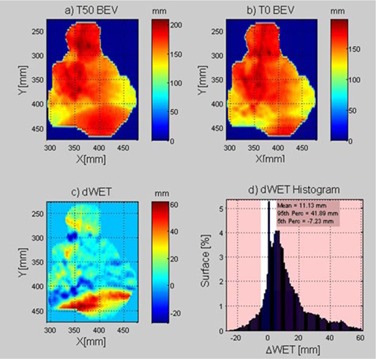
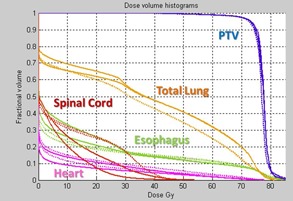
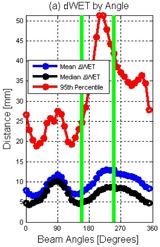
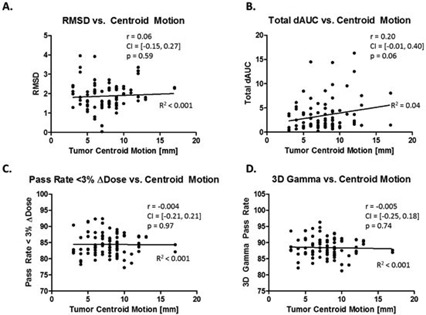
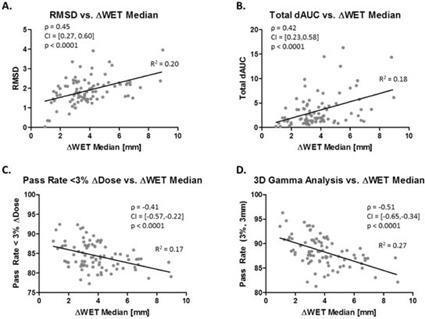
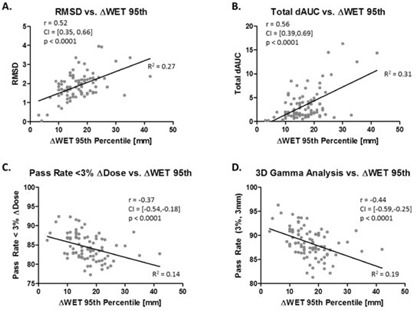
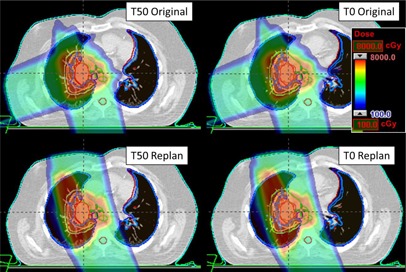
Respiratory motion is traditionally assessed using tumor motion magnitude. In proton therapy, respiratory motion causes density variations along the beam path that result in uncertainties of proton range. This work has investigated the use of water-equivalent thickness (WET) to quantitatively assess the effects of respiratory motion on calculated dose in passively scattered proton therapy (PSPT). A cohort of 29 locally advanced non-small cell lung cancer patients treated with 87 PSPT treatment fields were selected for analysis. The variation in WET (ΔWET) along each field was calculated between exhale and inhale phases of the simulation four-dimensional computed tomography. The change in calculated dose (ΔDose) between full-inhale and full-exhale phase was quantified for each field using dose differences, 3D gamma analysis, and differential area under the curve (ΔAUC) analysis. Pearson correlation coefficients were calculated between ΔDose and ΔWET. Three PSPT plans were redesigned using field angles to minimize variations in ΔWET and compared to the original plans. The median ΔWET over 87 treatment fields ranged from 1-9 mm, while the ΔWET 95th percentile value ranged up to 42 mm. The ΔWET was significantly correlated (p < 0.001) to the ΔDose for all metrics analyzed. The patient plans that were redesigned using ΔWET analysis to select field angles were more robust to the effects of respiratory motion, as ΔAUC values were reduced by more than 60% in all three cases. The tumor motion magnitude alone does not capture the potential dosimetric error due to respiratory motion because the proton range is sensitive to the motion of all patient anatomy. The use of ΔWET has been demonstrated to identify situations where respiratory motion can impact the calculated dose. Angular analysis of ΔWET may be capable of designing radiotherapy plans that are more robust to the effects of respiratory motion.
传统上,呼吸运动是通过肿瘤运动幅度来评估的。在质子治疗中,呼吸运动会导致沿射线路径的密度变化,从而导致质子射程的不确定性。这项研究调查了使用水等效厚度(WET)来定量评估呼吸运动对被动散射质子治疗(PSPT)中计算剂量的影响。选取了29例接受87个PSPT治疗野治疗的局部晚期非小细胞肺癌患者进行分析。在模拟的四维计算机断层扫描的呼气和吸气阶段之间,计算每个野的WET变化(ΔWET)。使用剂量差异、三维伽马分析和曲线下微分面积(ΔAUC)分析,对每个野在全吸气和全呼气阶段之间计算剂量的变化(Δ剂量)进行量化。计算Δ剂量和ΔWET之间的Pearson相关系数。使用射野角度重新设计了三个PSPT计划,以尽量减少ΔWET的变化,并与原始计划进行比较。87个治疗野的ΔWET中位数范围为1-9毫米,而ΔWET的第95百分位数高达42毫米。对于所有分析指标,ΔWET与Δ剂量均显著相关(p < 0.001)。使用ΔWET分析来选择射野角度重新设计的患者计划对呼吸运动的影响更具鲁棒性,因为在所有三种情况下,ΔAUC值均降低了60%以上。仅肿瘤运动幅度并不能反映由于呼吸运动引起的潜在剂量学误差,因为质子射程对所有患者解剖结构的运动都很敏感。已证明使用ΔWET能够识别呼吸运动可能影响计算剂量的情况。对ΔWET进行角度分析可能能够设计出对呼吸运动影响更具鲁棒性的放射治疗计划。