Zhaeentan Soheila, Legeby Markus, Ahlström Susanne, Stark André, Salomonsson Björn
Karolinska Institute, Division of Clinical Sciences, Danderyds University Hospital, 182 88, Stockholm, Sweden.
Karolinska Institute Danderyds University Hospital, Stockholm, Sweden.
BMC Musculoskelet Disord. 2016 Apr 14;17:165. doi: 10.1186/s12891-016-1014-y.
The Western Ontario Rotator Cuff Index (WORC) is a widely used instrument to measure quality of life in patients with subacromial pain or rotator cuff syndrome. The purpose of this study was to evaluate the psychometric properties of the Swedish version of the WORC for assessment of subacromial disease including rotator cuff syndrome treated by surgery.
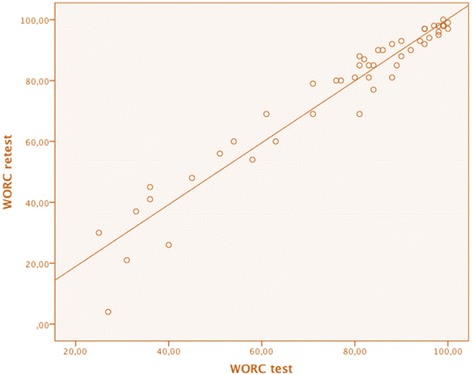
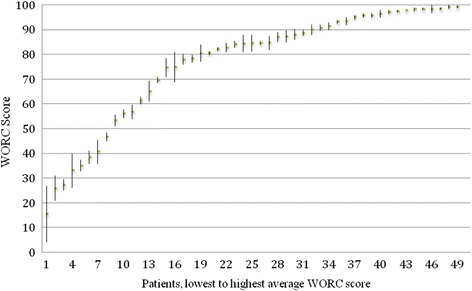
A total of 65 patients were included in this study, mean age 60 years (range 36-82), 42% women, all were candidates for surgery for subacromial pain conditions at two orthopedic units during 2004-2006 and 2011-2012. Calculations of the validity of Pearson's correlation coefficient, floor and ceiling effects, reliability and responsiveness have formed the basis of assessment of the WORC index properties. WORC has been tested against Western Ontario Osteoarthritis of the Shoulder (WOOS), Oxford Shoulder Score and EQ-5D. An additional 49 patients, mean age 64 years (range 36-74) 20% of whom were women, were analyzed in a WORC test-retest with ICC and also correlated to Constant-Murley Score.
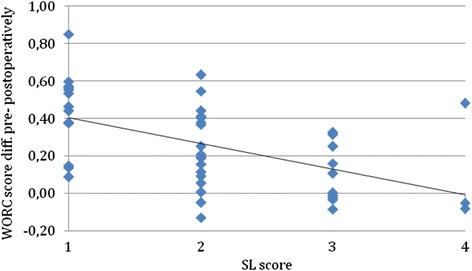
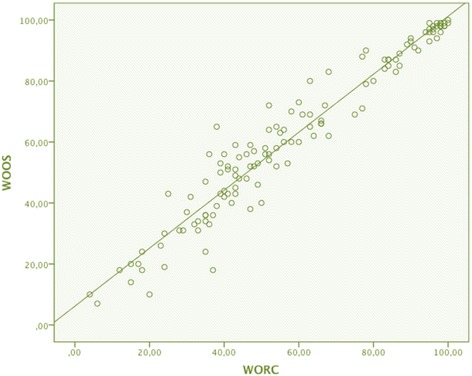
The validity analysis of WORC showed high correlations with both the specific and the generic health measurement instrument. The reliability calculations of the WORC resulted in ICC = 0.97 and Cronbach's alpha = 0.97. Responsiveness was also excellent for WORC with Effect size = 1.35 and Standardized Response mean = 1.01. We found that the WORC showed a strong correlation with the WOOS (0.97) and the Constant-Murley Score (0.85). A good correlation was found with the Oxford Shoulder Score (0.74) and the EQ-5D (0.71).
The Swedish version of WORC can be considered reliable, valid and responsive for use as an assessment of outcome and a health measurement instrument for patients treated by surgery for subacromial disease including rotator cuff syndrome.
西安大略肩袖指数(WORC)是一种广泛用于测量肩峰下疼痛或肩袖综合征患者生活质量的工具。本研究的目的是评估瑞典语版WORC在评估肩峰下疾病(包括手术治疗的肩袖综合征)方面的心理测量特性。
本研究共纳入65例患者,平均年龄60岁(范围36 - 82岁),女性占42%,所有患者均为2004 - 2006年及2011 - 2012年期间两个骨科单位肩峰下疼痛疾病手术的候选者。Pearson相关系数的有效性计算、地板效应和天花板效应、可靠性和反应性构成了WORC指数特性评估的基础。WORC已与西安大略肩关节炎(WOOS)、牛津肩评分和EQ - 5D进行了对比测试。另外49例患者,平均年龄64岁(范围36 - 74岁),其中20%为女性,通过组内相关系数(ICC)进行WORC重测分析,并与Constant - Murley评分相关。
WORC的有效性分析显示与特定和通用健康测量工具均具有高度相关性。WORC的可靠性计算得出ICC = 0.97,Cronbach's α = 0.97。WORC的反应性也极佳,效应量 = 1.35,标准化反应均值 = 1.01。我们发现WORC与WOOS(0.97)和Constant - Murley评分(0.85)显示出强相关性。与牛津肩评分(0.74)和EQ - 5D(0.71)发现良好相关性。
瑞典语版WORC可被认为是可靠、有效且具有反应性的,可作为肩峰下疾病(包括肩袖综合征)手术治疗患者的结局评估和健康测量工具。