Nocchi Samara Requena, de Moura-Costa Gislaine Franco, Novello Claudio Roberto, Rodrigues Juliana, Longhini Renata, de Mello João Carlos Palazzo, Filho Benedito Prado Dias, Nakamura Celso Vataru, Ueda-Nakamura Tânia
Post-Graduate Program in Pharmaceutical Sciences, State University of Maringá, Maringá, Paraná, Brazil.
Coordination of Chemical Engineering, Federal Technical University of Paraná, Francisco Beltrão Campus, Santa Barbara Line s/n, BR-85601-970, Francisco Beltrão, Paraná, Brazil.
Pharmacogn Mag. 2016 Apr-Jun;12(46):160-4. doi: 10.4103/0973-1296.177903.
Herpes simplex virus type 1 (HSV-1) is associated with orofacial infections and is transmitted by direct contact with infected secretions. Several efforts have been expended in the search for drugs to the treatment for herpes. Schinus terebinthifolius is used in several illnesses and among them, for the topical treatment of skin wounds, especially wounds of mucous membranes, whether infected or not.
To evaluate the cytotoxicity and anti-HSV-1 activity of the crude hydroethanolic extract (CHE) from the stem bark of S. terebinthifolius, as well as its fractions and isolated compounds.
The CHE was subjected to bioguided fractionation. The anti-HSV-1 activity and the cytotoxicity of the CHE, its fractions, and isolated compounds were evaluated in vitro by SRB method. A preliminar investigation of the action of CHE in the virus-host interaction was conducted by the same assay.
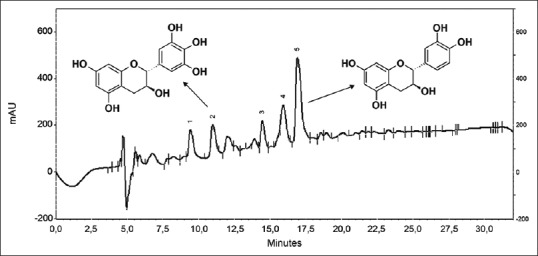
CHE presented flavan-3-ols and showed anti-HSV-1 activity, better than its fractions and isolated compounds. The class of substances found in CHE can bind to proteins to form unstable complexes and enveloped viruses, as HSV-1 may be vulnerable to this action. Our results suggest that the CHE interfered with virion envelope structures, masking viral receptors that are necessary for adsorption or entry into host cells.
The plant investigated exhibited potential for future development treatment against HSV-1, but further tests are necessary, especially to elucidate the mechanism of action of CHE, as well as preclinical and clinical studies to confirm its safety and efficacy.
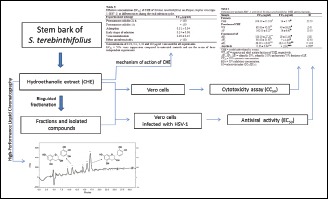
Crude hydroethanolic extract (CHE) presents promising activity against herpes simplex virus type 1 (HSV 1), with selectivity index (SI) = 22.50CHE has flavan-3-ols in its composition, such as catechin and gallocatechinThe fractions and isolated compounds obtained from CHE by bioguided fractionation are less active than the CHE against HSV-1CHE interferes with viral entry process in the host cell and acts directly on the viral particle. Abbreviations used: HSV: Herpes simplex virus, CHE: Crude hydroethanolic extract, WF: Water fraction, AF: Ethyl-acetate fraction, MPLC: Medium-performance liquid chromatography, TLC: Thin-layer chromatography, NMR: Nuclear magnetic resonance, ESI-MS: Electrospray ionization mass spectrometry, SRB: Sulforhodamine B, CPE: Cytopathic effect, CC50: 50% cytotoxic concentration, EC50: 50% effective concentration, PBS: Phosphate-buffered saline.
单纯疱疹病毒1型(HSV-1)与口腔面部感染相关,可通过直接接触感染性分泌物传播。人们已付出诸多努力寻找治疗疱疹的药物。巴西胡椒在多种疾病中都有应用,其中包括用于皮肤伤口的局部治疗,尤其是粘膜伤口,无论是否感染。
评估巴西胡椒茎皮粗乙醇提取物(CHE)及其馏分和分离化合物的细胞毒性和抗HSV-1活性。
对CHE进行生物导向分级分离。采用SRB法体外评估CHE及其馏分和分离化合物的抗HSV-1活性和细胞毒性。通过相同试验对CHE在病毒-宿主相互作用中的作用进行初步研究。
CHE含有黄烷-3-醇并表现出抗HSV-1活性,优于其馏分和分离化合物。CHE中发现的这类物质可与蛋白质结合形成不稳定复合物以及包膜病毒,因为HSV-1可能易受此作用影响。我们的结果表明,CHE干扰了病毒粒子包膜结构,掩盖了吸附或进入宿主细胞所需的病毒受体。
所研究的植物在未来开发抗HSV-1治疗方面具有潜力,但还需要进一步测试,特别是要阐明CHE的作用机制,以及进行临床前和临床研究以确认其安全性和有效性。
粗乙醇提取物(CHE)对单纯疱疹病毒1型(HSV-1)具有有前景的活性,选择性指数(SI)=22.50。CHE的成分中含有黄烷-3-醇,如儿茶素和没食子儿茶素。通过生物导向分级分离从CHE获得的馏分和分离化合物对HSV-1的活性低于CHE。CHE干扰宿主细胞中的病毒进入过程并直接作用于病毒粒子。使用的缩写:HSV:单纯疱疹病毒,CHE:粗乙醇提取物,WF:水相馏分,AF:乙酸乙酯馏分,MPLC:中压液相色谱,TLC:薄层色谱,NMR:核磁共振,ESI-MS:电喷雾电离质谱,SRB:磺酰罗丹明B,CPE:细胞病变效应,CC50:50%细胞毒性浓度,EC50:50%有效浓度,PBS:磷酸盐缓冲盐水。