Alvarez M A, Tranquilli G, Lewis S, Kippes N, Dubcovsky J
Department of Plant Sciences, University of California, Mail Stop 1, One Shields Avenue, Davis, CA, 95616-8780, USA.
Instituto de Recursos Biológicos, INTA, Villa Udaondo (1686), Hurlingham, Buenos Aires, Argentina.
Funct Integr Genomics. 2016 Jul;16(4):365-82. doi: 10.1007/s10142-016-0490-3. Epub 2016 Apr 16.
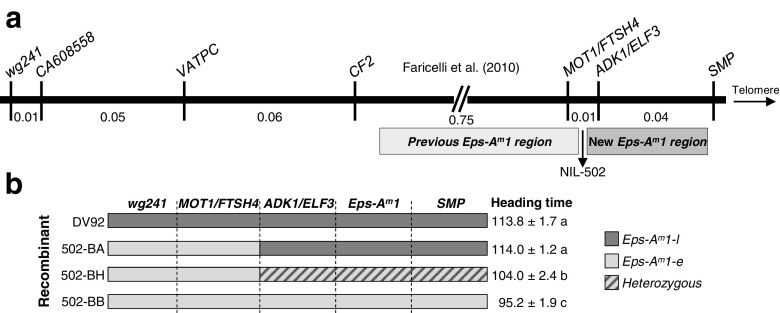
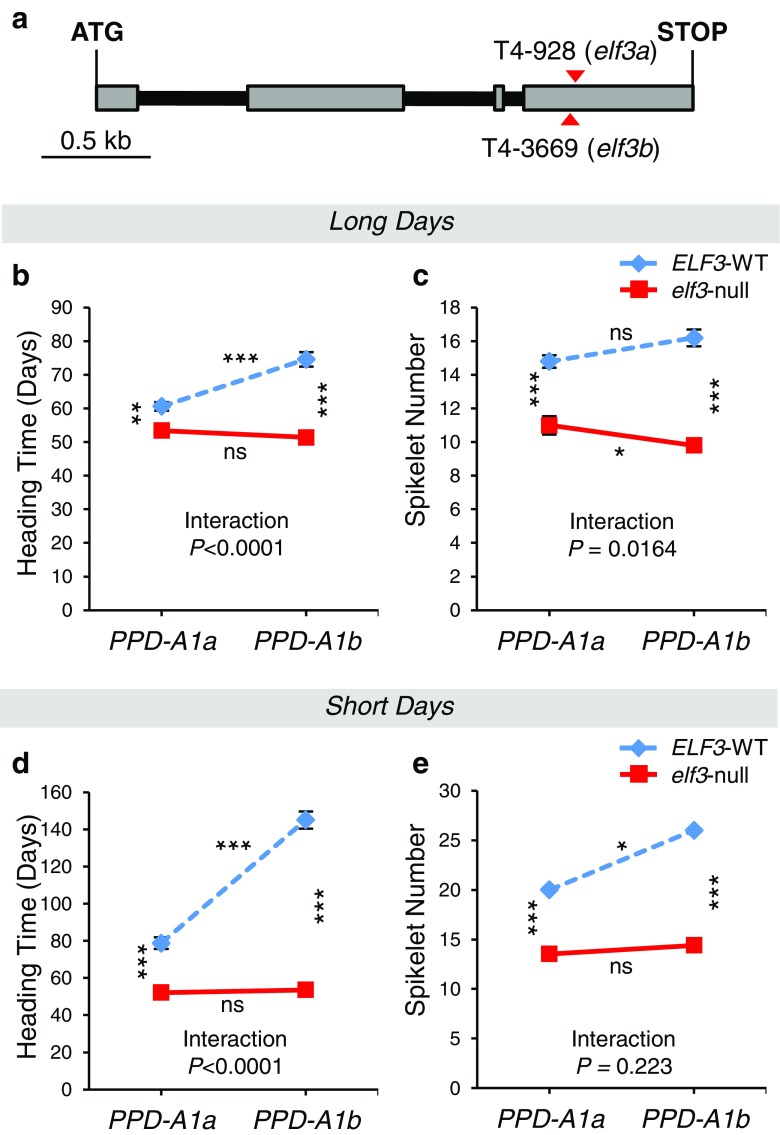
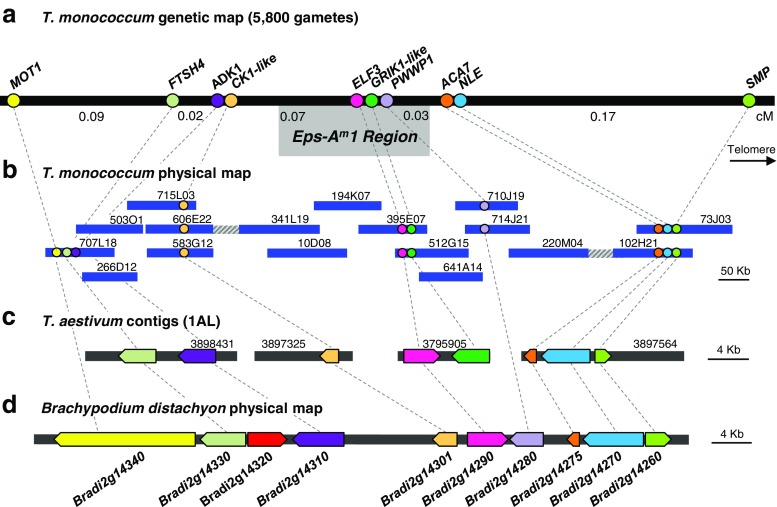
Wheat cultivars exposed to optimal photoperiod and vernalization treatments still exhibit differences in flowering time, referred to as earliness per se (Eps). We previously identified the Eps-A (m) 1 locus from Triticum monococcum and showed that the allele from cultivated accession DV92 significantly delays heading time and increases the number of spikelets per spike relative to the allele from wild accession G3116. Here, we expanded a high-density genetic and physical map of the Eps-A (m) 1 region and identified the wheat ortholog of circadian clock regulator EARLY FLOWERING 3 (ELF3) as a candidate gene. No differences in ELF3 transcript levels were found between near-isogenic lines carrying the DV92 and G3116 Eps-A (m) 1 alleles, but the encoded ELF3 proteins differed in four amino acids. These differences were associated with altered transcription profiles of PIF-like, PPD1, and FT1, which are known downstream targets of ELF3. Tetraploid wheat lines with combined truncation mutations in the A- and B-genome copies of ELF3 flowered earlier and had less spikelets per spike than the wild-type control under short- and long-day conditions. Both effects were stronger in a photoperiod-sensitive than in a reduced photoperiod-sensitive background, indicating a significant epistatic interaction between PPD1 and ELF3 (P < 0.0001). By contrast, the introgression of the T. monococcum chromosome segment carrying the Eps-A (m) 1 allele from DV92 into durum wheat delayed flowering and increased the number of spikelets per spike. Taken together, the above results support the hypothesis that ELF3 is Eps-A (m) 1. The ELF3 alleles identified here provide additional tools to modulate reproductive development in wheat.
暴露于最佳光周期和春化处理的小麦品种在开花时间上仍表现出差异,即所谓的本身早熟性(Eps)。我们之前从小麦中鉴定出Eps-A(m)1位点,并表明相对于野生材料G3116的等位基因,栽培材料DV92的等位基因显著延迟抽穗时间并增加每穗小穗数。在此,我们扩展了Eps-A(m)1区域的高密度遗传和物理图谱,并鉴定出生物钟调节因子早花3(ELF3)的小麦直系同源基因作为候选基因。在携带DV92和G3116 Eps-A(m)1等位基因的近等基因系之间,未发现ELF3转录水平存在差异,但编码的ELF3蛋白在四个氨基酸上有所不同。这些差异与已知的ELF3下游靶标PIF样、PPD1和FT1的转录谱改变有关。在短日照和长日照条件下,ELF3的A和B基因组拷贝中具有组合截短突变的四倍体小麦品系比野生型对照开花更早,每穗小穗数更少。在光周期敏感背景下,这两种效应比在光周期敏感性降低的背景下更强,表明PPD1和ELF3之间存在显著的上位性相互作用(P<0.0001)。相比之下,将携带来自DV92的Eps-A(m)1等位基因的小麦染色体片段导入硬粒小麦中,延迟了开花并增加了每穗小穗数。综上所述,上述结果支持ELF3是Eps-A(m)1的假设。这里鉴定出的ELF3等位基因为调节小麦生殖发育提供了额外工具。