Shaukat Aleena, Thivierge Jean-Philippe
School of Psychology, University of Ottawa Ottawa, ON, Canada.
School of Psychology, University of OttawaOttawa, ON, Canada; Center for Neural Dynamics, University of OttawaOttawa, ON, Canada.
Front Comput Neurosci. 2016 Apr 7;10:29. doi: 10.3389/fncom.2016.00029. eCollection 2016.
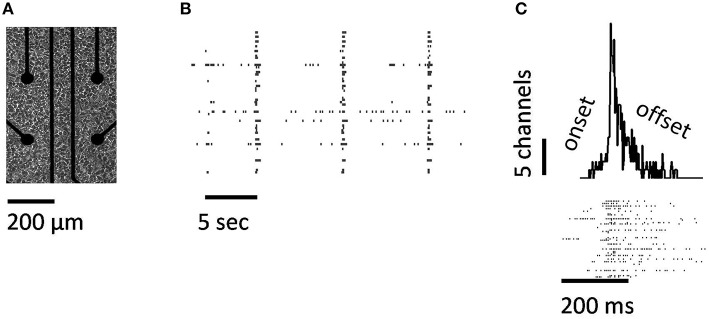
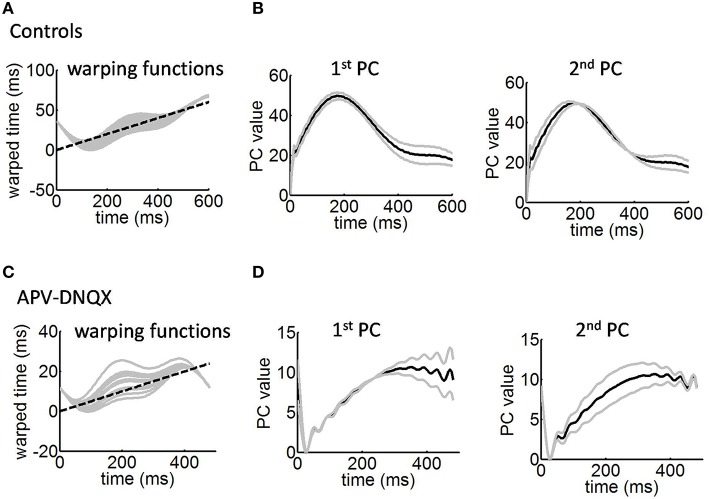
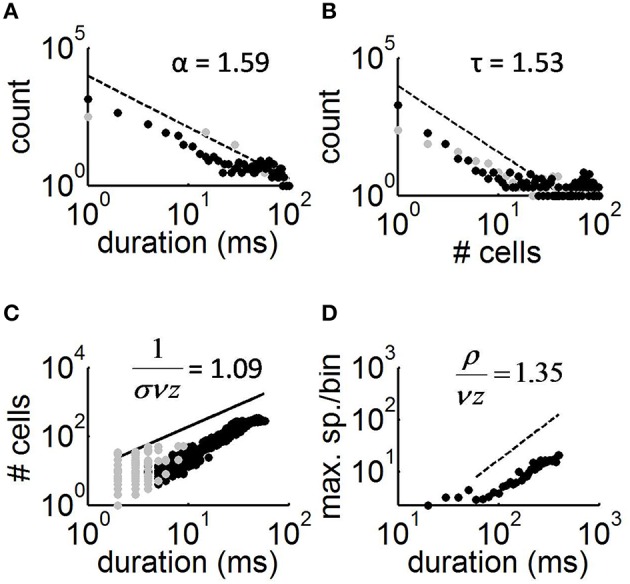
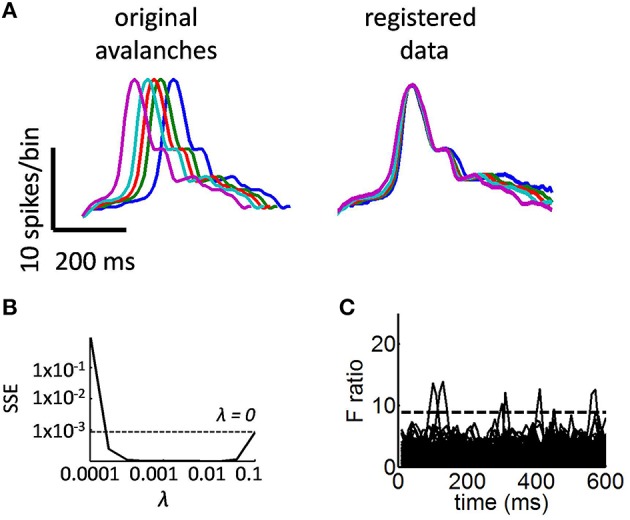
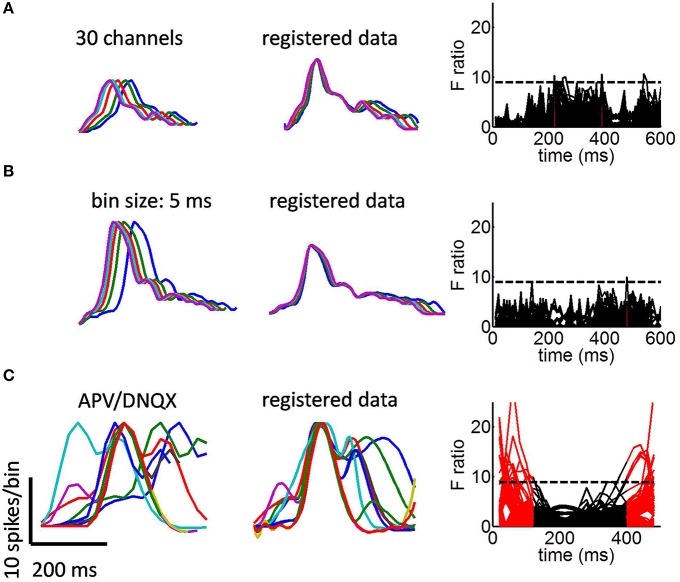
Neural avalanches are a prominent form of brain activity characterized by network-wide bursts whose statistics follow a power-law distribution with a slope near 3/2. Recent work suggests that avalanches of different durations can be rescaled and thus collapsed together. This collapse mirrors work in statistical physics where it is proposed to form a signature of systems evolving in a critical state. However, no rigorous statistical test has been proposed to examine the degree to which neuronal avalanches collapse together. Here, we describe a statistical test based on functional data analysis, where raw avalanches are first smoothed with a Fourier basis, then rescaled using a time-warping function. Finally, an F ratio test combined with a bootstrap permutation is employed to determine if avalanches collapse together in a statistically reliable fashion. To illustrate this approach, we recorded avalanches from cortical cultures on multielectrode arrays as in previous work. Analyses show that avalanches of various durations can be collapsed together in a statistically robust fashion. However, a principal components analysis revealed that the offset of avalanches resulted in marked variance in the time-warping function, thus arguing for limitations to the strict fractal nature of avalanche dynamics. We compared these results with those obtained from cultures treated with an AMPA/NMDA receptor antagonist (APV/DNQX), which yield a power-law of avalanche durations with a slope greater than 3/2. When collapsed together, these avalanches showed marked misalignments both at onset and offset time-points. In sum, the proposed statistical evaluation suggests the presence of scale-free avalanche waveforms and constitutes an avenue for examining critical dynamics in neuronal systems.
神经雪崩是一种显著的大脑活动形式,其特征是全网络突发,其统计数据遵循斜率接近3/2的幂律分布。最近的研究表明,不同持续时间的雪崩可以重新缩放,从而合并在一起。这种合并反映了统计物理学中的工作,其中提出这形成了处于临界状态下演化系统的一个特征。然而,尚未提出严格的统计检验来检查神经元雪崩合并在一起的程度。在这里,我们描述了一种基于功能数据分析的统计检验,其中原始雪崩首先用傅里叶基进行平滑,然后使用时间扭曲函数进行重新缩放。最后,采用F比率检验结合自助置换来确定雪崩是否以统计上可靠的方式合并在一起。为了说明这种方法,我们像之前的工作一样,在多电极阵列上记录了皮质培养物中的雪崩。分析表明,各种持续时间的雪崩可以以统计上稳健的方式合并在一起。然而,主成分分析表明,雪崩的偏移导致时间扭曲函数中存在明显的方差,因此表明雪崩动力学的严格分形性质存在局限性。我们将这些结果与用AMPA/NMDA受体拮抗剂(APV/DNQX)处理的培养物所获得的结果进行了比较,后者产生了斜率大于3/2的雪崩持续时间幂律。当合并在一起时,这些雪崩在起始和偏移时间点都显示出明显的错位。总之,所提出的统计评估表明存在无标度的雪崩波形,并构成了一种研究神经元系统临界动力学的途径。