Zhang Xingyu, Hou Fengsu, Li Xiaosong, Zhou Lijun, Liu Yuanyuan, Zhang Tao
Department of Epidemiology and Health Statistics, West China School of Public Health, Sichuan University, No. 17 Section 3, South Renmin Road, Chengdu, Sichuan 610041, PR China; Department of Anatomy with Radiology, University of Auckland, Auckland, New Zealand.
School of Public Health, Sun Yat-sen University, Guangzhou, Guangdong Province, PR China; Sun Yat-sen Global Health Institute, Institute of State Governance, Sun Yat-sen University, Guangzhou, Guangdong Province, PR China.
Int J Infect Dis. 2016 Jul;48:7-13. doi: 10.1016/j.ijid.2016.04.010. Epub 2016 Apr 14.
The surveillance of infection is very important for public health management and disease control. It has been 10 years since China implemented its new web-based infection surveillance system, which covers the largest population in the world.
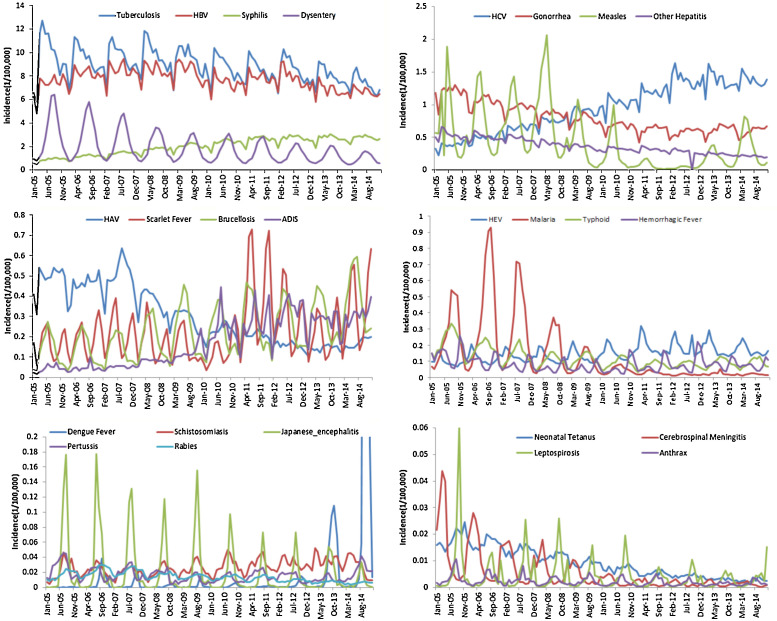
In this study, time series data were collected for 28 infectious diseases reported from 2005 to 2014 . Seasonality and long-term trends were explored using decomposition methods. Seasonality was expressed by calculating the seasonal indices. Long-term trends in the diseases were assessed using a linear regression model on the deseasonalized series.
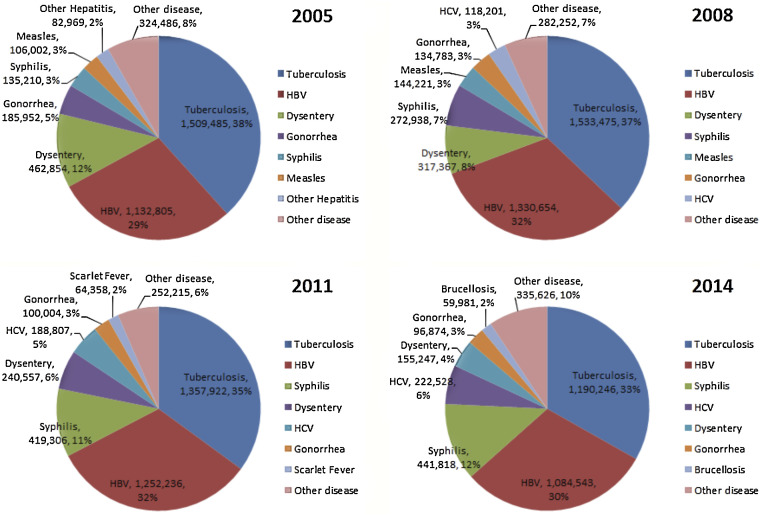
During the 10-year period, 38 982 567 cases and 126 372 deaths were reported in the system. The proportion of deaths caused by AIDS increased from 12% in 2005 to 78% in 2014. There were six diseases for which the seasonal index range was greater than 2: dengue fever, Japanese encephalitis, leptospirosis, anthrax, cerebrospinal meningitis, and measles . Among the 28 diseases, the incidence of syphilis increased fastest, with an average increase of 0.018626/100 000 every month after adjustment for seasonality.
Effective surveillance is helpful in gaining a better understanding of the infection behaviour of infectious diseases; this will greatly facilitate disease control and management.
感染监测对于公共卫生管理和疾病控制非常重要。中国实施基于网络的新型感染监测系统已有10年,该系统覆盖了世界上最大的人口群体。
在本研究中,收集了2005年至2014年报告的28种传染病的时间序列数据。使用分解方法探索季节性和长期趋势。通过计算季节性指数来表示季节性。使用去季节性化序列上的线性回归模型评估疾病的长期趋势。
在这10年期间,该系统报告了38982567例病例和126372例死亡。艾滋病导致的死亡比例从2005年的12%上升到2014年的78%。有六种疾病的季节性指数范围大于2:登革热、日本脑炎、钩端螺旋体病、炭疽、脑脊髓膜炎和麻疹。在这28种疾病中,梅毒发病率增长最快,经季节性调整后每月平均增长0.018626/10万。
有效的监测有助于更好地了解传染病的感染行为;这将极大地促进疾病的控制和管理。