China Institute for Urban Governance, Shanghai Jiao Tong University, Shanghai, China.
School of International and Public Affairs, Shanghai Jiao Tong University, Shanghai, China.
JMIR Public Health Surveill. 2023 Apr 27;9:e42820. doi: 10.2196/42820.
China is the most populous country globally and has made significant achievements in the control of infectious diseases over the last decades. The 2003 SARS epidemic triggered the initiation of the China Information System for Disease Control and Prevention (CISDCP). Since then, numerous studies have investigated the epidemiological features and trends of individual infectious diseases in China; however, few considered the changing spatiotemporal trends and seasonality of these infectious diseases over time.
This study aims to systematically review the spatiotemporal trends and seasonal characteristics of class A and class B notifiable infectious diseases in China during 2005-2020.
We extracted the incidence and mortality data of 8 types (27 diseases) of notifiable infectious diseases from the CISDCP. We used the Mann-Kendall and Sen's methods to investigate the diseases' temporal trends, Moran I statistic for their geographical distribution, and circular distribution analysis for their seasonality.
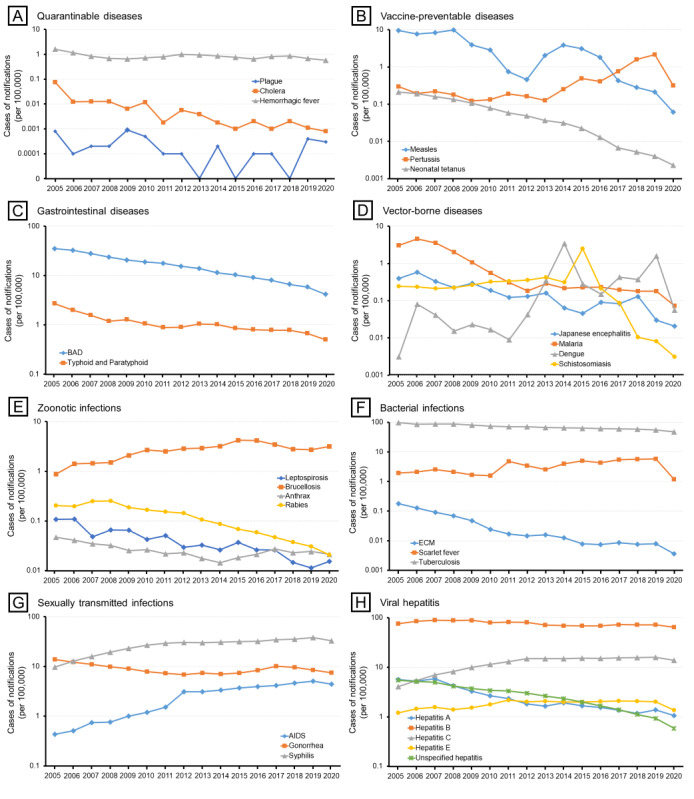
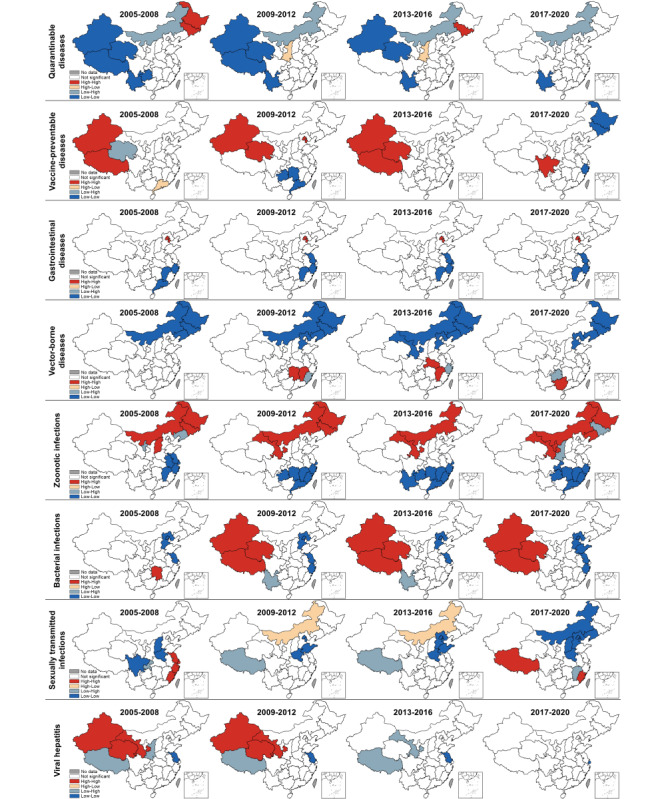
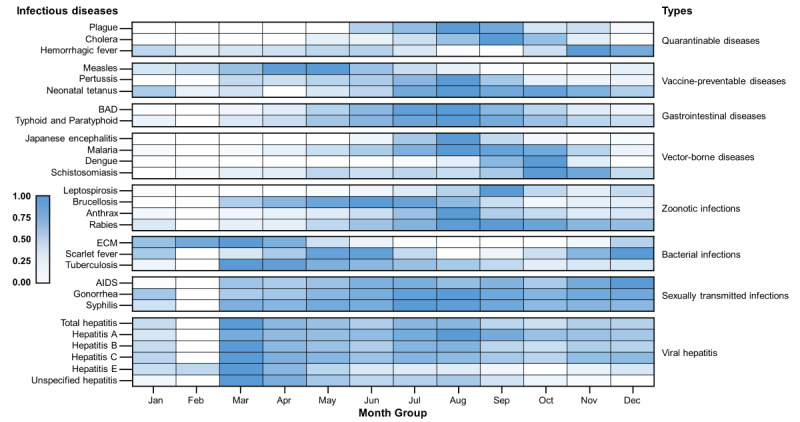
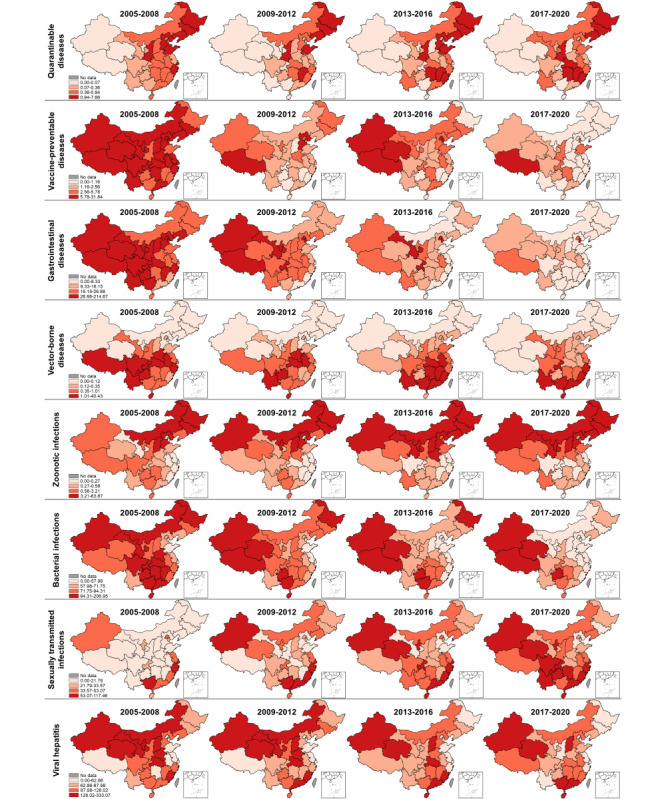
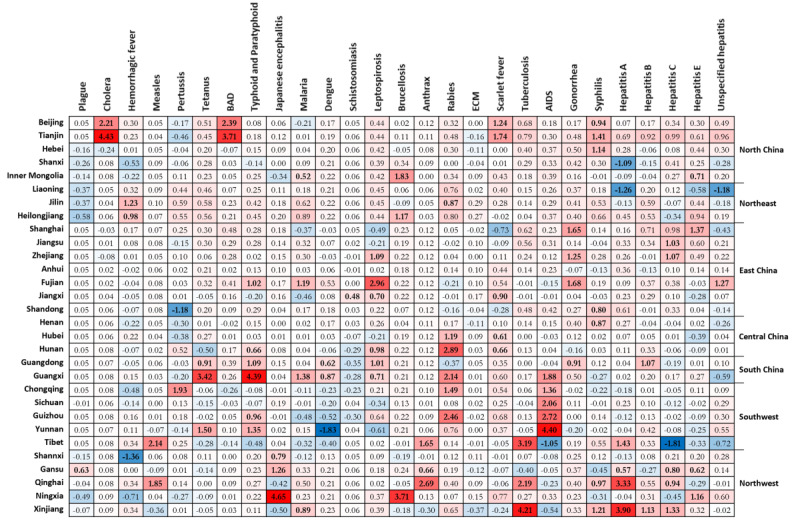
Between January 2005 and December 2020, 51,028,733 incident cases and 261,851 attributable deaths were recorded. Pertussis (P=.03), dengue fever (P=.01), brucellosis (P=.001), scarlet fever (P=.02), AIDS (P<.001), syphilis (P<.001), hepatitis C (P<.001) and hepatitis E (P=.04) exhibited significant upward trends. Furthermore, measles (P<.001), bacillary and amebic dysentery (P<.001), malaria (P=.04), dengue fever (P=.006), brucellosis (P=.03), and tuberculosis (P=.003) exhibited significant seasonal patterns. We observed marked disease burden-related geographic disparities and heterogeneities. Notably, high-risk areas for various infectious diseases have remained relatively unchanged since 2005. In particular, hemorrhagic fever and brucellosis were largely concentrated in Northeast China; neonatal tetanus, typhoid and paratyphoid, Japanese encephalitis, leptospirosis, and AIDS in Southwest China; BAD in North China; schistosomiasis in Central China; anthrax, tuberculosis, and hepatitis A in Northwest China; rabies in South China; and gonorrhea in East China. However, the geographical distribution of syphilis, scarlet fever, and hepatitis E drifted from coastal to inland provinces during 2005-2020.
The overall infectious disease burden in China is declining; however, hepatitis C and E, bacterial infections, and sexually transmitted infections continue to multiply, many of which have spread from coastal to inland provinces.
中国是全球人口最多的国家,在过去几十年中在传染病控制方面取得了重大成就。2003 年的 SARS 疫情引发了中国疾病预防控制信息系统(CISDCP)的启动。此后,许多研究调查了中国个别传染病的流行病学特征和趋势;然而,很少有研究考虑到这些传染病随时间的时空变化趋势和季节性。
本研究旨在系统回顾 2005-2020 年中国 A 类和 B 类法定传染病的时空趋势和季节性特征。
我们从 CISDCP 中提取了 8 种(27 种疾病)法定传染病的发病率和死亡率数据。我们使用曼肯德尔和森的方法来研究疾病的时间趋势,使用 Moran I 统计量来研究疾病的地理分布,使用圆形分布分析来研究疾病的季节性。
2005 年 1 月至 2020 年 12 月,共记录了 51028733 例发病病例和 261851 例归因死亡。百日咳(P=.03)、登革热(P=.01)、布鲁氏菌病(P=.001)、猩红热(P=.02)、艾滋病(P<.001)、梅毒(P<.001)、丙型肝炎(P<.001)和戊型肝炎(P=.04)呈显著上升趋势。此外,麻疹(P<.001)、细菌性和阿米巴性痢疾(P<.001)、疟疾(P=.04)、登革热(P=.006)、布鲁氏菌病(P=.03)和结核病(P=.003)呈显著季节性模式。我们观察到与疾病负担相关的显著地理差异和异质性。值得注意的是,自 2005 年以来,各种传染病的高危地区相对保持不变。特别是,出血热和布鲁氏菌病主要集中在中国东北地区;新生儿破伤风、伤寒和副伤寒、乙型脑炎、钩端螺旋体病和艾滋病主要集中在中国西南地区;BAD 主要集中在中国北方地区;血吸虫病主要集中在中国中部地区;炭疽、结核病和甲型肝炎主要集中在中国西北地区;狂犬病主要集中在中国南方地区;淋病主要集中在中国东部地区。然而,梅毒、猩红热和戊型肝炎的地理分布从沿海省份向内陆省份漂移。
中国的整体传染病负担正在下降;然而,丙型和戊型肝炎、细菌感染和性传播感染仍在增加,其中许多已从沿海省份蔓延到内陆省份。