Lee Joon, Yang Woo, Hostetler Andrew, Schultz Nathan, Suckow Mark A, Stewart Kay L, Kim Daniel D, Kim Hyung Soo
Research and Development, Benebios LLC, 10527 Garden Grove Blvd, Garden Grove, CA, 92843, USA.
400 Freimann Life Science Center, University of Notre Dame, Notre Dame, IN, 46556, USA.
BMC Microbiol. 2016 Apr 19;16:69. doi: 10.1186/s12866-016-0686-7.
The gut microbiota is playing more important roles in host immune regulation than was initially expected. Since many benefits of microbes are highly strain-specific and their mechanistic details remain largely elusive, further identification of new probiotic bacteria with immunoregulatory potentials is of great interest.
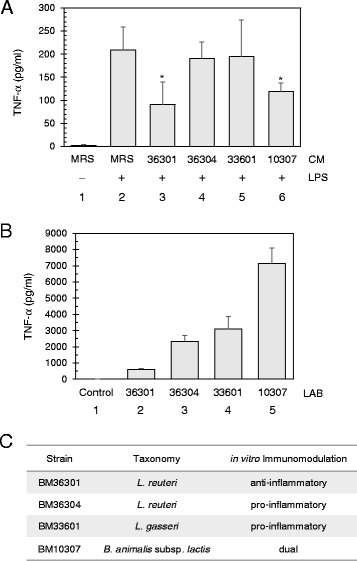
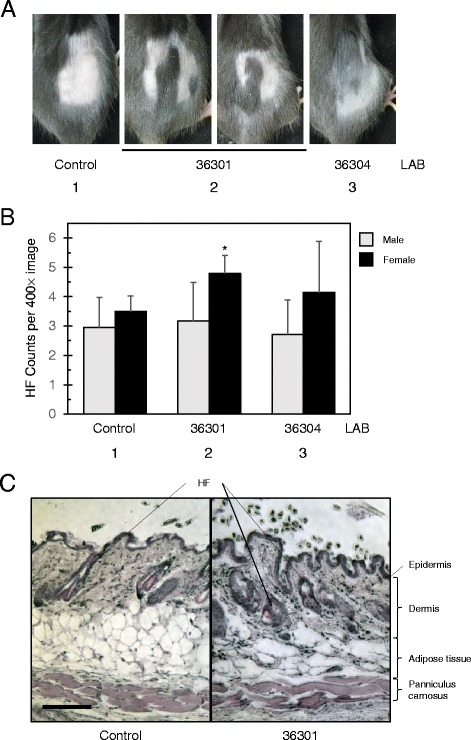
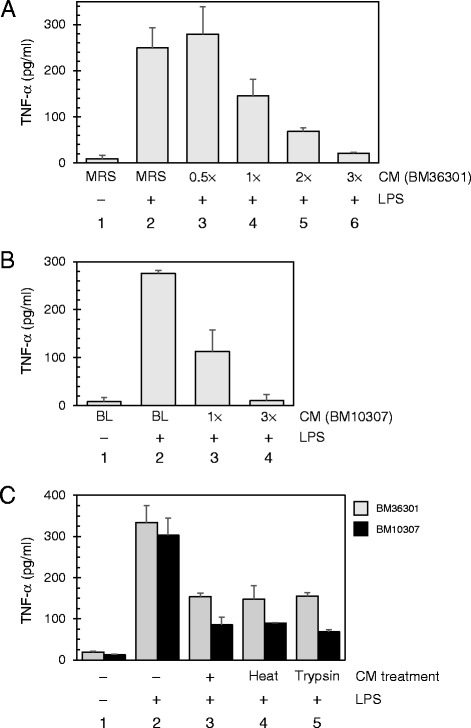
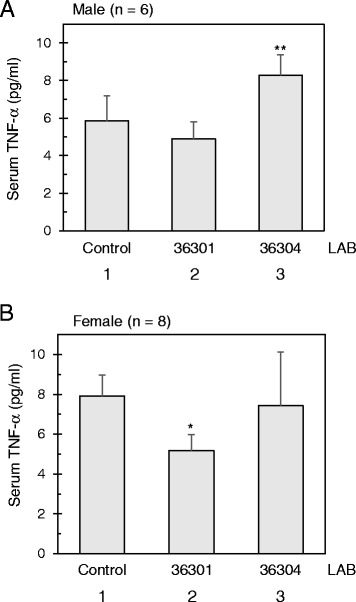
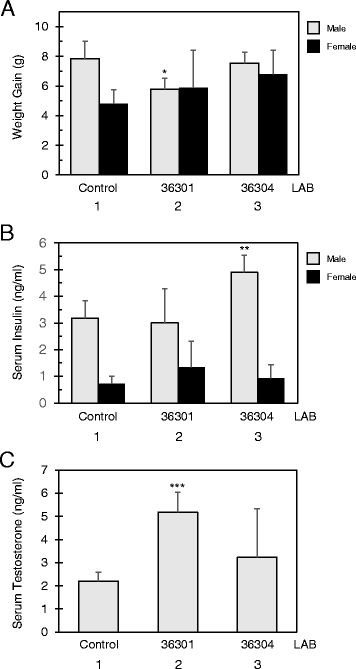
We have screened our collection of probiotic lactic acid bacteria (LAB) for their efficacy in modulating host immune response. Some LAB are characterized by suppression of TNF-α induction when LAB culture supernatants are added to THP-1 cells, demonstrating the LAB's anti-inflammatory potential. These suppressive materials were not inactivated by heat or trypsin. On the other hand, treatment of THP-1 directly with live bacterial cells identified a group of pro-inflammatory LAB, which stimulated significant production of TNF-α. Among those, we chose the Lactobacillus reuteri BM36301 as an anti-inflammatory strain and the L. reuteri BM36304 as a pro-inflammatory strain, and further studied their in vivo effects. We supplied C57BL/6 mice with these bacteria in drinking water while feeding them a standard diet for 20 weeks. Interestingly, these L. reuteri strains evoked different consequences depending on the gender of the mice. That is, males treated with anti-inflammatory BM36301 experienced less weight gain and higher testosterone level; females treated with BM36301 maintained lower serum TNF-α as well as healthy skin with active folliculogenesis and hair growth. Furthermore, while males treated with pro-inflammatory BM36304 developed higher serum levels of TNF-α and insulin, in contrast females did not experience such effects from this bacteria strain.
The L. reuteri BM36301 was selected as an anti-inflammatory strain in vitro. It helped mice maintain healthy conditions as they aged. These findings propose the L. reuteri BM36301 as a potential probiotic strain to improve various aspects of aging issues.
肠道微生物群在宿主免疫调节中发挥着比最初预期更重要的作用。由于许多微生物的益处具有高度的菌株特异性,且其作用机制细节在很大程度上仍不清楚,因此进一步鉴定具有免疫调节潜力的新型益生菌备受关注。
我们筛选了我们收集的益生菌乳酸菌(LAB)调节宿主免疫反应的功效。当LAB培养上清液添加到THP-1细胞中时,一些LAB的特征是抑制TNF-α的诱导,证明了LAB的抗炎潜力。这些抑制性物质不会被加热或胰蛋白酶灭活。另一方面,用活细菌细胞直接处理THP-1鉴定出一组促炎性LAB,它们刺激TNF-α的大量产生。在这些菌株中,我们选择罗伊氏乳杆菌BM36301作为抗炎菌株,罗伊氏乳杆菌BM36304作为促炎菌株,并进一步研究它们的体内作用。我们在给C57BL/6小鼠提供标准饮食的同时,在饮用水中添加这些细菌,持续20周。有趣的是,这些罗伊氏乳杆菌菌株根据小鼠的性别引发了不同的结果。也就是说,用抗炎的BM36301处理的雄性小鼠体重增加较少,睾酮水平较高;用BM36301处理的雌性小鼠血清TNF-α水平较低,皮肤健康,毛囊生成活跃,头发生长良好。此外,虽然用促炎的BM36304处理的雄性小鼠血清TNF-α和胰岛素水平升高,但相比之下,雌性小鼠没有受到该菌株的这种影响。
罗伊氏乳杆菌BM36301在体外被选为抗炎菌株。它有助于小鼠在衰老过程中保持健康状态。这些发现表明罗伊氏乳杆菌BM36301是一种潜在的益生菌菌株,可改善衰老问题的各个方面。