Yu Zhicong, Leng Shuai, Li Zhoubo, Halaweish Ahmed F, Kappler Steffen, Ritman Erik L, McCollough Cynthia H
From the *Department of Radiology, Mayo Clinic; and †Biomedical Engineering and Physiology Graduate Program, Mayo Graduate School, Rochester, MN; ‡Siemens Healthcare, Malvern, PA; §Siemens Healthcare, Forchheim, Germany; and ∥Department of Physiology and Biomedical Engineering, Mayo Clinic, Rochester, MN.
J Comput Assist Tomogr. 2016 Jul-Aug;40(4):663-70. doi: 10.1097/RCT.0000000000000412.
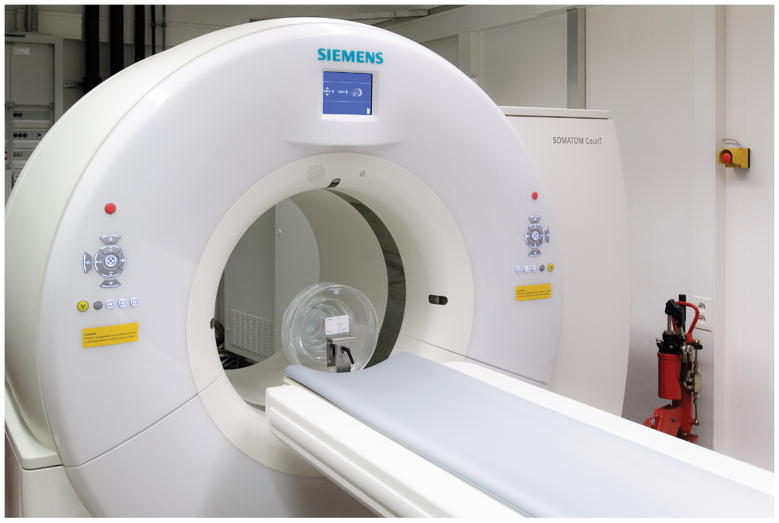
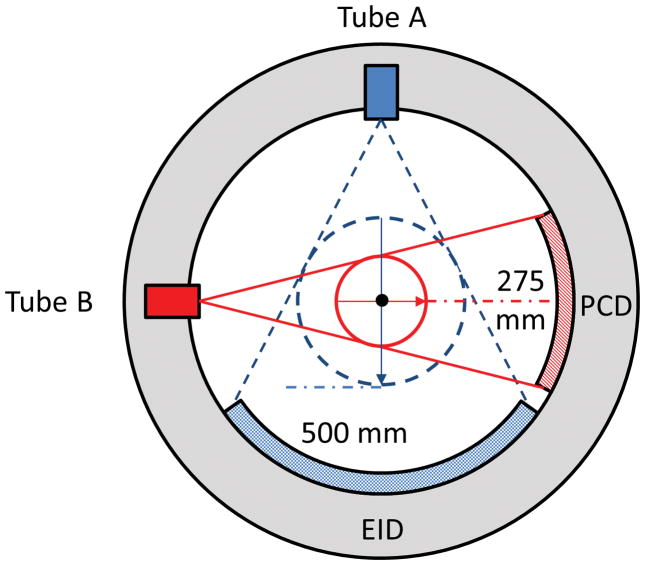
A research photon-counting computed tomography (CT) system that consists of an energy-integrating detector (EID) and a photon-counting detector (PCD) was installed in our laboratory. The scanning fields of view of the EID and PCD at the isocenter are 500 and 275 mm, respectively. When objects are larger than the PCD scanning field of view, a data-completion scan (DCS) using the EID subsystem is needed to avoid truncation artifacts in PCD images. The goals of this work were to (1) find the impact of a DCS on noise of PCD images and (2) determine the lowest possible dose for a DCS such that truncation artifacts are negligible in PCD images.
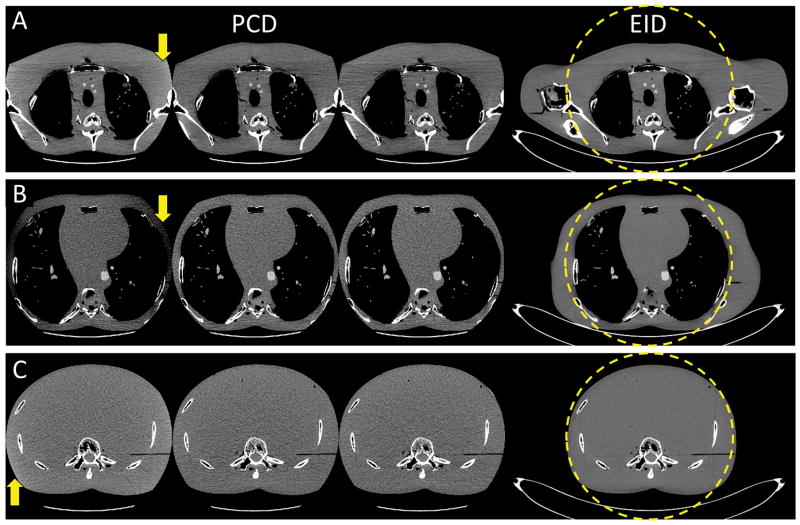
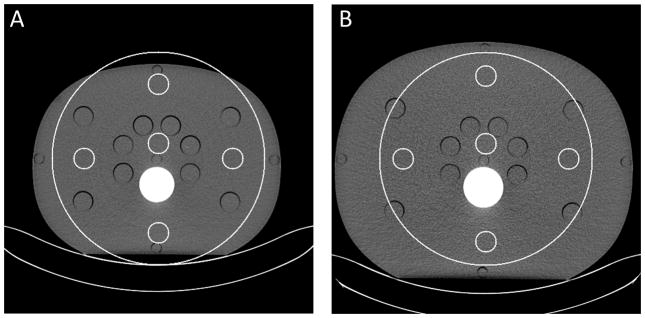
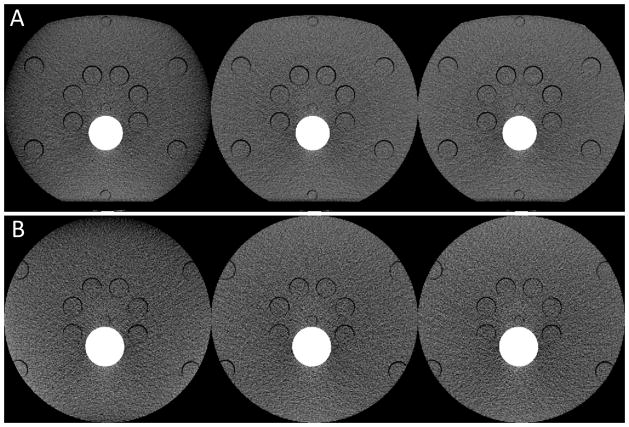
First, 2 semianthropomorphic abdomen phantoms were scanned on the PCD subsystem. For each PCD scan, we acquired 1 DCS with the maximum effective mAs and 5 with lower effective mAs values. The PCD image reconstructed using the maximum effective mAs was considered as the reference image, and those using the lower effective mAs as the test images. The PCD image reconstructed without a DCS was considered the baseline image. Each PCD image was assessed in terms of noise and CT number uniformity; the results were compared among the baseline, test, and reference images. Finally, the impact of a DCS on PCD image quality was qualitatively assessed for other body regions using an anthropomorphic torso phantom.
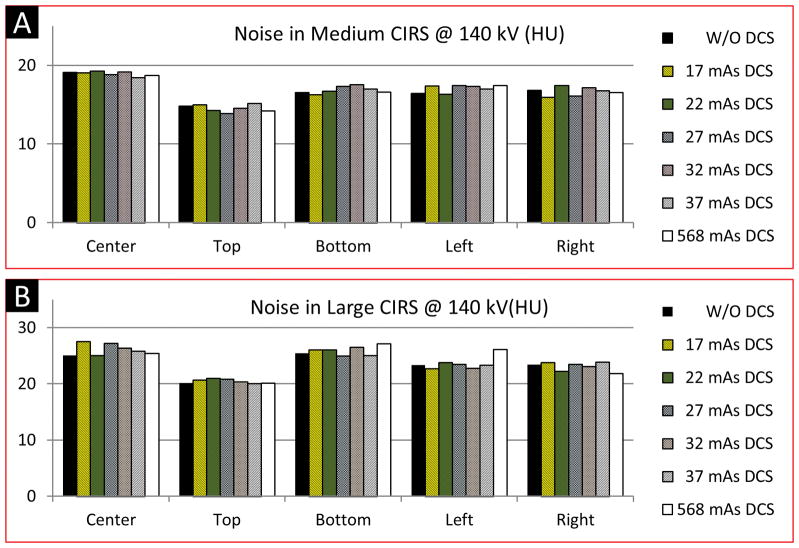
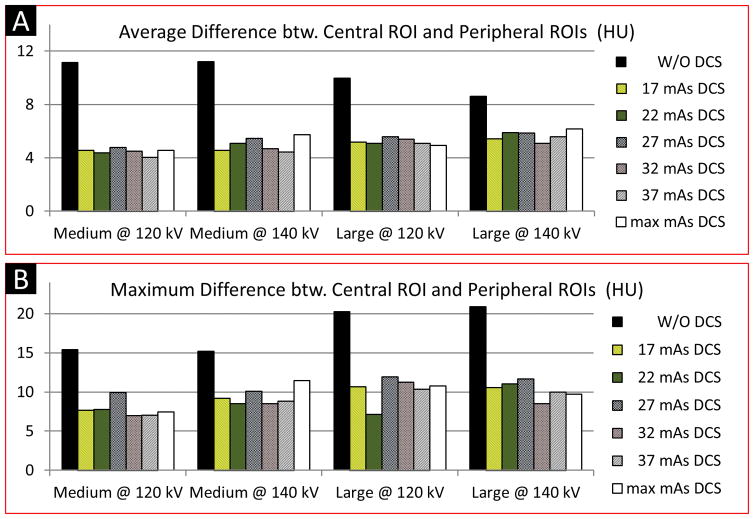
The DCS had a negligible impact on the noise magnitude in the PCD images. The PCD images with the minimum available dose (CTDIvol < 2 mGy) showed greatly enhanced CT number uniformity compared with the baseline images without noticeable truncation artifacts. Further increasing the effective mAs of a DCS did not yield noticeable improvement in CT number uniformity.
A DCS using the minimum available dose had negligible effect on image noise and was sufficient to maintain satisfactory CT number uniformity for the PCD scans.
我们实验室安装了一种研究型光子计数计算机断层扫描(CT)系统,该系统由能量积分探测器(EID)和光子计数探测器(PCD)组成。在等中心处,EID和PCD的扫描视野分别为500和275毫米。当物体大于PCD扫描视野时,需要使用EID子系统进行数据补全扫描(DCS),以避免PCD图像中出现截断伪影。本研究的目的是:(1)找出DCS对PCD图像噪声的影响;(2)确定DCS的最低可能剂量,以使PCD图像中的截断伪影可忽略不计。
首先,在PCD子系统上扫描2个半人体腹部模型。对于每次PCD扫描,我们获取1次最大有效毫安秒(mAs)的DCS和5次较低有效mAs值的DCS。使用最大有效mAs重建的PCD图像被视为参考图像,使用较低有效mAs重建的图像作为测试图像。未进行DCS重建的PCD图像被视为基线图像。对每个PCD图像的噪声和CT值均匀性进行评估;将结果在基线、测试和参考图像之间进行比较。最后,使用人体躯干模型对其他身体部位定性评估DCS对PCD图像质量的影响。
DCS对PCD图像中的噪声幅度影响可忽略不计。与没有明显截断伪影的基线图像相比,具有最低可用剂量(CTDIvol < 2 mGy)的PCD图像显示出CT值均匀性大大提高。进一步增加DCS的有效mAs在CT值均匀性方面没有产生明显改善。
使用最低可用剂量的DCS对图像噪声影响可忽略不计,并且足以在PCD扫描中保持令人满意的CT值均匀性。