Hang Liang-Wen, Hsu Jeng-Yuan, Chang Chee-Jen, Wang Hao-Chien, Cheng Shih-Lung, Lin Ching-Hsiung, Chan Ming-Cheng, Wang Chin-Chou, Perng Diahn-Warng, Yu Chong-Jen
Department of Respiratory Therapy, College of Health Care, China Medical University, Taichung, Republic of China; Sleep Medicine Center, Department of Pulmonary and Critical Care Medicine, China Medical University Hospital, Taichung, Republic of China.
Department of Internal Medicine, Taichung Veterans General Hospital, Taichung, Republic of China.
Int J Chron Obstruct Pulmon Dis. 2016 Mar 30;11:665-73. doi: 10.2147/COPD.S96504. eCollection 2016.
COPD and obstructive sleep apnea (OSA) share similar pathological processes and cardiovascular sequelae. Coexisting OSA in COPD - "overlap syndrome" - has worse prognosis than either condition alone, and appropriate treatment improves survival. Our objectives were to ascertain the frequency at which COPD coexists with the risk of OSA in Taiwan and to compare the risk factors, COPD symptoms, and life quality metrics between COPD subgroups with versus without risk of OSA.
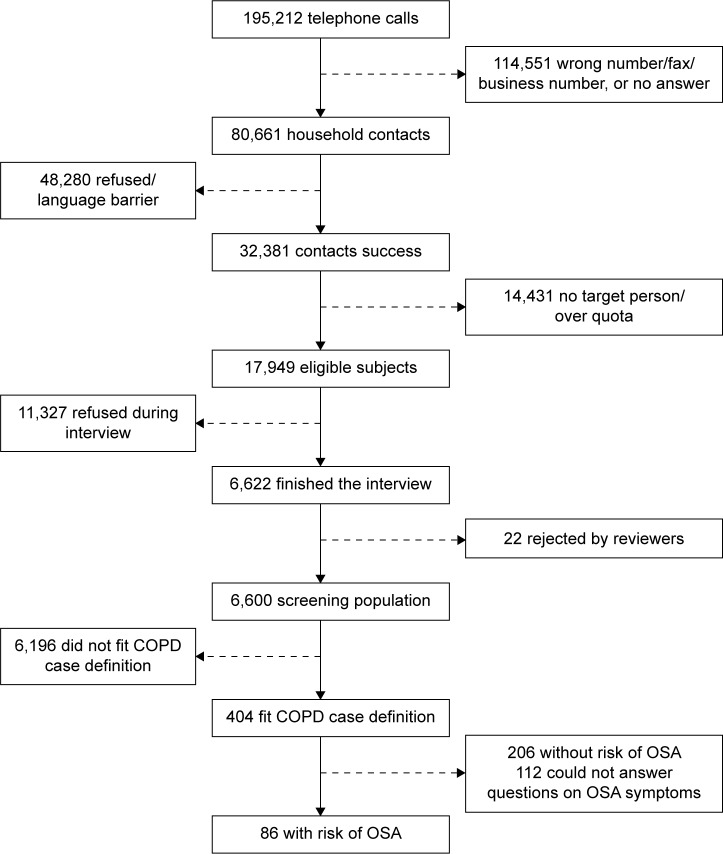
We conducted a random cross-sectional national telephone survey of adults >40 years old in Taiwan. Participants fulfilling an epidemiological case definition of COPD completed a questionnaire to assess COPD symptoms and OSA risk, comorbidities, and performance of daily activities. Data from COPD cohorts with and without risk of OSA were analyzed and compared.
Of 6,600 interviews completed, 404 subjects fit the epidemiological case definition of COPD - an overall prevalence of 6.1% in this national sample. Data on OSA risk were available for 292 of this COPD cohort, of whom 29.5% were at risk of OSA. Compared to those without risk of OSA, those with risk of OSA were significantly more likely to have hypertension or cardiovascular disease and diabetes, had significantly higher body mass index and COPD Assessment Test scores, and reported impaired work performance and leisure activities.
Among adults in Taiwan who fulfill epidemiologic criteria for COPD, 29.5% have coexisting risk of OSA. Comorbid hypertension or cardiovascular disease and diabetes are common and significantly more prevalent among the COPD population at risk of OSA than those who are not. OSA screening is warranted in patients with COPD with those risk factors that are more prevalent in COPD with risk of OSA than without, to target early interventions to reduce adverse cardiovascular sequelae from overlap syndrome.
慢性阻塞性肺疾病(COPD)与阻塞性睡眠呼吸暂停(OSA)具有相似的病理过程和心血管后遗症。COPD患者合并OSA(“重叠综合征”)的预后比单纯患其中任何一种疾病更差,而适当的治疗可提高生存率。我们的目的是确定台湾地区COPD患者中合并OSA风险的频率,并比较有OSA风险与无OSA风险的COPD亚组之间的风险因素、COPD症状和生活质量指标。
我们在台湾对40岁以上成年人进行了一项随机横断面全国电话调查。符合COPD流行病学病例定义的参与者完成了一份问卷,以评估COPD症状和OSA风险、合并症以及日常活动表现。对有和无OSA风险的COPD队列数据进行了分析和比较。
在完成的6600次访谈中,404名受试者符合COPD的流行病学病例定义——在这个全国样本中的总体患病率为6.1%。该COPD队列中有292人提供了OSA风险数据,其中29.5%有OSA风险。与无OSA风险者相比,有OSA风险者患高血压、心血管疾病和糖尿病的可能性显著更高,体重指数和COPD评估测试得分显著更高,且工作表现和休闲活动受损情况报告更多。
在台湾符合COPD流行病学标准的成年人中,29.5%合并OSA风险。合并高血压、心血管疾病和糖尿病很常见,且在有OSA风险的COPD人群中比无此风险者显著更普遍。对于有那些在有OSA风险的COPD中比无风险的COPD更普遍的风险因素的COPD患者,有必要进行OSA筛查,以便进行早期干预,减少重叠综合征的不良心血管后遗症。