Department of Chemistry and Biochemistry, Jackson State University , 1400 Lynch Street, Jackson, Mississippi 39217, United States.
Wuhan Yaogu Bio-tech Company, Ltd. , Wuhan 430075, China.
Anal Chem. 2016 May 17;88(10):5338-44. doi: 10.1021/acs.analchem.6b00638. Epub 2016 May 4.
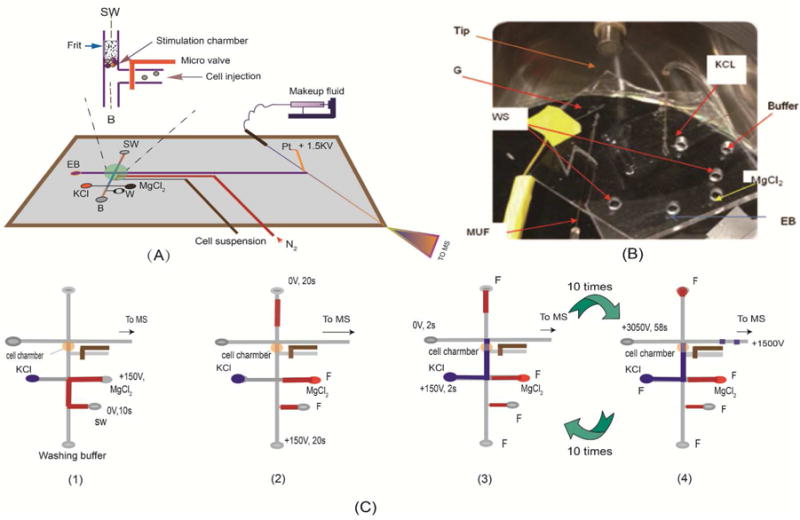
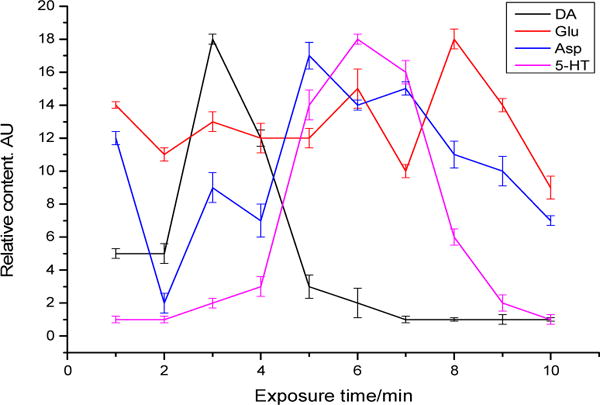
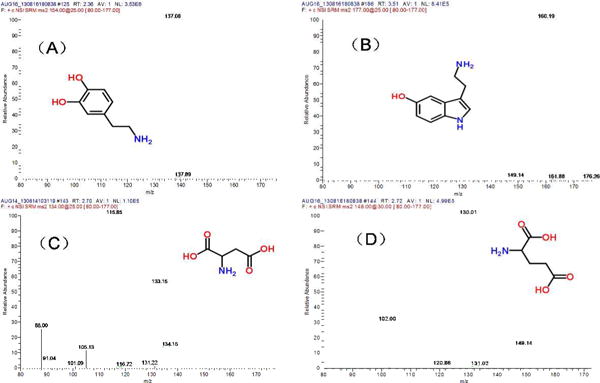
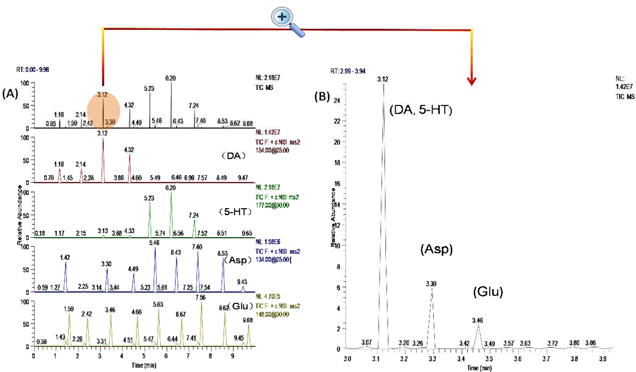
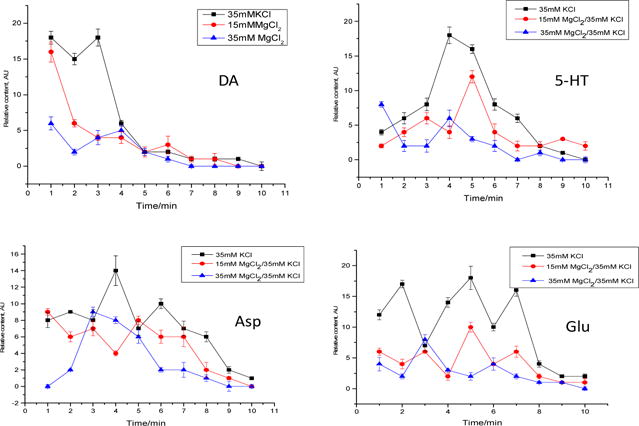
Chemical stimulus-induced neurotransmitter release from neuronal cells is well-documented. However, the dynamic changes in neurochemical release remain to be fully explored. In this work, a three-layered microfluidic chip was fabricated and evaluated for studying the dynamics of neurotransmitter release from PC-12 cells. The chip features integration of a nanoliter sized chamber for cell perfusion, pneumatic pressure valves for fluidic control, a microfluidic channel for electrophoretic separation, and a nanoelectrospray emitter for ionization in MS detection. Deploying this platform, a microchip electrophoresis-mass spectrometric method (MCE-MS) was developed to simultaneously quantify important neurotransmitters, including dopamine (DA), serotonin (5-HT), aspartic acid (Asp), and glutamic acid (Glu) without need for labeling or enrichment. Monitoring neurotransmitter release from PC-12 cells exposed to KCl (or alcohol) revealed that all four neurotransmitters investigated were released. Two release patterns were observed, one for the two monoamine neurotransmitters (i.e., DA and 5-HT) and another for the two amino acid neurotransmitters. Release dynamics for the two monoamine neurotransmitters was significantly different. The cells released DA most quickly and heavily in response to the stimulation. After exposure to the chemical stimulus for 4 min, the DA level in the perfusate from the cells was 86% lower than that at the beginning. Very interestingly, the cells started to release 5-HT in large quantities when they stopped releasing DA. These results suggest that DA and 5-HT are packaged into different vesicle pools and they are mobilized differently in response to chemical stimuli. The microfluidic platform proposed is proven useful for monitoring cellular release in biological studies.
化学刺激诱导神经元细胞释放神经递质已有大量文献记载。然而,神经化学递质释放的动态变化仍有待充分探索。在这项工作中,我们制备了一个三层微流控芯片,用于研究 PC-12 细胞中神经递质释放的动力学。该芯片集成了纳升级别的细胞灌注室、气动压力阀用于流体控制、用于电泳分离的微流道以及用于 MS 检测的纳喷雾发射器用于离子化。利用该平台,我们开发了一种微芯片电泳-质谱联用方法(MCE-MS),可同时定量分析重要的神经递质,包括多巴胺(DA)、5-羟色胺(5-HT)、天冬氨酸(Asp)和谷氨酸(Glu),无需标记或富集。监测暴露于 KCl(或酒精)的 PC-12 细胞中神经递质的释放,结果表明所有四种研究的神经递质均被释放。观察到两种释放模式,一种是两种单胺神经递质(即 DA 和 5-HT),另一种是两种氨基酸神经递质。两种单胺神经递质的释放动力学有明显差异。细胞对刺激的反应最快且释放最多的是 DA。暴露于化学刺激 4 分钟后,细胞灌流液中的 DA 水平比初始水平降低了 86%。非常有趣的是,当细胞停止释放 DA 时,它们开始大量释放 5-HT。这些结果表明,DA 和 5-HT 被包装到不同的囊泡池中,它们在响应化学刺激时的动员方式不同。所提出的微流控平台在生物研究中监测细胞释放方面被证明是有用的。