Rha Brian, Lopman Benjamin A, Alcala Ashley N, Riddle Mark S, Porter Chad K
Division of Viral Diseases, National Center for Immunization and Respiratory Diseases, Centers for Disease Control and Prevention, Atlanta, Georgia, United States of America.
Epidemic Intelligence Service, Centers for Disease Control and Prevention, Atlanta, Georgia, United States of America.
PLoS One. 2016 Apr 26;11(4):e0148505. doi: 10.1371/journal.pone.0148505. eCollection 2016.
Norovirus is a leading cause of gastroenteritis episodes and outbreaks in US military deployments, but estimates of endemic disease burden among military personnel in garrison are lacking.
Diagnostic codes from gastroenteritis-associated medical encounters of active duty military personnel and their beneficiaries from July 1998-June 2011 were obtained from the Armed Forces Health Surveillance Center. Using time-series regression models, cause-unspecified encounters were modeled as a function of encounters for specific enteropathogens. Model residuals (representing unexplained encounters) were used to estimate norovirus-attributable medical encounters. Incidence rates were calculated using population data for both active duty and beneficiary populations.
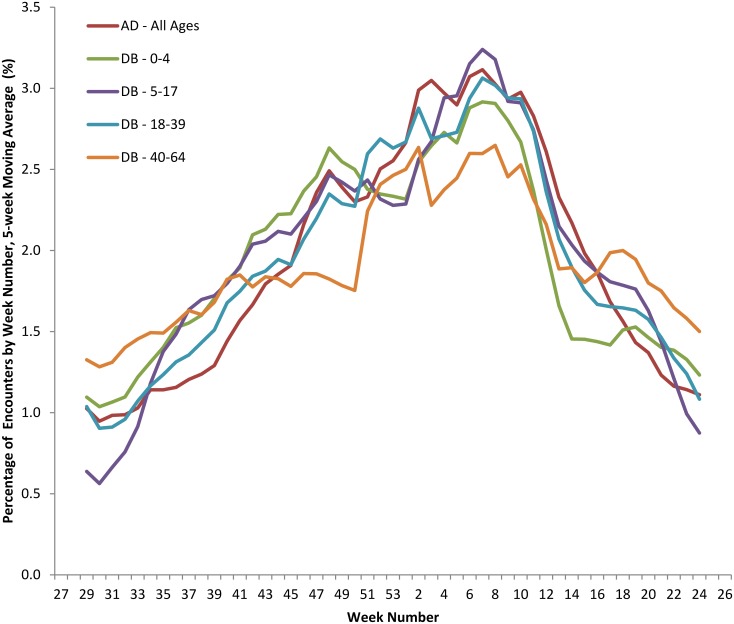
The estimated annual mean rate of norovirus-associated medically-attended visits among active duty personnel and their beneficiaries was 292 (95% CI: 258 to 326) and 93 (95% CI: 80 to 105) encounters per 10,000 persons, respectively. Rates were highest among beneficiaries <5 years of age with a median annual rate of 435 (range: 318 to 646) encounters per 10,000 children. Norovirus was estimated to cause 31% and 27% of all-cause gastroenteritis encounters in the active duty and beneficiary populations, respectively, with over 60% occurring between November and April. There was no evidence of any lag effect where norovirus disease occurred in one population before the other, or in one beneficiary age group before the others.
Norovirus is a major cause of medically-attended gastroenteritis among non-deployed US military active duty members as well as in their beneficiaries.
诺如病毒是美国军队部署期间胃肠炎发作和暴发的主要原因,但目前缺乏对驻军军人中地方性疾病负担的估计。
从武装部队健康监测中心获取1998年7月至2011年6月现役军人及其受益人的与胃肠炎相关医疗接触的诊断代码。使用时间序列回归模型,将病因未明确的接触作为特定肠道病原体接触的函数进行建模。模型残差(代表无法解释的接触)用于估计诺如病毒所致的医疗接触。发病率使用现役军人和受益人的人口数据计算。
现役军人及其受益人中诺如病毒相关就医就诊的估计年平均发生率分别为每10,000人292次(95%置信区间:258至326)和93次(95%置信区间:80至105)。5岁以下受益人中的发生率最高,每10,000名儿童的年中位数发生率为435次(范围:318至646)。估计诺如病毒分别导致现役军人和受益人中所有病因性胃肠炎接触的31%和27%,其中60%以上发生在11月至4月之间。没有证据表明诺如病毒疾病在一个人群中先于另一个人群发生,或在一个受益人年龄组中先于其他年龄组发生存在任何滞后效应。
诺如病毒是美国非部署现役军人及其受益人中就医治疗的胃肠炎的主要病因。