Fang Jianqiao, Chen Lifang, Ma Ruijie, Keeler Crystal Lynn, Shen Laihua, Bao Yehua, Xu Shouyu
Department of Acupuncture, The Third Affiliated Hospital of Zhejiang Chinese Medical University, 219 Moganshan Road, Xihu District, Hangzhou City, Zhejiang Province 310005, China.
Zhejiang Chinese Medical University, 548 Binwen Road, Binjiang District, Hangzhou City, Zhejiang Province 310053, China.
Sci Rep. 2016 May 13;6:25850. doi: 10.1038/srep25850.
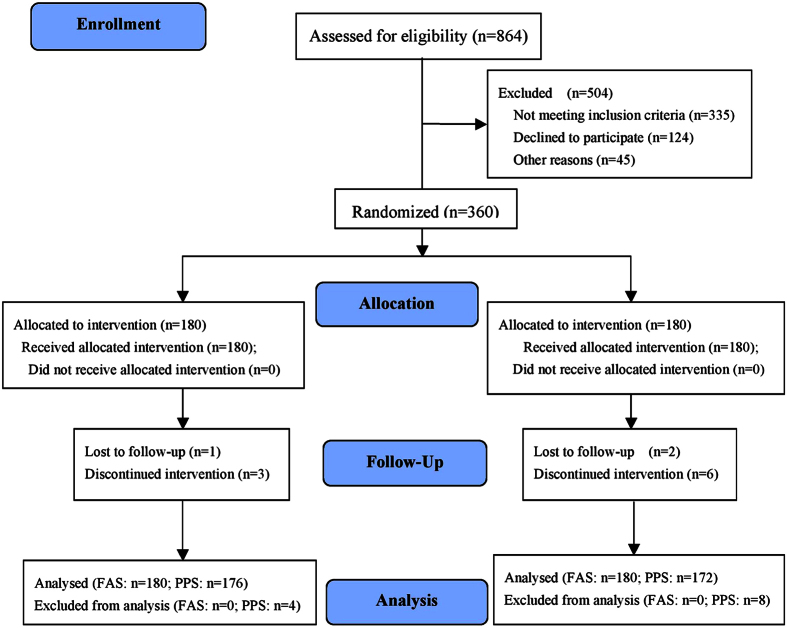
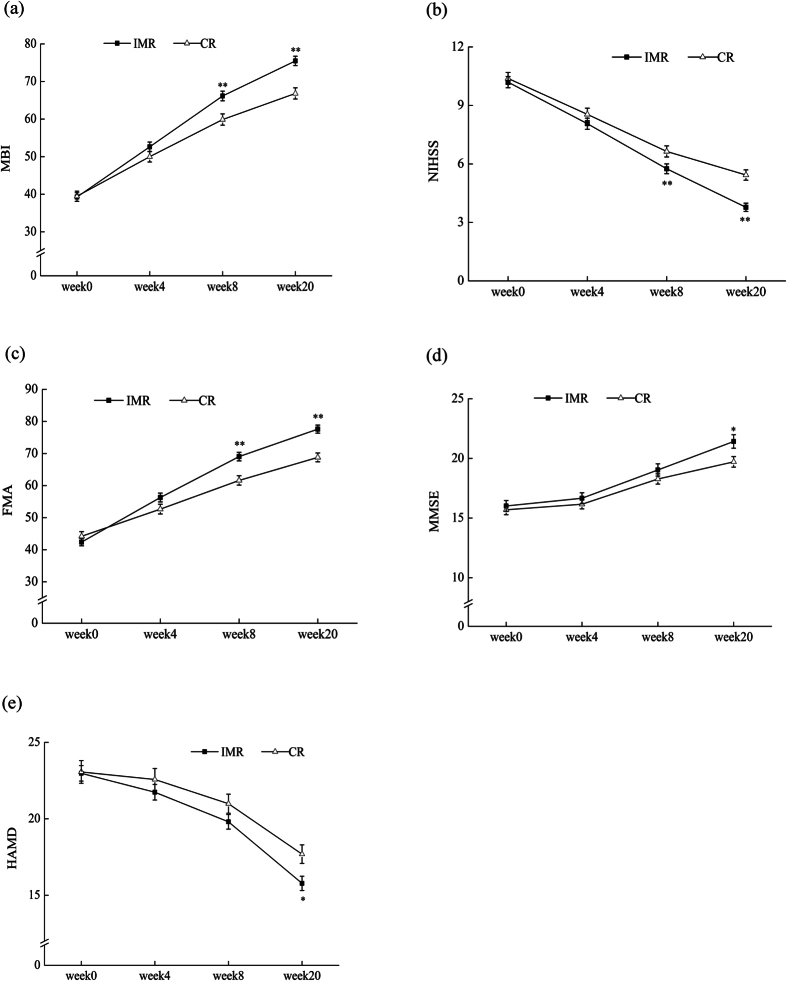
To determine whether integrative medicine rehabilitation (IMR) that combines conventional rehabilitation (CR) with acupuncture and Chinese herbal medicine has better effects for subacute stroke than CR alone, we conducted a multicenter randomized controlled trial that involved three hospitals in China. Three hundred sixty patients with subacute stroke were randomized into IMR and CR groups. The primary outcome was the Modified Barthel Index (MBI). The secondary outcomes were the National Institutes of Health Stroke Scale (NIHSS), the Fugl-Meyer Assessment (FMA), the mini-mental state examination (MMSE), the Montreal Cognitive Assessment (MoCA), Hamilton's Depression Scale (HAMD), and the Self-Rating Depression Scale (SDS). All variables were evaluated at week 0 (baseline), week 4 (half-way of intervention), week 8 (after treatment) and week 20 (follow-up). In comparison with the CR group, the IMR group had significantly better improvements (P < 0.01 or P < 0.05) in all the primary and secondary outcomes. There were also significantly better changes from baseline in theses outcomes in the IMR group than in the CR group (P < 0.01). A low incidence of adverse events with mild symptoms was observed in the IMR group. We conclude that conventional rehabilitation combined with integrative medicine is safe and more effective for subacute stroke rehabilitation.
为了确定将传统康复(CR)与针灸和中药相结合的中西医结合康复(IMR)对亚急性中风是否比单纯CR具有更好的效果,我们在中国的三家医院进行了一项多中心随机对照试验。360例亚急性中风患者被随机分为IMR组和CR组。主要结局指标是改良Barthel指数(MBI)。次要结局指标包括美国国立卫生研究院卒中量表(NIHSS)、Fugl-Meyer评估量表(FMA)、简易精神状态检查表(MMSE)、蒙特利尔认知评估量表(MoCA)、汉密尔顿抑郁量表(HAMD)和自评抑郁量表(SDS)。所有变量在第0周(基线)、第4周(干预中期)、第8周(治疗后)和第20周(随访)进行评估。与CR组相比,IMR组在所有主要和次要结局指标上均有显著更好的改善(P < 0.01或P < 0.05)。IMR组这些结局指标相对于基线的变化也显著优于CR组(P < 0.01)。IMR组不良事件发生率低,症状较轻。我们得出结论,传统康复结合中西医结合疗法对亚急性中风康复是安全且更有效的。