Castro Ana Rita, Rocha Isabel, Alves Maria Madalena, Pereira Maria Alcina
CEB-Centro de Engenharia Biológica, Universidade do Minho, Campus de Gualtar, 4710-57, Braga, Portugal.
AMB Express. 2016 Dec;6(1):35. doi: 10.1186/s13568-016-0207-y. Epub 2016 May 14.
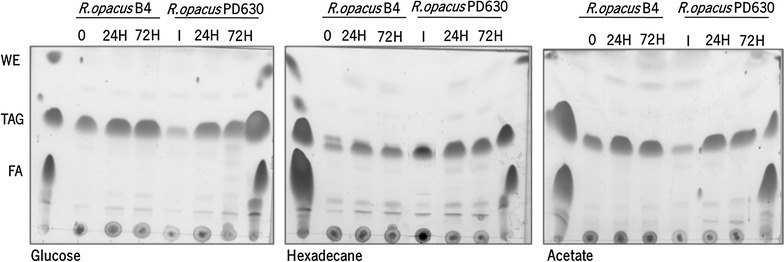
Bacterial lipids have relevant applications in the production of renewable fuels and biobased oleochemicals. The genus Rhodococcus is one of the most relevant lipid producers due to its capability to accumulate those compounds, mainly triacylglycerols (TAG), when cultivated on different defined substrates, namely sugars, organic acids and hydrocarbons but also on complex carbon sources present in industrial wastes. In this work, the production of storage lipids by Rhodococcus opacus B4 using glucose, acetate and hexadecane is reported for the first time and its productivity compared with Rhodococcus opacus PD630, the best TAG producer bacterium reported. Both strains accumulated mainly TAG from all carbon sources, being influenced by the carbon source itself and by the duration of the accumulation period. R. opacus B4 produced 0.09 and 0.14 g L(-1) at 24 and 72 h, with hexadecane as carbon source, which was 2 and 3.3 fold higher than the volumetric production obtained by R. opacus PD630. Both strains presented similar fatty acids (FA) profiles in intact cells while in TAG produced fraction, R. opacus B4 revealed a higher variability in fatty acid composition than R. opacus PD630, when both strains were cultivated on hexadecane. The obtained results open new perspectives for the use of R. opacus B4 to produce TAG, in particular using oily (alkane-contaminated) waste and wastewater as cheap raw-materials. Combining TAG production with hydrocarbons degradation is a promising strategy to achieve environmental remediation while producing added value compounds.
细菌脂质在可再生燃料和生物基油脂化学品的生产中具有重要应用。红球菌属是最主要的脂质生产者之一,因为当在不同的特定底物(即糖、有机酸和碳氢化合物)上培养时,它有能力积累这些化合物,主要是三酰甘油(TAG),而且在工业废料中的复杂碳源上也能积累。在这项工作中,首次报道了不透明红球菌B4利用葡萄糖、乙酸盐和十六烷生产储存脂质,并将其生产力与已报道的最佳TAG生产菌不透明红球菌PD630进行了比较。两种菌株都主要从所有碳源中积累TAG,这受到碳源本身和积累期持续时间的影响。以十六烷作为碳源时,不透明红球菌B4在24小时和72小时分别产生了0.09和0.14 g L⁻¹,这比不透明红球菌PD630的体积产量分别高2倍和3.3倍。当两种菌株在十六烷上培养时,完整细胞中的脂肪酸(FA)谱相似,而在TAG产生部分中,不透明红球菌B4的脂肪酸组成变异性比不透明红球菌PD630更高。所获得的结果为利用不透明红球菌B4生产TAG开辟了新的前景,特别是使用油性(受烷烃污染的)废料和废水作为廉价原料。将TAG生产与碳氢化合物降解相结合是一种在生产增值化合物的同时实现环境修复的有前景的策略。