Department of Endocrinology and Diabetes Nagoya University Graduate School of Medicine Nagoya Japan.
Department of Genetics, Division of Stress Adaptation and Recognition, Research Institute of Environmental Medicine Nagoya University Nagoya Japan.
J Diabetes Investig. 2016 Apr;7 Suppl 1(Suppl 1):27-32. doi: 10.1111/jdi.12449. Epub 2016 Mar 14.
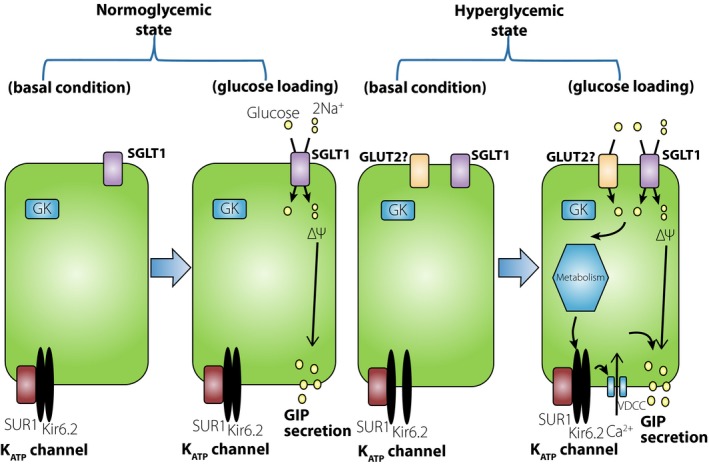
Glucose-dependent insulinotropic polypeptide (GIP) and glucagon-like peptide-1 (GLP-1) are the incretin hormones secreted from enteroendocrine K-cells and L-cells, respectively, by oral ingestion of various nutrients including glucose. K-cells, L-cells and pancreatic β-cells are glucose-responsive cells with similar glucose-sensing machinery including glucokinase and an adenosine triphosphate-sensitive K(+) channel comprising KIR6.2 and sulfonylurea receptor 1. However, the physiological role of the adenosine triphosphate-sensitive K(+) channel in GIP secretion in K-cells and GLP-1 secretion in L-cells is not elucidated. Recently, it was reported that GIP and GLP-1-producing cells are present also in pancreatic islets, and islet-derived GIP and GLP-1 contribute to glucose-induced insulin secretion from pancreatic β-cells. In this short review, we focus on GIP and GLP-1 secretion by monosaccharides, such as glucose or fructose, and the role of the adenosine triphosphate-sensitive K(+) channel in GIP and GLP-1 secretion.
葡萄糖依赖性胰岛素多肽 (GIP) 和胰高血糖素样肽-1 (GLP-1) 分别是由肠道内分泌 K 细胞和 L 细胞分泌的肠促胰岛素激素,由各种营养物质(包括葡萄糖)摄入后引起。K 细胞、L 细胞和胰腺β细胞是葡萄糖反应性细胞,具有相似的葡萄糖感应机制,包括葡萄糖激酶和包含 KIR6.2 和磺酰脲受体 1 的三磷酸腺苷敏感的 K(+) 通道。然而,三磷酸腺苷敏感的 K(+) 通道在 K 细胞中的 GIP 分泌和 L 细胞中的 GLP-1 分泌中的生理作用尚未阐明。最近,有报道称胰腺胰岛中也存在产生 GIP 和 GLP-1 的细胞,胰岛衍生的 GIP 和 GLP-1 有助于葡萄糖诱导的胰腺β细胞胰岛素分泌。在这篇简短的综述中,我们重点介绍单糖(如葡萄糖或果糖)对 GIP 和 GLP-1 的分泌作用,以及三磷酸腺苷敏感的 K(+) 通道在 GIP 和 GLP-1 分泌中的作用。