Ku Seockmo
Laboratory of Renewable Resources Engineering, Department of Agricultural and Biological Engineering, Purdue University, West Lafayette, IN 47907-2022, USA.
Molecules. 2016 May 16;21(5):645. doi: 10.3390/molecules21050645.
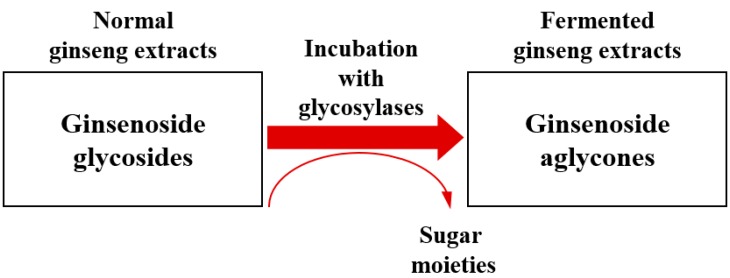
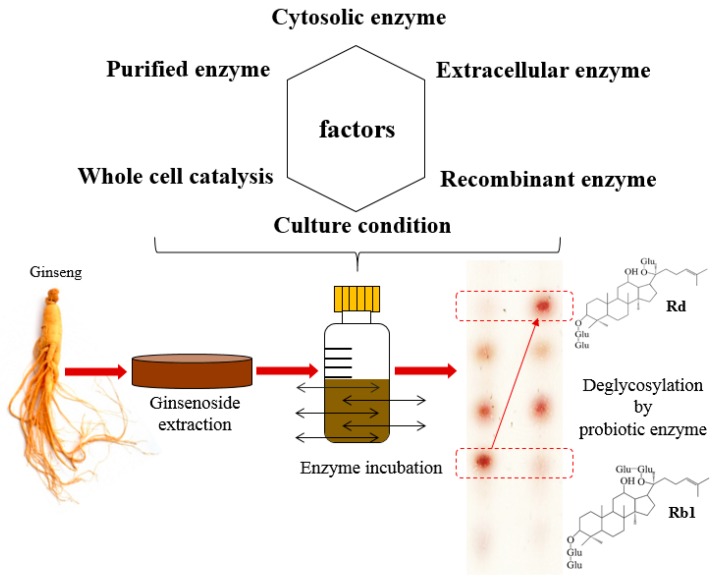
Various microorganisms have been widely applied in nutraceutical industries for the processing of phytochemical conversion. Specifically, in the Asian food industry and academia, notable attention is paid to the biocatalytic process of ginsenosides (ginseng saponins) using probiotic bacteria that produce high levels of glycosyl-hydrolases. Multiple groups have conducted experiments in order to determine the best conditions to produce more active and stable enzymes, which can be applicable to produce diverse types of ginsenosides for commercial applications. In this sense, there are various reviews that cover the biofunctional effects of multiple types of ginsenosides and the pathways of ginsenoside deglycosylation. However, little work has been published on the production methods of probiotic enzymes, which is a critical component of ginsenoside processing. This review aims to investigate current preparation methods, results on the discovery of new glycosylases, the application potential of probiotic enzymes and their use for biocatalysis of ginsenosides in the nutraceutical industry.
各种微生物已被广泛应用于营养保健品行业,用于植物化学转化过程。具体而言,在亚洲食品工业和学术界,人们特别关注利用产生高水平糖基水解酶的益生菌对人参皂苷(人参皂甙)进行生物催化的过程。多个研究小组进行了实验,以确定生产更具活性和稳定性的酶的最佳条件,这些酶可用于生产多种类型的人参皂苷以供商业应用。从这个意义上说,有各种综述涵盖了多种人参皂苷的生物功能效应和人参皂苷去糖基化途径。然而,关于益生菌酶生产方法的研究报道很少,而益生菌酶是人参皂苷加工的关键组成部分。本综述旨在研究当前的制备方法、新糖基酶的发现成果、益生菌酶的应用潜力及其在营养保健品行业中用于人参皂苷生物催化的情况。