Bharti Ajay R, Woods Steven Paul, Ellis Ronald J, Cherner Mariana, Rosario Debra, Potter Michael, Heaton Robert K, Everall Ian P, Masliah Eliezer, Grant Igor, Letendre Scott L
Department of Medicine, University of California San Diego, San Diego, CA, USA.
Department of Psychiatry, University of California San Diego, San Diego, CA, USA.
HIV AIDS (Auckl). 2016 Apr 29;8:93-9. doi: 10.2147/HIV.S93306. eCollection 2016.
Human immunodeficiency virus (HIV) and methamphetamine use commonly affect neurocognitive (NC) functioning. We evaluated the relationships between NC functioning and two fibroblast growth factors (FGFs) in volunteers who differed in HIV serostatus and methamphetamine dependence (MAD).
A total of 100 volunteers were categorized into four groups based on HIV serostatus and MAD in the prior year. FGF-1 and FGF-2 were measured in cerebrospinal fluid by enzyme-linked immunosorbent assays along with two reference biomarkers (monocyte chemotactic protein [MCP]-1 and neopterin). Comprehensive NC testing was summarized by global and domain impairment ratings.
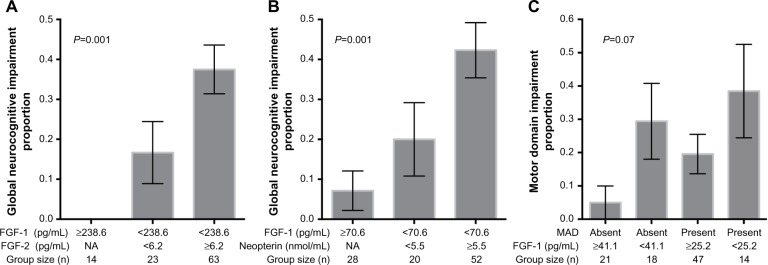
Sixty-three volunteers were HIV+ and 59 had a history of MAD. FGF-1, FGF-2, and both reference biomarkers differed by HIV and MAD status. For example, FGF-1 levels were lower in subjects who had either HIV or MAD than in HIV- and MAD- controls (P=0.003). Multivariable regression identified that global NC impairment was associated with an interaction between FGF-1 and FGF-2 (model R(2)=0.09, P=0.01): higher FGF-2 levels were only associated with neurocognitive impairment among subjects who had lower FGF-1 levels. Including other covariates in the model (including antidepressant use) strengthened the model (model R(2)=0.18, P=0.004) but did not weaken the association with FGF-1 and FGF-2. Lower FGF-1 levels were associated with impairment in five of seven cognitive domains, more than FGF-2, MCP-1, or neopterin.
These findings provide in vivo support that HIV and MAD alter expression of FGFs, which may contribute to the NC abnormalities associated with these conditions. These cross-sectional findings cannot establish causality and the therapeutic benefits of recombinant FGF-1 need to be investigated.
人类免疫缺陷病毒(HIV)感染与甲基苯丙胺使用通常会影响神经认知(NC)功能。我们评估了在HIV血清学状态和甲基苯丙胺依赖(MAD)方面存在差异的志愿者中,NC功能与两种成纤维细胞生长因子(FGFs)之间的关系。
根据上一年的HIV血清学状态和MAD情况,将100名志愿者分为四组。通过酶联免疫吸附测定法测量脑脊液中的FGF-1和FGF-2,以及两种参考生物标志物(单核细胞趋化蛋白[MCP]-1和新蝶呤)。综合NC测试通过整体和领域损伤评分进行总结。
63名志愿者为HIV阳性,59名有MAD病史。FGF-1、FGF-2以及两种参考生物标志物因HIV和MAD状态而异。例如,患有HIV或MAD的受试者的FGF-1水平低于HIV阴性和无MAD的对照组(P=0.003)。多变量回归分析确定,整体NC损伤与FGF-1和FGF-2之间的相互作用有关(模型R(2)=0.09,P=0.01):只有在FGF-1水平较低的受试者中,较高的FGF-2水平才与神经认知损伤有关。在模型中纳入其他协变量(包括使用抗抑郁药)增强了模型(模型R(2)=0.18,P=0.004),但并未削弱与FGF-1和FGF-2的关联。较低的FGF-1水平与七个认知领域中的五个领域的损伤有关,比FGF-2、MCP-1或新蝶呤更明显。
这些发现提供了体内证据,表明HIV和MAD会改变FGFs的表达,这可能导致与这些情况相关的NC异常。这些横断面研究结果无法确定因果关系,重组FGF-1的治疗益处需要进一步研究。