Seider Talia R, Fieo Robert A, O'Shea Andrew, Porges Eric C, Woods Adam J, Cohen Ronald A
Center for Cognitive Aging and Memory, Department of Aging and Geriatric Research, Institute on Aging, University of FloridaGainesville, FL, USA; Department of Clinical and Health Psychology, University of FloridaGainesville, FL, USA.
Center for Cognitive Aging and Memory, Department of Aging and Geriatric Research, Institute on Aging, University of Florida Gainesville, FL, USA.
Front Aging Neurosci. 2016 May 2;8:94. doi: 10.3389/fnagi.2016.00094. eCollection 2016.
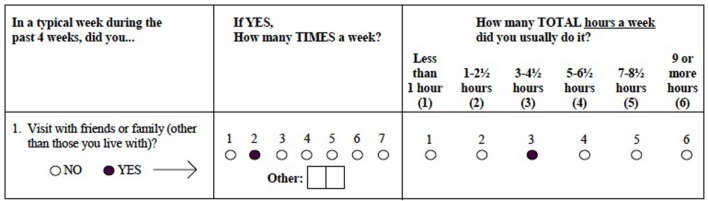
As the population ages and dementia becomes a growing healthcare concern, it is increasingly important to identify targets for intervention to delay or attenuate cognitive decline. Research has shown that the most successful interventions aim at altering lifestyle factors. Thus, this study examined how involvement in physical, cognitive, and social activity is related to brain structure in older adults. Sixty-five adults (mean age = 71.4 years, standard deviation = 8.9) received the Community Healthy Activities Model Program for Seniors (CHAMPS), a questionnaire that polls everyday activities in which older adults may be involved, and also underwent structural magnetic resonance imaging. Stepwise regression with backward selection was used to predict weekly time spent in either social, cognitive, light physical, or heavy physical activity from the volume of one of the cortical or subcortical regions of interest (corrected by intracranial volume) as well as age, education, and gender as control variables. Regressions revealed that more time spent in cognitive activity was associated with greater volumes of all brain regions studied: total cortex (β = 0.289, p = 0.014), frontal (β = 0.276, p = 0.019), parietal (β = 0.305, p = 0.009), temporal (β = 0.275, p = 0.020), and occipital (β = 0.256, p = 0.030) lobes, and thalamus (β = 0.310, p = 0.010), caudate (β = 0.233, p = 0.049), hippocampus (β = 0.286, p = 0.017), and amygdala (β = 0.336, p = 0.004). These effects remained even after accounting for the positive association between cognitive activity and education. No other activity variable was associated with brain volumes. Results indicate that time spent in cognitively engaging activity is associated with greater cortical and subcortical brain volume. Findings suggest that interventions aimed at increasing levels of cognitive activity may delay cognitive consequences of aging and decrease the risk of developing dementia.
随着人口老龄化以及痴呆症日益成为医疗保健领域关注的焦点,确定延缓或减轻认知衰退的干预目标变得愈发重要。研究表明,最成功的干预措施旨在改变生活方式因素。因此,本研究考察了老年人参与身体活动、认知活动和社交活动与脑结构之间的关系。65名成年人(平均年龄 = 71.4岁,标准差 = 8.9)接受了老年人社区健康活动模式项目(CHAMPS),这是一份调查问卷,用以询问老年人可能参与的日常活动,同时他们还接受了结构磁共振成像检查。采用向后选择的逐步回归分析,以感兴趣的皮质或皮质下区域之一的体积(经颅内体积校正)以及年龄、教育程度和性别作为控制变量,来预测每周花在社交、认知、轻度身体活动或重度身体活动上的时间。回归分析显示,花在认知活动上的时间越多,与所研究的所有脑区体积越大相关:总皮质(β = 0.289,p = 0.014)、额叶(β = 0.276,p = 0.019)、顶叶(β = 0.305,p = 0.009)、颞叶(β = 0.275,p = 0.020)、枕叶(β = 0.256,p = 0.030)以及丘脑(β = 0.310,p = 0.010)、尾状核(β = 0.233,p = 0.049)、海马体(β = 0.286,p = 0.017)和杏仁核(β = 0.336,p = 0.004)。即使在考虑了认知活动与教育程度之间的正相关关系之后,这些影响依然存在。没有其他活动变量与脑体积相关。结果表明,花在认知参与活动上的时间与更大的皮质和皮质下脑体积相关。研究结果表明,旨在提高认知活动水平的干预措施可能会延缓衰老的认知后果,并降低患痴呆症的风险。