Waldstein Wenzel, Kolbitsch Paul, Koller Ulrich, Boettner Friedrich, Windhager Reinhard
Department of Orthopaedics, Vienna General Hospital, Medical University of Vienna, Waehringer Guertel 18-20, 1090, Vienna, Austria.
Adult Reconstruction and Joint Replacement Division, Hospital for Special Surgery, New York, NY, USA.
Knee Surg Sports Traumatol Arthrosc. 2017 Mar;25(3):717-728. doi: 10.1007/s00167-016-4167-1. Epub 2016 May 21.
Unicompartmental knee arthroplasty (UKA) can be a surgical treatment option for patients with high expectations regarding the post-operative level of physical activity. A systematic review was undertaken to answer three research questions: (1) is there an improvement of physical activity based on validated activity scores following UKA? (2) What are the sport disciplines and the sport patterns of UKA patients? (3) What are the pre- and post-operative sport participation rates and the return to activity rates of UKA patients?
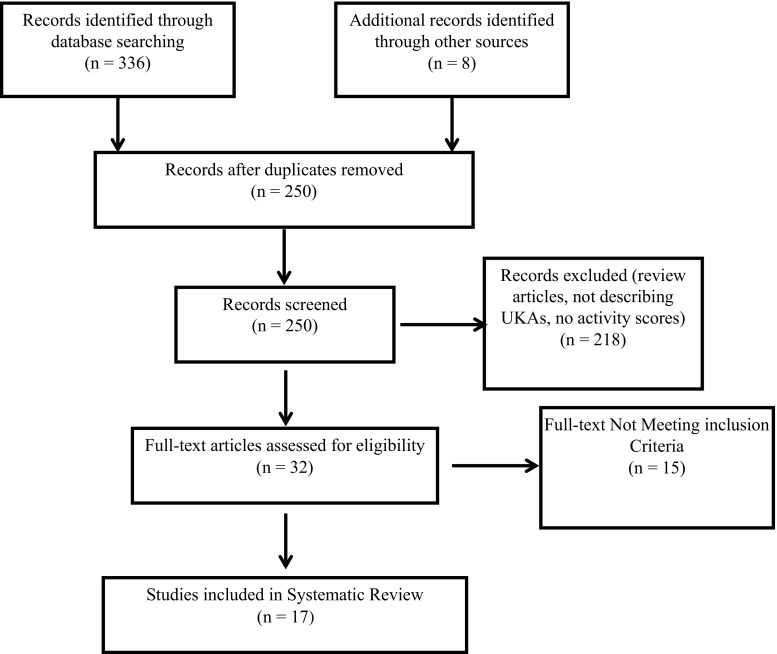
Following the PRISMA guidelines, EMBASE, MEDLINE, ISI Web of Science and the Cochrane Central Register of Controlled Trials were searched for studies reporting the level of sport and/or physical activity before and after UKA, and/or included at least one activity score before and after UKA.
Seventeen studies were identified reporting on 2972 UKAs, of which 89 % were medial UKAs and 92 % were mobile-bearing implants, respectively. Ten studies reported a statistically significant improvement of physical activity following UKA according to the UCLA activity score, the Tegner activity score or the High Activity Arthroplasty Score, respectively. Hiking, cycling and swimming are the most common activities following UKA. Sport participation before the onset of restricting symptoms ranged from 64 to 93 % and slightly decreased by 2-9 % following UKA. The return to activity rate ranged from 87 to 98 %.
Patients following UKA are physically active according to validated activity scores. A significant increase in low-impact activities and a decrease in high-impact activities after UKA was observed. Patients with a UKA regularly participate in sports; however, sport participation slightly decreased compared to pre-arthritic levels. This systematic review helps physicians to manage the expectations of patients regarding the level of physical activity following UKA.
III.
对于对术后体力活动水平有较高期望的患者,单髁膝关节置换术(UKA)可以作为一种手术治疗选择。进行了一项系统评价,以回答三个研究问题:(1)基于UKA术后经过验证的活动评分,体力活动是否有所改善?(2)UKA患者的运动项目和运动模式是什么?(3)UKA患者术前和术后的运动参与率及恢复活动率是多少?
按照PRISMA指南,检索了EMBASE、MEDLINE、ISI科学网和Cochrane对照试验中心注册库,查找报告UKA术前和术后运动和/或体力活动水平,和/或包含UKA术前和术后至少一项活动评分的研究。
确定了17项报告2972例UKA的研究,其中分别有89%为内侧UKA,92%为活动平台假体。10项研究分别根据加州大学洛杉矶分校(UCLA)活动评分、泰格纳(Tegner)活动评分或高活动度关节成形术评分报告UKA术后体力活动有统计学显著改善。徒步、骑自行车和游泳是UKA术后最常见的活动。在出现限制症状之前,运动参与率为64%至93%,UKA术后略有下降,下降了2%至9%。恢复活动率为87%至98%。
根据经过验证的活动评分,UKA术后患者体力活动良好。观察到UKA术后低冲击活动显著增加,高冲击活动减少。UKA患者经常参加运动;然而,与关节炎前水平相比,运动参与略有下降。这项系统评价有助于医生管理患者对UKA术后体力活动水平的期望。
III级