Department of Physics, University of Central Florida, Orlando, Florida 32816, USA.
Department of Chemistry, National University of Singapore, 3 Science Drive 3, Singapore 117543, Singapore.
Nat Commun. 2016 May 23;7:11595. doi: 10.1038/ncomms11595.
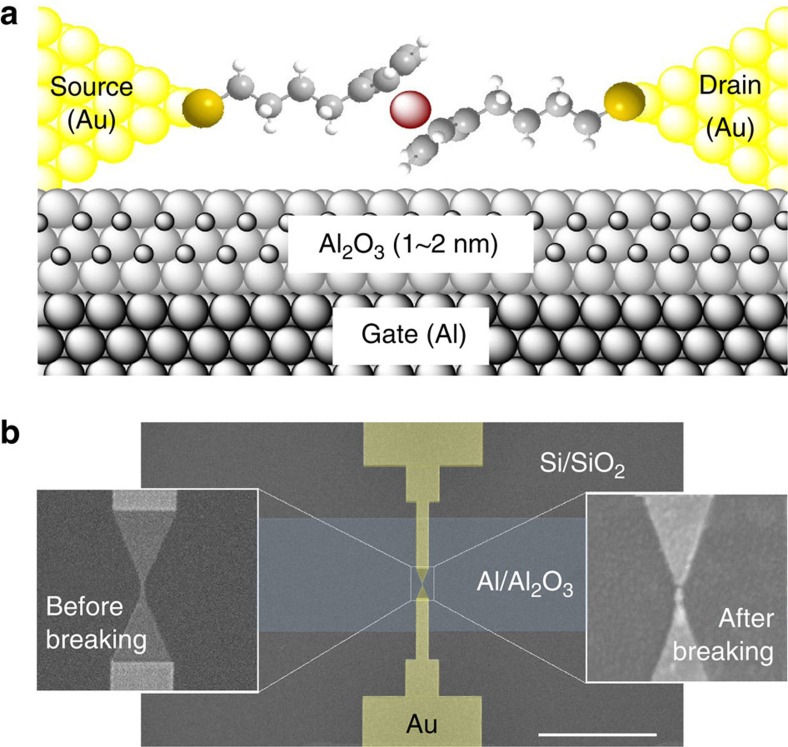
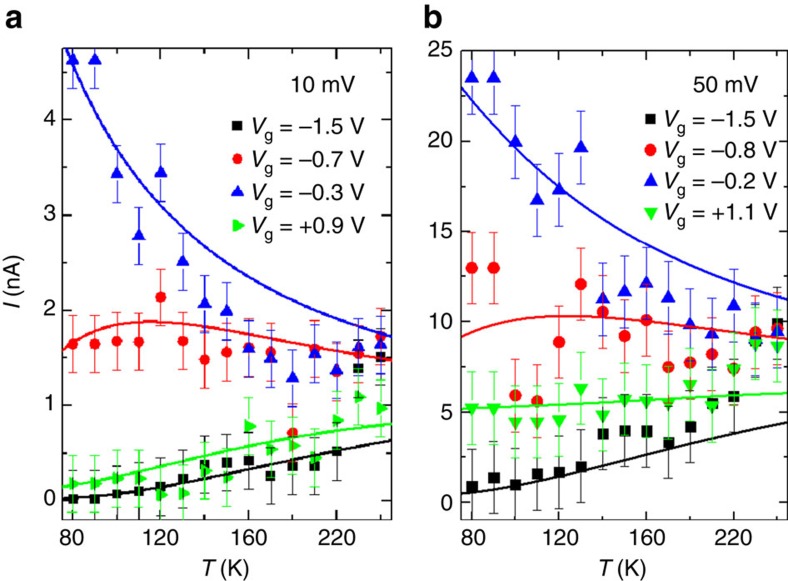
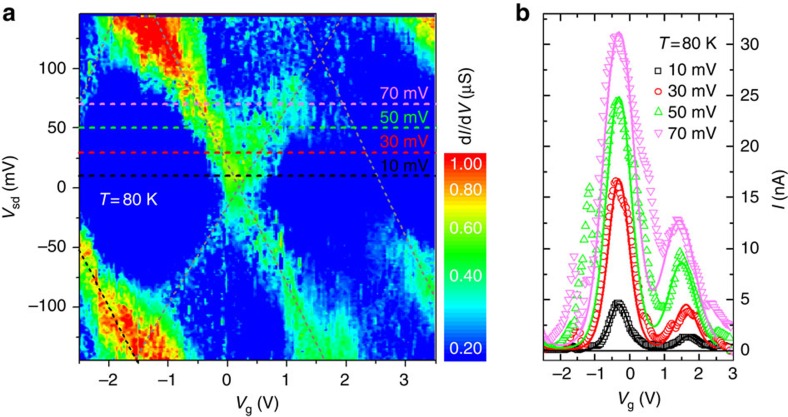
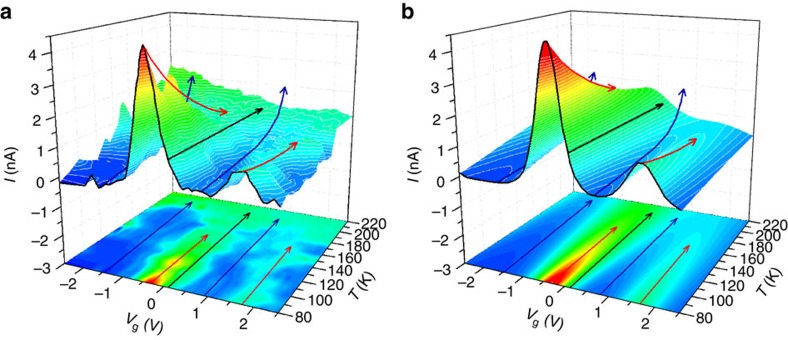
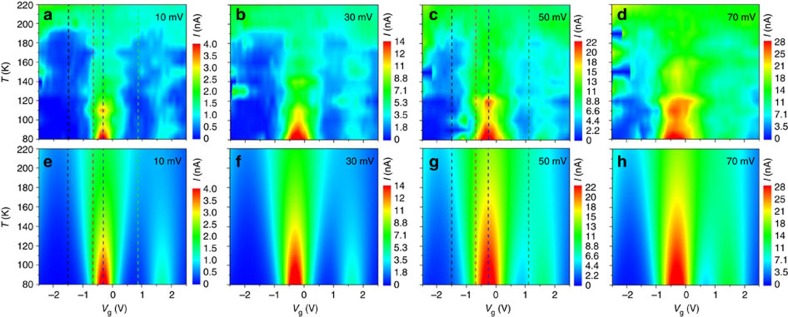
Understanding how the mechanism of charge transport through molecular tunnel junctions depends on temperature is crucial to control electronic function in molecular electronic devices. With just a few systems investigated as a function of bias and temperature so far, thermal effects in molecular tunnel junctions remain poorly understood. Here we report a detailed charge transport study of an individual redox-active ferrocene-based molecule over a wide range of temperatures and applied potentials. The results show the temperature dependence of the current to vary strongly as a function of the gate voltage. Specifically, the current across the molecule exponentially increases in the Coulomb blockade regime and decreases at the charge degeneracy points, while remaining temperature-independent at resonance. Our observations can be well accounted for by a formal single-level tunnelling model where the temperature dependence relies on the thermal broadening of the Fermi distributions of the electrons in the leads.
了解分子隧道结中电荷输运的机制如何依赖于温度对于控制分子电子器件中的电子功能至关重要。到目前为止,只有少数几个系统作为偏压和温度的函数进行了研究,因此分子隧道结中的热效应仍未得到很好的理解。在这里,我们报告了对单个氧化还原活性二茂铁基分子在很宽的温度和外加电压范围内的详细电荷输运研究。结果表明,电流对温度的依赖性强烈地随栅极电压的变化而变化。具体来说,在库仑阻塞区域,分子两端的电流呈指数增长,而在电荷简并点处则减小,而在共振时则与温度无关。我们的观察结果可以很好地用一个形式上的单能级隧道模型来解释,其中温度依赖性依赖于电子在引线中的费米分布的热展宽。