Mirambo Mariam M, Aboud Said, Mushi Martha F, Seugendo Mwanaisha, Majigo Mtebe, Groß Uwe, Mshana Stephen E
Department of Microbiology and Immunology, Weill Bugando School of Medicine, P.O. Box 1464, Mwanza, Tanzania.
Department of Microbiology and Immunology, Muhimbili university of Health and allied sciences, P.O. Box 65001, Dar es Salaam, Tanzania.
Ital J Pediatr. 2016 May 25;42(1):54. doi: 10.1186/s13052-016-0264-5.
Control of rubella infection is essential for preventing congenital rubella syndrome (CRS) and one of the important steps is to define a target population for vaccination. Therefore this study was done to determine serological evidence of acute rubella infection among under-fives in order to anticipate the magnitude of rubella virus transmission in Tanzania.
A cross-sectional study involving children aged between 1 and 59 months was conducted between September and October 2014 before national rubella vaccination campaigns commenced. Rubella IgM antibodies were detected using commercial indirect enzyme-linked immunosorbent assay (ELISA). Data were analyzed using STATA version 11.
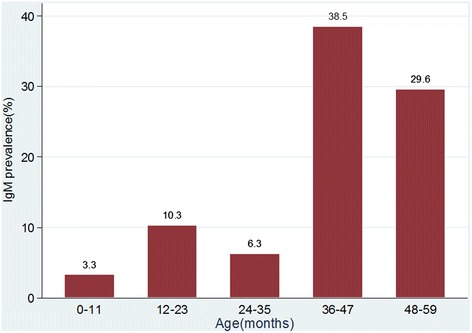
A total of230 under-fives were enrolled, their median age was 14 (Interquartile range (IQR) 7-26) months. The overall seroprevalence of rubella IgM antibodies was 10.9 % (25/230) with two confirmed cases of CRS. Two-sample Wilcoxon rank-sum test showed that the median age of rubella IgM seropositive children was significantly higher than that of IgM seronegative children (39 IQR: 18-51months vs. 14 IQR: 7-24 months, P < 0.001). On multivariate logistic regression analysis increase in age (OR: 1.07, 95 % CI; 1.03-1.1, P < 0.001) and residing in rural areas (OR: 8.07, 95 % CI; 1.43-45.6, P = 0.018) were independently found to predict acute rubella infection among under-fives.
Our findings indicate that rubella virus is prevalent in our setting posing a risk of transmitting to childbearing aged women hence increasing the risk of CRS. Increasing prevalence of acute infection with age in under-fives indicates the protective role of maternal antibodies among infants. The sustained vaccination programme of under-fives as effective measure to control CRS should be emphasized in developing countries.
控制风疹感染对于预防先天性风疹综合征(CRS)至关重要,重要步骤之一是确定疫苗接种的目标人群。因此开展本研究以确定五岁以下儿童急性风疹感染的血清学证据,从而预测坦桑尼亚风疹病毒的传播规模。
在2014年9月至10月全国风疹疫苗接种运动开始之前,对1至59个月大的儿童进行了一项横断面研究。使用商业间接酶联免疫吸附测定(ELISA)检测风疹IgM抗体。使用STATA 11版分析数据。
共纳入230名五岁以下儿童,他们的中位年龄为14(四分位间距(IQR)7 - 26)个月。风疹IgM抗体的总体血清阳性率为10.9%(25/230),有两例确诊的CRS病例。双样本Wilcoxon秩和检验显示,风疹IgM血清阳性儿童的中位年龄显著高于IgM血清阴性儿童(39 IQR:18 - 51个月对14 IQR:7 - 24个月,P < 0.001)。多因素逻辑回归分析发现,年龄增加(比值比:1.07,95%置信区间;1.03 - 1.1,P < 0.001)和居住在农村地区(比值比:8.07,95%置信区间;1.43 - 45.6,P = 0.018)独立预测五岁以下儿童的急性风疹感染。
我们的研究结果表明,风疹病毒在我们的研究环境中普遍存在,有传播给育龄妇女的风险,从而增加CRS的风险。五岁以下儿童急性感染患病率随年龄增加表明母体抗体对婴儿有保护作用。在发展中国家应强调将持续的五岁以下儿童疫苗接种计划作为控制CRS的有效措施。